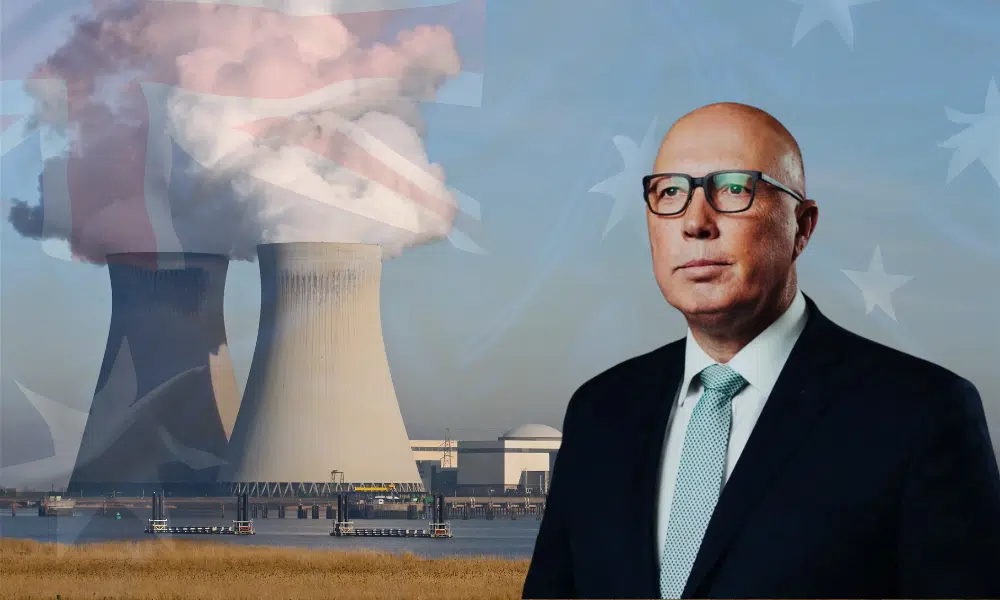






Nuclear energy is back in Australia’s political headlines. On 23 September 2026, the federal Coalition unveiled an energy plan that would repeal the national ban on nuclear power within 30 days of winning government. Labor remains firmly opposed, with Energy Minister Chris Bowen saying nuclear “is not an answer for Australia any time”.
For homeowners, the nuclear energy debate in Australia raises a practical question: should it change how you think about your power bills, your rooftop solar or a home battery?
More than one in three Australian households already have solar on their roof, and over 500,000 batteries have been installed under the federal Cheaper Home Batteries Program. Those decisions pay off over years. A nuclear plant, by contrast, would take at least 15 years to deliver power once legal barriers were removed, according to CSIRO.
This guide explains where the debate stands, what each side argues, what nuclear would cost and what it means for your home.
Quick summary
- Nuclear power is banned in Australia. The Coalition wants to lift the ban if it wins the next federal election; Labor wants to keep it.
- Even if the ban were lifted, CSIRO estimates the first reactor would take at least 15 years to deliver power, so nuclear won’t affect power bills this decade.
- Rooftop solar and batteries save money from day one, so the nuclear debate is no reason to delay a home energy upgrade.
Where does the nuclear debate stand in Australia?
Nuclear power generation is currently illegal in Australia, and that won’t change unless a future government and Parliament decide to change it.
The nuclear ban
Federal law has banned nuclear power since the late 1990s, under amendments to the radiation safety law in 1998 and the Environment Protection and Biodiversity Conservation Act 1999. Several states and territories have their own bans too, and some also restrict related activities such as uranium mining, according to the ABC. Lifting the federal ban alone wouldn’t be enough to build a reactor in a state that still prohibits one.
The 2025 election and after
At the 2025 federal election, the Coalition proposed building nuclear power plants at seven sites, mostly at retiring coal stations. It lost heavily, and an internal Liberal Party review later found the nuclear plan was among policies widely seen as “politically mistimed or alienating”, the ABC reported.
The idea didn’t disappear. In September 2026, Shadow Energy Minister Dan Tehan released the Coalition’s new energy plan, built around a proposed Scrap Net Zero (Cheaper Energy) Bill. According to ESD News, it would:
- repeal all legislative prohibitions on nuclear energy
- repeal the Climate Change Act 2022, which sets Australia’s emissions targets
- introduce a code of conduct for renewable energy developers
- tie federal energy funding for the states to affordability and reliability.
AAP also reported the plan would revoke four offshore wind zones and encourage investment in all energy types, including coal, gas and nuclear. Coalition MPs have also argued that lifting the ban would let private projects, such as AI data centres, use nuclear power.
Labor’s position
The Albanese Government is firmly opposed to lifting the ban. Its plan is to reach 82% renewable electricity by 2030, using solar and wind backed by batteries, pumped hydro and gas.
What would need to happen for nuclear to go ahead
The next federal election is due by 2028. For nuclear power to proceed, the Coalition would need to win government, pass its legislation through the Senate, and work with states to remove their own bans. Only then could planning, licensing and construction begin.



Should Australia have nuclear power? The case for and against
There are serious arguments on both sides of the Australian nuclear power debate. Here’s what supporters and critics say.
What supporters argue
- Reliable, around-the-clock power. Nuclear plants generate electricity day and night regardless of weather. Advocates such as ANU honorary associate professor Tony Irwin argue that makes nuclear a strong partner for wind and solar, describing it to the ABC as reliable and low emissions.
- Long operating life. Nuclear plants can run for 60 years or more, which supporters say spreads their high upfront cost over a longer period than most renewable projects.
- Proven overseas. Nuclear supplies around 9% of the world’s electricity, according to CSIRO’s GenCost report, and many comparable economies use it.
- Growing demand. Coalition MPs argue that power-hungry AI data centres need constant supply, and that the ban deters investors who want to use nuclear, as tech companies such as Google are doing in the US.
- Building on existing expertise. Some supporters argue that Australia’s nuclear-powered submarine program under AUKUS will build skills that a civil nuclear industry could draw on.
What critics argue
- Cost. CSIRO’s GenCost analysis finds nuclear is a higher-cost way to generate electricity in Australia than renewables backed by storage and transmission (see the next section).
- Time. CSIRO estimates it would take at least 15 years after the ban was lifted to deliver the first nuclear power, too late to replace most of Australia’s ageing coal plants.
- Cost overruns. Large nuclear projects have a history of running over budget. GenCost cites research finding the global average cost overrun for nuclear projects is 120%.
- Waste and approvals. Australia has no facility for storing high-level nuclear waste, and states would also need to repeal their own bans.
- Fit with rooftop solar. Critics point out that Australia already gets a large share of daytime power from rooftop solar, which makes it harder for a plant designed to run flat out all day to compete.
Where public opinion sits
Public opinion has shifted over time. A 2024 Lowy Institute poll found around six in 10 Australians supported some form of nuclear energy. Support fell during the 2025 election campaign, with an Essential poll in April 2025 showing 42% in favour and 44% opposed.
Some experts want the debate to be less partisan. UNSW nuclear engineering academic Edward Obbard told the ABC that nuclear should be assessed like-for-like with other technologies and used where it’s useful.
What would nuclear energy cost Australia?
Cost is the most contested part of the debate. The main independent Australian benchmark, CSIRO and AEMO’s annual GenCost report, finds nuclear would be among the more expensive ways to generate power here. Nuclear supporters dispute some of its assumptions.
What GenCost 2025-26 found
The GenCost 2025-26 final report, released in July 2026, compares the cost of building new generation by 2050. Its key findings on nuclear:
- Large-scale nuclear is slightly more expensive than gas with carbon capture and storage, and in a similar range to coal with carbon capture.
- Small modular reactors (SMRs) are the most expensive of all the technologies assessed.
- A system built mainly on solar and wind, including the storage, transmission and backup needed to keep it reliable, would generate power for $141 to $152 per megawatt-hour by 2050.
GenCost also notes there’s no cheap option for the long term. By 2050, it found no new-build technology, fossil or clean, that could generate reliable power for less than $100/MWh. New coal would cost $107 to $182/MWh.

The “first-of-a-kind” problem
First projects in a country usually cost more than planned. GenCost suggests adding a premium of 120% for Australia’s first large-scale nuclear plant and 92% for its first SMR, based on research into global cost overruns. The premium halves for the second project and disappears after that.
The overseas examples GenCost draws on show why. Its SMR costs are based on Canada’s Darlington project, four 300 MW units budgeted at C$20.9 billion. Its large-scale costs are based on South Korea, which has a long record of building reactors efficiently, adjusted for Australian conditions.
How other estimates compare
Not everyone agrees with GenCost. In 2024, modelling by Frontier Economics for the Coalition estimated its seven-site plan would cost $331 billion over 25 years, and claimed it would be cheaper than a mainly renewable system. Critics noted it assumed slower growth in electricity demand and spread construction costs over 50 years, compared with 30 years in GenCost, which partly explains the lower figure.
International estimates also vary. A 2025 report from the OECD’s Nuclear Energy Agency and the Electric Power Research Institute put the median near-term cost of large-scale nuclear at US$141/MWh, falling to US81/MWhifreactorsarebuiltinstandardisedfleets.ThesamereportputsolaratUS67/MWh and onshore wind at US$59/MWh.
Expert reference:
CSIRO’s GenCost report is produced each year with the Australian Energy Market Operator and is open to public consultation before release. It’s the benchmark most often cited by government, industry and researchers, though nuclear advocates continue to challenge its assumptions on plant lifetime and capacity factor.
Expert tip
Generation costs per megawatt-hour aren’t the same as your power bill. Generation makes up only around a third of a typical retail electricity price, so a change in generation costs has a smaller effect on what households pay.
How long would it take to build a nuclear reactor in Australia?
Even under the fastest realistic scenario, a nuclear reactor in Australia wouldn’t produce power until well into the 2040s.
CSIRO estimates it would take at least 15 years after legal restrictions were removed before the first nuclear power could be generated. That covers setting up a regulator, choosing sites, community consultation, licensing and construction. Its reasoning:
- Over the past five years, the global median construction time for a nuclear plant has been 8.2 years.
- In the past decade, no country with a level of democracy similar to Australia’s has completed construction in under 10 years.
- Australia would be starting from scratch, with no existing nuclear power regulator, workforce or supply chain.
Not everyone accepts that figure. Nuclear advocates often point to the United Arab Emirates, which went from a nuclear strategy to operating plants in about 13 years. CSIRO argues Australia’s more extensive consultation and approval processes make that hard to repeat. The Coalition’s own 2024 modelling assumed the first reactors would come online from 2036, while a federal parliamentary committee’s interim report in 2025 put the timeline for a single reactor at 15 to 25 years.
What that means in practice
Here’s a simple illustration. If a Coalition government were elected at the 2028 federal election and the ban were lifted soon after, CSIRO’s estimate would put the first nuclear power at around 2043 or later. By then, most of Australia’s coal plants are expected to have closed, so the grid would still need other sources to fill the gap in the meantime.
Expert tip
The typical rooftop solar system pays for itself well within a decade. By the time any nuclear plant could be running, a system installed today would likely have paid for itself and spent years cutting your bills.
Would nuclear power lower household power bills?
In the short term, no. Nuclear power can’t affect bills this decade because no plant could be operating until the 2040s. Over the longer term, the answer depends on which cost estimates prove right, and that’s exactly what the two sides disagree about.
What drives your power bill today
Generation, the cost of producing electricity, is only part of what you pay. According to GenCost, generation makes up around 33% of a typical retail electricity price. Distribution networks account for about 34%, transmission about 7%, and the rest covers metering, retail services and government programs.
GenCost also expects wholesale generation costs to keep falling for now, from an average of $104/MWh in 2025 to around $80 to $90/MWh by 2030, based on electricity futures prices. After 2030, it expects generation costs to rise above $100/MWh whichever technologies are built, because almost all of today’s power stations will eventually need replacing.
The two sides of the argument
The Coalition argues that its plan, including nuclear power and a technology-neutral scheme to pay for reliable generation, would deliver cheaper and more reliable energy. Dan Tehan has said Australians want to hear how energy will be made cheaper rather than be “lectured to” about the energy transition.
The Government and many energy analysts argue the opposite: that a system built mainly on firmed renewables is the lowest-cost path, and that nuclear would add cost and delay. Grattan Institute energy expert Tony Wood told the ABC that nuclear could return to the agenda if backing up wind and solar proves far too expensive or difficult, but that Australia’s current plan is a strong one.
Whichever side wins the argument, GenCost notes that solar and onshore wind are almost the only generation technologies advanced enough to be built before 2030, so the next few years will be shaped by projects already in the pipeline.
Expert tip
The fastest way to reduce your exposure to rising power prices is to make and store more of your own electricity. Every kilowatt-hour your solar and battery supply is one you don’t buy from the grid, whatever happens to wholesale prices.
Nuclear vs solar: what the debate means for your home
For homeowners, the nuclear debate and the decision to install solar or a battery operate on completely different timescales. Nuclear is a question about how Australia’s grid might look in the 2040s. Rooftop solar and batteries are about your bills from the day they’re switched on.
| Nuclear power | Rooftop solar and home battery | |
| When it could start saving | 2040s at the earliest (CSIRO estimate) | From the day it’s installed |
| Who decides | Federal and state governments and Parliament | You |
| Who pays upfront | Taxpayers or private investors, recovered through power prices | You, with federal rebates |
| Current legal status | Banned federally and in several states | Legal, with rebates available |
| How it affects your bill | Indirectly, through wholesale prices | Directly, by reducing what you buy from the grid |
Australia’s home energy boom
Australia already leads the world on rooftop solar. More than one in three households have solar panels, and the federal Cheaper Home Batteries Program, which cuts around 30% off the upfront cost of an eligible battery, passed 500,000 installations in August 2026. The government now expects around 2 million batteries to be installed under the program by 2030.
Those households are cutting their bills now by using more of their own solar power, rather than waiting for decisions about the grid in 20 years’ time. Read more in our coverage of Australia passing 500,000 home batteries.
Could the debate affect solar and battery rebates?
This is the more relevant question for homeowners. Reports on the Coalition’s September 2026 plan haven’t detailed any changes to household solar or battery rebates, but energy policy can change between now and the next election.
Some changes are already locked in regardless of who wins. The federal STC discount for solar panels shrinks every January and ends in 2030, so waiting generally means a smaller rebate.
Expert tip
If you’re weighing up solar or a battery, base your decision on your own usage, roof and budget, not on political headlines. Get a few quotes and compare the payback period using current rebates, which you can check in our solar and battery calculator.
So, should homeowners be worried?
For most households, the short answer is no. The nuclear debate is an important national policy question, but it has little direct effect on decisions you’ll make about your home in the next few years.
Here’s why:
- Nothing has changed yet. Nuclear power is still banned, and lifting the ban would require an election win, legislation through the Senate and changes to state laws.
- The timelines don’t overlap. Even on optimistic assumptions, nuclear couldn’t supply power until the late 2030s, and CSIRO’s estimate points to the 2040s.
- Your savings are in your hands. Solar and batteries reduce what you buy from the grid regardless of how that grid power is generated.
What to keep an eye on
That said, energy policy does matter to homeowners, and a few things are worth watching between now and the next federal election:
- Rebates and incentives. Any change to the Cheaper Home Batteries Program, the STC solar discount or state rebates would directly affect what you pay for an upgrade.
- Grid and tariff changes. How power is priced at different times of day, including cheap midday rates and feed-in tariffs, affects the value of your solar.
- Wholesale prices after 2030. GenCost expects generation costs to rise above $100/MWh after 2030 whatever is built, which makes generating your own power more valuable over time.
- The Coalition’s detailed policy. Watch for costings, timelines and whether its plan includes government-funded reactors or relies on private investment.
Expert tip
Political debates come and go, but the basics of a good home energy investment don’t change: size your system to your usage, use a reputable installer, and make the most of rebates while they’re available.
Frequently asked questions
Is nuclear power legal in Australia?
No. Nuclear power generation has been banned under federal law since the late 1990s, and several states and territories have their own bans. Australia does operate a nuclear research reactor at Lucas Heights in Sydney, which produces nuclear medicines, but it doesn’t generate electricity for the grid.
How long would it take to build a nuclear reactor in Australia?
CSIRO estimates at least 15 years from when legal restrictions are removed to the first power, including regulation, site selection, licensing and construction. Nuclear supporters argue it could be faster, citing the United Arab Emirates, which took about 13 years. Either way, no reactor could operate before the late 2030s.
Is nuclear cheaper than solar in Australia?
According to CSIRO’s GenCost 2025-26 report, no. Large-scale nuclear is more expensive than a system built mainly on solar and wind, even after including storage and transmission costs, and small modular reactors cost more again. Coalition-commissioned modelling has argued the opposite, using different assumptions about plant life and demand.
Will nuclear power lower my electricity bills?
Not this decade, because no plant could be running before the late 2030s. In the longer term, the two sides disagree. The Coalition argues nuclear would lower costs and improve reliability, while CSIRO’s analysis finds it would be more expensive than firmed renewables. Generation is only about a third of a typical bill.
Should I wait for the nuclear debate to settle before installing solar or a battery?
There’s little reason to wait. Solar and batteries reduce your bills from the day they’re installed, while any nuclear plant is at least 15 years away. Federal solar rebates also shrink every January, so waiting usually means paying more upfront for the same system.
Key takeaways
- Nuclear power is banned in Australia. The Coalition’s September 2026 plan would lift the federal ban if it wins government, while Labor remains firmly opposed.
- CSIRO estimates it would take at least 15 years after the ban is lifted to deliver the first nuclear power, putting any plant in the late 2030s at the earliest and more likely the 2040s.
- CSIRO’s GenCost 2025-26 report finds large-scale nuclear costs more than firmed renewables, with small modular reactors the most expensive option, though nuclear supporters dispute its assumptions.
- Nuclear can’t affect household power bills this decade, and generation is only about a third of a typical electricity bill.
- For homeowners, rebates and tariffs matter more than the nuclear debate, and solar and batteries cut bills from day one.
Take control of your power bills
Whatever happens in the nuclear debate, you can start cutting your energy costs today. Compare quotes from trusted local installers and see how much solar and a battery could save you.
CSIRO GenCost 2025-26 final report
Prime Minister’s media release on home batteries