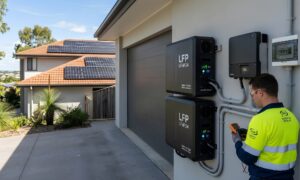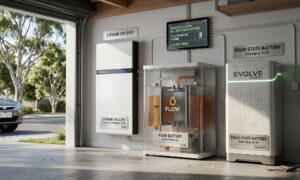





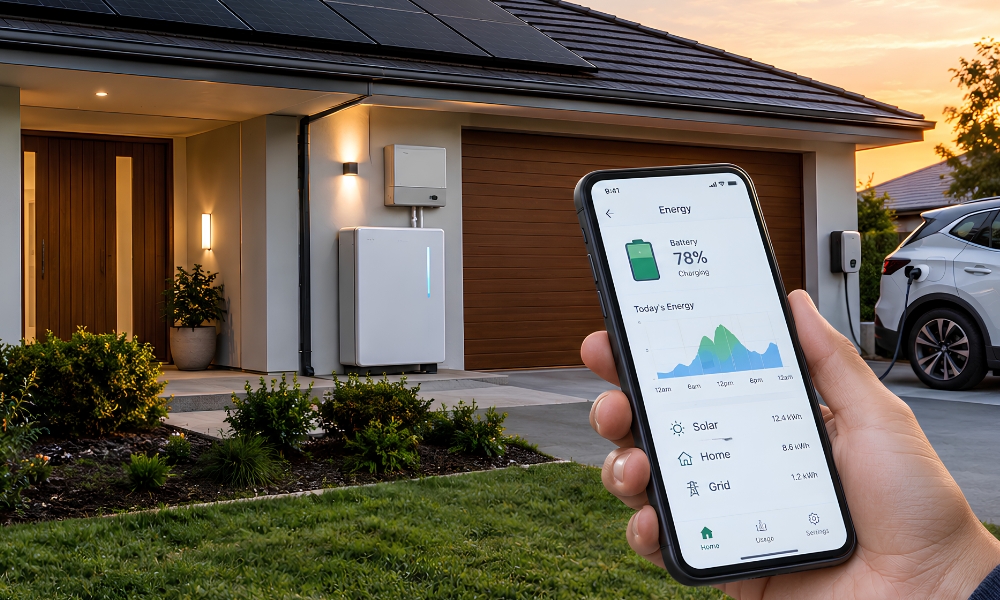
Australia’s rooftop solar boom has changed the way households use electricity. The next step is making better decisions about when to store that energy and when to use it, rather than simply charging a battery whenever the sun shines.
For homeowners with home solar systems→, AI battery dispatch in Australia is becoming an important consideration when choosing a home battery or getting more value from an existing one. Instead of relying solely on fixed schedules, an intelligent system can anticipate changing conditions and adjust its charging and discharging strategy throughout the day.
For Energy Matters, helping Australians understand these technologies means looking beyond marketing claims to the practical questions that matter most: Will it reduce your electricity bills, protect you from expensive peak periods and make your solar investment work harder?
Ready to put your battery to work? Get a smart battery with AI dispatch →
Quick answer
- AI-powered battery dispatch uses software, forecasts and household energy data to decide when a home battery should charge, store electricity or discharge it for household use.
- Smart battery dispatch can improve savings by matching battery operation to rooftop solar generation, household consumption, electricity tariffs and, where available, grid service opportunities.
- Australian homeowners can benefit, but results depend on the battery’s control system, local electricity tariffs, network rules, usable capacity and how well the system is configured.



What is AI-powered battery dispatch and why should Australian homeowners care?
AI-powered battery dispatch uses software, forecasting, and optimisation algorithms to decide when a battery should charge, hold energy, or discharge electricity. Depending on the system, these decisions can be based on solar generation forecasts, household demand, weather conditions and electricity prices.
The technology is part of a broader shift towards intelligent energy management. Rather than simply storing surplus solar electricity, a smart battery can decide how to use that energy to support a household’s changing needs.
Expert insight: A smart battery’s real value isn’t just how much electricity it stores. It is how effectively the system manages that electricity around your household’s energy needs, tariff structure and backup requirements.
The key facts
- Smart battery dispatch: Automatically determines charging and discharging schedules.
- AI battery management: Uses data and algorithms to optimise battery operation within equipment limits.
- Battery AI optimisation: Balances bill savings, battery efficiency, backup reserves and potential grid participation.
- Intelligent battery charging: Coordinates solar production, household loads and, where suitable, cheaper grid electricity.
- Predictive battery Australia: Reflects the growing importance of forecasting solar generation, consumption and market conditions for Australian energy users.
Not every battery advertised as smart uses artificial intelligence in the advanced sense. Some systems rely on straightforward schedules or predefined rules, while others use predictive models that adapt to changing conditions.
Why this matters right now in Australia
Australia’s battery market is expanding rapidly. The Clean Energy Council’s September 2026 update reported that 276,011 home batteries were installed in the first half of 2026, while rooftop solar installations also reached record levels.
That growth matters because electricity prices change throughout the day. Rooftop solar can generate more power than a household needs around lunchtime, while demand often rises in the evening when solar production falls.
Meanwhile, the Australian Government’s Cheaper Home Batteries Program→ helps eligible households reduce the upfront cost of batteries connected to new or existing solar systems. Program settings changed on 1 May 2026, and the discount is scheduled to decline over time, so homeowners should check the latest eligibility rules before purchasing.
For households already investing in solar panels→, intelligent dispatch can help bridge the gap between daytime generation and evening electricity consumption.
How AI-powered battery dispatch works in Australia
At its simplest, a smart battery controller repeatedly evaluates the home’s energy situation and selects an operating strategy. More advanced systems use forecasts to make decisions before conditions change.
The technical explanation
Imagine a Melbourne→ household with rooftop solar, a home battery, ducted air conditioning and an electric vehicle. On a sunny day, the battery controller may store excess solar electricity rather than export it for a low feed-in tariff→.
Later, the system can discharge stored energy when the family cooks dinner, runs appliances or charges the car. If tomorrow’s forecast predicts cloudy weather, the controller may preserve more stored energy overnight or adjust its charging strategy to prepare for the following day.
A typical dispatch cycle follows these steps:
1. Predict conditions: The controller estimates solar generation, household demand, weather and available electricity prices.
2. Choose a strategy: Software compares possible charging and discharging schedules against the household’s goals and operating limits.
3. Control the battery: The inverter and solar battery storage→ management system execute permitted commands while monitoring power, temperature and state of charge.
4. Learn and adjust: Depending on the product, the controller uses new readings and performance data to revise future decisions.
The battery management system remains responsible for essential protection functions, including safe operating limits. AI dispatch is the decision-making layer, not a replacement for those protections.
Use Energy Matters’ easy-to-use solar power and solar battery storage system calculator to determine the right size for your solar system with storage. Our solar calculator will generate performance information and potential savings.
We can send this information to 3 pre-vetted, trusted local installers in your area so they can provide obligation-free solar quotes and help you take the first step toward true energy independence!

Australian examples and data
The opportunity is especially relevant in Australia’s National Electricity Market, where wholesale electricity prices and rooftop solar output can vary considerably throughout the day. Retailers may offer time-of-use tariffs or dynamic pricing, allowing compatible battery systems to respond to price signals.
Western Australia’s South West Interconnected System operates under different market arrangements than the National Electricity Market. Its evolving solar and battery connection requirements also affect how household systems can interact with the grid.
The Australian Energy Market Operator’s planning and system information provide useful context for the increasing role of storage and flexible consumer energy resources.
Expert insight: Forecasting is useful only when it leads to a better decision. A system that accurately predicts tomorrow’s solar output still needs to consider battery capacity, conversion losses, electricity tariffs, and the household’s actual energy needs.
What does AI battery dispatch mean for your electricity bills?
The main financial opportunity is to shift electricity use away from expensive periods and use more of the energy your solar panels generate.
However, savings are not guaranteed. They depend on the difference between electricity purchase prices and export payments, available solar energy, battery efficiency, system costs, and the household’s consumption habits.
Short-term impact
An intelligent controller may help reduce grid electricity purchases by storing surplus daytime solar and discharging it during evening peaks. Depending on the tariff and system design, it may also charge from the grid when electricity is cheap and preserve energy for a more expensive period.
A simplified example illustrates the principle.
| Dispatch decision | Potential household benefit | Important limitation |
| Store surplus solar | Use more self-generated electricity | Battery may already be full |
| Discharge during peak tariffs | Reduce expensive grid imports | Must retain enough energy for later |
| Charge during off-peak periods | Take advantage of cheaper electricity | Round-trip losses reduce the benefit |
| Export during valuable price periods | Potentially earn additional revenue | Requires suitable tariff and export permissions |
| Reserve energy for outages | Improve resilience during blackouts | Reduces capacity available for bill savings |
The controller should compare the financial value of using, exporting or storing each unit of electricity. If the feed-in tariff is unusually attractive, exporting some energy may be more beneficial than storing all of it.
Long-term implications
Over several years, AI battery management may improve the value a household receives from its equipment by reducing unnecessary grid imports and coordinating energy use more effectively.
But battery optimisation can’t automatically make an uneconomic installation profitable. Homeowners should assess the total installed price, financing costs, battery degradation, warranty conditions and realistic annual savings before deciding.
The ABC reported in March 2025 that Australian battery installations were increasing as solar feed-in tariffs → fell, with industry modelling pointing to the growing importance of storing daytime electricity for use at night. Those figures provide historical context, not a guaranteed forecast of individual household savings.
The Guardian Australia’s reporting has also highlighted the financial trade-offs of home storage, particularly for households without rooftop solar.
To make an informed decision, compare several solar quotes→ and ask installers to explain projected savings under your actual tariff, rather than relying on generic payback claims.
Expert insight: The strongest financial case usually comes from matching the battery to the household’s real energy profile. An oversized battery that rarely cycles fully can be less valuable than a right-sized system with effective controls.
What Australian homeowners can do right now?
You do not need to be an energy-market expert to benefit from intelligent battery charging. The important first step is understanding how your household uses electricity and whether your equipment can respond to changing conditions.
Actionable steps
- Review your electricity bills. Identify your peak and off-peak rates, daily supply charge and solar feed-in tariff. Check whether your retailer offers a time-of-use or dynamic tariff.
- Understand your consumption profile. Look at when you use air conditioning, hot water, cooking appliances, and charge your electric vehicle.
- Check your existing system. Some inverters support advanced energy management through a software update, while others require compatible hardware or replacement equipment.
- Compare battery control options. Ask whether the system supports forecasting, automatic tariff optimisation, remote monitoring and integration with other household devices.
- Protect your backup reserve. If you want electricity during blackouts, make sure the system can maintain a reserve without sacrificing too much everyday savings.
- Check available incentives. Review federal and state programs, including their approved-product, installer and virtual power plant (VPP)→ requirements.
- Measure results after installation. Compare grid imports, solar exports, battery cycling and electricity costs over several billing periods.
Households can also improve results by reducing unnecessary consumption. Better insulation, efficient appliances, and a suitable solar hot water system→ can reduce the electricity the battery needs to supply.
Questions to ask your installer or retailer
Before committing to a system, ask:
- Does the battery use predictive optimisation or just a fixed charging schedule?
- Can it respond automatically to my specific electricity tariff?
- Does it use weather forecasts and historical household consumption?
- Can I change its priorities between savings, backup power and solar self-consumption?
- What happens if internet access or the manufacturer's cloud service fails?
- Are there ongoing subscription fees or virtual power plant obligations?
- How are savings estimated, and what assumptions underpin the forecast?
- Will it work with my existing inverter, smart meter and EV charger→?
Powering up your EV with solar
If you're thinking of buying an EV, adding an EV charger to your solar system is a smart way to "fuel" your car with clean, renewable energy.
Expert insight: A good installation should clearly explain what the software can and cannot do. Ask for realistic performance estimates, written warranty terms and a way to monitor the system without relying entirely on the installer's promises.
Ready to make your solar work harder?
Compare solar and battery options with Energy Matters to find a system suited to your home, electricity tariff and energy goals.
Expert guidance: Ask your installer to show how the battery will respond to solar forecasts, tariff changes, and backup needs before you sign.
State-by-state considerations for AI battery dispatch
Battery optimisation varies across Australia. Retail tariffs, network rules, export limits and incentive programs influence when a battery should charge and discharge.
The following overview reflects published program information available in October 2026. Incentive eligibility and terms can change, so check the linked government sources before purchasing.
| State | What homeowners should consider |
| Victoria (VIC)→ | Compare time-of-use tariffs, solar exports and local network requirements. |
| New South Wales (NSW)→ | Compare retailer tariffs and consider incentives for joining a virtual power plant. |
| Queensland (QLD)→ | Assess local network export arrangements, retail tariffs and the value of storing daytime solar. |
| South Australia→ | Pay particular attention to solar exports, flexible tariffs and battery operation during periods of abundant rooftop generation. |
| Western Australia→ | Check the applicable network, inverter and retailer requirements, as well as virtual power plant conditions. |
Federal and state incentives in practice
The Australian Government's Cheaper Home Batteries Program provides an upfront discount for eligible systems, with revised arrangements taking effect on 1 May 2026. The exact benefit depends on eligible capacity and applicable certificate rules.
Other programs can add value, but they come with different conditions:
- New South Wales: The government offers incentives for eligible households connecting batteries to virtual power plants. Published eligibility was expanded from 1 July 2026, with batteries up to 50 kWh potentially eligible, subject to program rules.
- Western Australia: The WA Residential Battery Scheme offers rebates of up to $1,300 for eligible Synergy customers and $3,800 for eligible Horizon Power customers. Participation in an eligible virtual power plant is required, and qualifying households may also access no-interest loans.
- Victoria, Queensland and South Australia: Check the relevant state energy websites for current household programs, network conditions and retailer offers. Do not assume that an older rebate or loan scheme remains open.
Western Australia also introduced updated requirements for many new or upgraded solar and battery systems on 1 May 2026. These include provisions for remote disconnection and reconnection or export limitation, alongside applicable inverter standards.
Expert insight: A rebate can reduce the purchase price, but it does not necessarily make every battery or control platform the best choice. Compare the incentive, tariff, export rules and any virtual power plant contract together.

AI-powered battery dispatch will likely become more important as Australia adds rooftop solar, household storage, electric vehicles, and flexible electricity tariffs.
The Clean Energy Council's 2026 reporting shows the scale of this transition. Its January to June 2026 figures recorded 276,011 home battery installations, while the September report highlighted how quickly household storage uptake is growing.
Three developments are worth watching.
1. More sophisticated forecasting
Battery software will likely use more local weather forecasts, household demand patterns, and tariff data. Better predictions could help households avoid charging too early, preserve energy for evening peaks or respond to expected low solar output.
The benefit will depend on forecast accuracy and the quality of the controller's decisions, not simply whether a product carries an AI label.
2. Virtual power plants become more accessible
Virtual power plants coordinate multiple household batteries to help supply electricity when the grid needs it. With the owner's permission and under an agreed program, a participating battery may export energy or adjust its operation in response to grid conditions.
The financial return depends on the provider's contract, payments, battery availability requirements and any limits on household control. Homeowners should read these terms before enrolling.
3. Household devices work together
Intelligent battery charging could increasingly coordinate with electric vehicle chargers, heat pumps→ and energy-efficient appliances→. Rather than optimising each device independently, an energy management system may schedule several loads to reduce costs while maintaining household comfort.
Energy Matters sees this as part of a wider shift from simply generating renewable electricity to managing it intelligently. For consumers, the priority remains practical value, reliable equipment and transparent performance estimates.
Frequently asked questions
1. What is AI battery dispatch in Australia?
AI battery dispatch in Australia uses software, forecasts and energy data to decide when a home battery should charge, store electricity or discharge power. Depending on the system, it can optimise solar self-consumption, respond to electricity tariffs and manage backup reserves to help households use stored energy more effectively.
2. Can AI battery management reduce my electricity bills?
Yes, AI battery management can reduce bills by storing excess solar energy and using it when grid electricity is more expensive. Savings depend on your tariff, solar production, household consumption, battery efficiency and installation cost. Intelligent controls cannot guarantee savings or a particular payback period.
3. Is an AI-powered battery better than a standard home battery?
An AI-enabled battery may offer better optimisation than a system using fixed schedules, particularly when electricity prices and household demand change frequently. However, the benefit depends on the software, tariff compatibility and control settings. A well-configured standard battery may outperform a poorly configured AI system.
4. Can a smart battery charge from the grid when electricity is cheap?
Some smart batteries can charge from the grid during cheaper periods and discharge later when prices rise. However, this depends on the battery's capabilities, retailer tariff, connection settings and applicable network rules. Also consider charging losses and battery wear when calculating potential savings.
5. Should I join a virtual power plant with my home battery?
A virtual power plant may pay you or offer other benefits by coordinating your battery with other participating systems. Before joining, review the contract, payment structure, battery availability requirements, backup settings and exit conditions. Compare the expected benefits against any restrictions on when you can use your stored electricity.

Key takeaways
- Understand the technology: AI battery dispatch uses forecasts and energy data to improve charging and discharging decisions.
- Check your tariff: The difference between electricity import prices and solar export payments strongly influences savings.
- Compare complete systems: Consider battery capacity, inverter compatibility, warranty, backup capability and software fees.
- Check incentives: Review the federal Cheaper Home Batteries Program and applicable state programs before signing a contract.
- Get expert advice: Compare quotes and ask for realistic savings estimates based on your actual household consumption.
Make your home battery work smarter with Energy Matters
AI-powered battery dispatch can help Australian households get more value from solar by coordinating stored energy with electricity prices, weather forecasts and daily consumption. The best results come from matching the technology to your household, not simply choosing the battery with the most impressive AI claims.
Energy Matters helps Australians explore solar and battery options with informed guidance and competitive quotes. Get a free solar + battery quote from SAA-accredited installers to compare suitable systems, understand available incentives and find a solution for your home.
Sources and References
- Clean Energy Council: Rooftop solar and storage report
- Australian Energy Market Operator: Integrated System Plan
- NSW Government: Virtual Power Plant incentive
- WA Government: Residential Battery Scheme
- ABC News: Household battery storage surges as plunging solar tariffs improve the economics
- The Guardian Australia: Australia's surge in household battery installations