



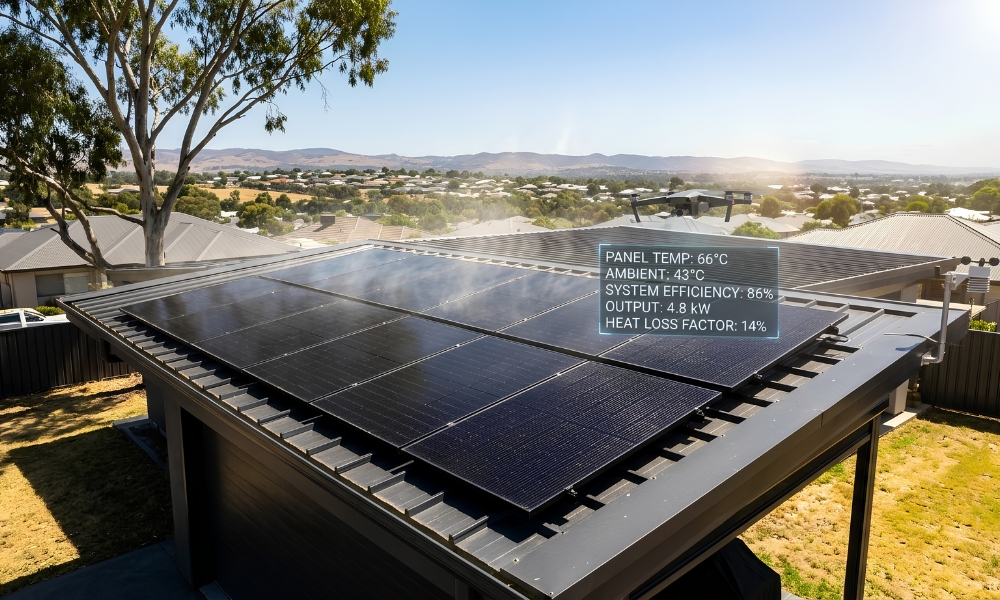
Australia recently experienced some of the hottest temperatures on record, with CSIRO climate projections showing sustained summer heatwaves across the country. As ambient temperatures surge, homeowners nationwide face a surprising paradox in rooftop energy production. Check how modern home solar systems→ perform in extreme heat to better understand your power output.
Understanding how global warming affects solar panel performance in Australia is crucial for every homeowner relying on clean energy to offset rising power bills. Extreme summer temperatures actually reduce the operating efficiency of standard photovoltaic modules. Ready to protect your summer output? Compare solar quotes→ with Energy Matters today.
Quick answer
- Heat reduces solar panel efficiency. Solar cells typically produce less electricity as their operating temperature rises above the standard testing temperature of 25°C.
- Hotter weather does not make solar panels useless. Strong sunlight can still deliver substantial generation, but extreme heat, bushfire smoke, dust and severe weather can affect output and reliability.
- Smart system design helps protect your investment. Choosing suitable panels, allowing good airflow, maintaining equipment and using electricity strategically can help Australian households get more from their solar systems.



How does heat affect solar panels, and why should Australian homeowners care?
The key facts
Solar panels turn light into electricity, not heat. Heat affects solar panels because as cells warm up, their voltage falls and efficiency slips. Manufacturers rate panels at a cell temperature of 25°C, yet a dark panel on a sunny roof often runs about 25°C hotter than the surrounding air.
That gap explains why even a mild day can push cells beyond their test conditions. Three numbers are worth remembering:
- 25°C: the cell temperature used for the power rating on every datasheet.
- Around 25°C hotter than the air: typical cell temperature on a sunny day.
- 0.3% to 0.5% per °C: the usual power loss for crystalline silicon panels above 25°C.
Why this matters right now in Australia
Australia leads the world in rooftop solar adoption, yet our summers are becoming progressively hotter and longer. The Clean Energy Council reports that extreme heat days directly reduce annual energy yields across major metropolitan centres.
Homeowners who rely on peak solar production during hot days often see reduced output when their air conditioners demand the most power.
Expert insight: ARENA’s solar performance guidance distinguishes between sunlight availability and module temperature. A system can have excellent solar exposure yet still lose performance due to temperature, which is why panel specifications and installation quality matter.
How global warming affects solar panel performance in Australia
Solar panels convert sunlight into electricity through photovoltaic cells. However, these cells do not operate at a fixed temperature, and their electrical characteristics change as they heat up.
The heat effect on solar panels, explained
When sunlight reaches a solar panel, some of the absorbed energy becomes electricity, while some becomes heat. On a hot, sunny day, the panel surface and its cells can become much hotter than the ambient air.
As cell temperature increases, the voltage produced by conventional silicon photovoltaic cells generally decreases. This reduces the panel’s maximum power output, even in bright sunshine.
This is why high-temperature solar efficiency matters. A panel rated at a particular wattage under standard test conditions will not necessarily deliver that exact power output on a hot roof.
Understanding the solar panel temperature coefficient
The solar panel temperature coefficient indicates how much a panel’s power output changes for each degree Celsius above its reference temperature, generally 25°C.
For example, consider a panel with a power temperature coefficient of -0.30% per °C. If its cell temperature reaches 65°C, it is operating 40°C above the reference temperature.
The estimated temperature-related power reduction would be:
40 × 0.30% = 12%
A 450-watt panel would therefore have an estimated output of 396 watts under those simplified conditions, before accounting for other losses. This illustrates temperature-related power reduction, not a prediction of a complete system’s daily energy production.
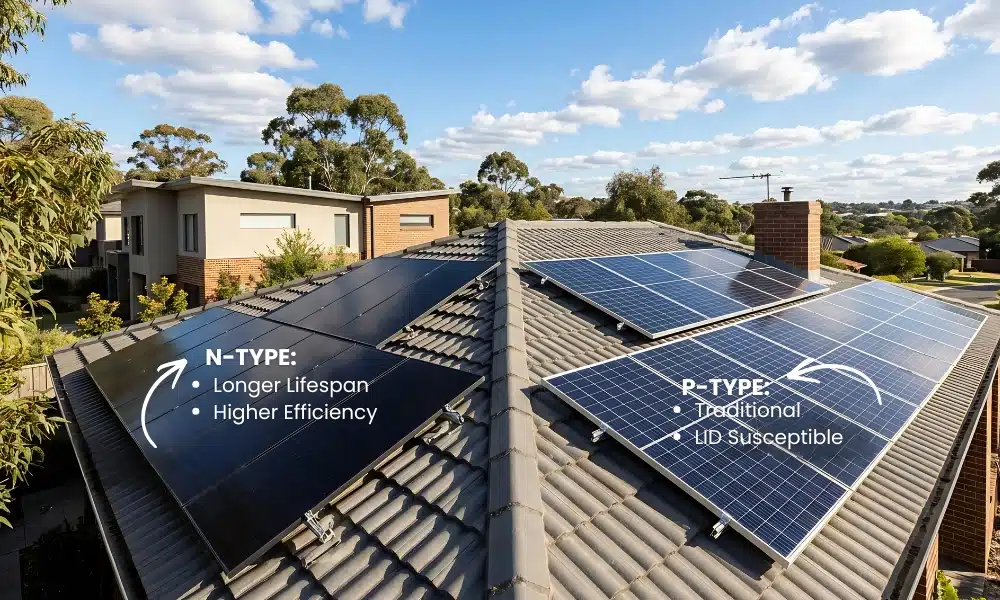
When comparing solar panels→, homeowners should look at the temperature coefficient alongside rated output, product warranty, degradation warranty and suitability for local conditions.
Why hot weather does not always mean less daily generation
A critical distinction is the difference between instantaneous power and total daily energy production.
A panel may lose some efficiency during the hottest hours but still produce considerable electricity across a long, sunny day. Longer daylight hours and strong solar irradiance can offset some temperature-related losses.
By contrast, cloud cover, smoke, shading or a dirty panel surface can reduce the sunlight reaching the cells. The net effect depends on the weather and the system’s design.
Australian examples and data
Australia’s climates vary widely, from humid tropical conditions in northern Queensland to dry inland environments, temperate southern regions and coastal locations exposed to salt.
Two otherwise identical systems can therefore perform differently because their panels experience different temperatures, wind conditions, sunlight levels and soiling rates.
ARENA’s benchmarking guidance identifies temperature as a key factor in assessing photovoltaic generation. For homeowners, the practical lesson is to compare expected annual generation and realistic operating conditions rather than relying on peak wattage alone.
Compare solar panels suited to your home →
Expert insight: A good installer should explain how the chosen panel’s temperature coefficient affects expected performance in your location. Ask for an estimate based on local weather data, roof orientation, shading and the system’s other electrical losses.

What does global warming mean for your electricity bills?
Heat-related losses can affect how much electricity your solar system generates, but they don’t automatically translate into a higher bill. Your electricity costs also depend on how much power you consume, when you use it, your retailer’s tariff and how much surplus energy you export.
Short-term impact during Australian summer
During a heatwave, air conditioners, fans and refrigeration systems can increase household electricity demand. Solar panels may produce substantial power at the same time, helping meet some of that demand.
However, the hotter cells become, the more their output may fall relative to what they could generate at a cooler temperature under the same sunlight. If household demand rises faster than solar production, you may need to import more electricity from the grid.
The best strategy is to use available solar power efficiently. Running suitable appliances during the middle of the day can increase self-consumption, subject to your household’s needs and any relevant electricity tariff conditions.
Long-term implications
Over time, rising temperatures may make thermal performance more important when choosing replacement panels or installing a new system. Other climate-related factors, including storms, hail, flooding, smoke and salt exposure, can also affect system reliability depending on the location.
Quality equipment, proper installation, and regular inspections can help reduce avoidable problems. However, no panel technology is immune to extreme weather or long-term degradation.
A home battery can store surplus daytime generation for evening use, but it cannot restore electricity the panels never generated. Its financial value depends on installation cost, usage patterns, tariffs, system sizing and available incentives.
Use Energy Matters’ easy-to-use solar power and solar battery storage system calculator to determine the right size for your solar system with storage. Our solar calculator will generate performance information and potential savings.
We can send this information to 3 pre-vetted, trusted local installers in your area so they can provide obligation-free solar quotes and help you take the first step toward true energy independence!

Expert insight: Evaluate solar as a complete household energy system, not simply a collection of panels. The relationship between generation, battery storage, appliance use, and electricity tariffs often matters more for bill savings than a small difference in panel efficiency.
What Australian homeowners can do right now?
You don’t need to replace a working solar system just because summers are getting hotter. Most households can start by reviewing their system’s performance, checking for avoidable losses and planning for local weather risks.
Actionable steps to protect your solar investment
- Check your monitoring data. Compare daily and monthly generation with previous periods, allowing for differences in sunshine, cloud cover and season. Investigate sustained unexplained drops rather than reacting to one unusually hot day.
- Understand your panel specifications. Review the temperature coefficient, product warranty and degradation warranty. These details help you compare how different panels may perform under Australian conditions.
- Maintain good airflow. Panels need appropriate mounting clearance and a correctly designed installation. Do not add improvised shading or modify the mounting system yourself.
- Arrange professional inspections. Ask a qualified solar professional to check mounting hardware, wiring, inverter performance and any signs of damage. Follow manufacturer guidance on cleaning and maintenance.
- Keep panels clear of avoidable shading. Overhanging branches, new structures and accumulated debris can affect production. Arrange tree work or electrical repairs through suitable professionals.
- Consider batteries carefully. Storage can improve the use of surplus daytime energy, particularly when evening demand is high. Compare the costs, usable capacity, efficiency, warranty and applicable incentives before committing.
- Improve household energy efficiency. Efficient cooling, appropriate thermostat settings and well-managed insulation can reduce electricity demand during heatwaves. Explore energy efficiency improvements → alongside solar upgrades.
- Prepare for severe weather. Check your insurer’s requirements and the equipment manufacturer’s guidance. After hail, storms, or flooding, don’t touch damaged panels or exposed wiring. Arrange a professional assessment.
Questions to ask your installer or retailer
Before installing a new system or upgrading an existing one, ask:
- What is the panel’s power temperature coefficient, and how does it compare with alternatives?
- What annual generation should I reasonably expect at my address?
- How will roof orientation, mounting clearance and ventilation affect performance?
- Are the panels, inverter and mounting equipment suitable for my area’s heat, humidity, salt or severe-weather exposure?
- What warranties apply, and what maintenance is recommended?
- Would a battery improve my household’s energy use enough to justify its cost?
- Which current government incentives am I eligible for, and what are their conditions?
Expert insight: The best recommendation isn't necessarily the panel with the highest advertised wattage. A suitable system combines reliable equipment, correct installation, a realistic generation estimate and a warranty that matches your expectations.
State-by-state considerations for hot climate solar panels
Australia's regional differences mean the best solar solution depends on local conditions. The following considerations are practical starting points, not a substitute for a site assessment.
| State | Climate considerations | What homeowners should prioritise |
| Victoria (VIC)→ | Heatwaves, cool winters and changing seasonal conditions | Compare annual generation estimates, assess summer cooling demand and check current Victorian energy programs. |
| New South Wales (NSW)→ | Inland heat, coastal humidity and severe storms in some areas | Review temperature performance, roof ventilation, shading and weather-related installation requirements. |
| Queensland (QLD)→ | High summer temperatures, humidity and tropical weather in some regions | Prioritise corrosion resistance where appropriate, robust mounting and suitability for local wind conditions. |
| South Australia→ | Hot, dry conditions and strong solar exposure in many areas | Compare temperature coefficients, manage dust and soiling, and evaluate battery economics. |
| Western Australia→ | Hot inland conditions, coastal salt exposure and varied regional climates | Check equipment suitability for the local environment, mounting quality and realistic generation estimates. |
What about rebates and state policies?
Government incentives can reduce upfront costs, but eligibility, funding and program rules change. The Australian Government's solar rebates→ and loans guide explains the Small-scale Renewable Energy Scheme and available support for eligible installations.
The federal Cheaper Home Batteries Program→ began on 1 July 2025 and offers an upfront discount for eligible home battery installations under the scheme's rules. Check the value and eligibility conditions against current official guidance before making a purchase.
State programs may provide additional assistance or have separate eligibility requirements. Check the relevant state government's official energy website before assuming that a rebate is available in 2026.
Expert insight: Do not choose a solar system based on a rebate alone. A well-matched system should make sense for your household's electricity consumption and property, even after incentives and electricity prices.
Expert predictions for 2027 and beyond
As global temperatures rise, solar system design will likely emphasise real-world performance, durability, and resilience. The direction is clear, though the exact effect on an individual rooftop system will depend on local conditions and the equipment installed.
Three developments deserve attention.
First, better-informed panel selection. Temperature coefficients, degradation data, product reliability and independent performance information will remain useful when comparing equipment. Buyers should look beyond headline wattage and consider how a system performs over its expected service life. Check our page for our recommended solar panel products.
Second, smarter household energy management. Batteries, monitoring software, flexible electricity tariffs, and controllable appliances can help households use solar energy more effectively. EV charging and efficient hot water systems can also shift more consumption into productive solar hours. Explore EV charging options→ and solar hot water systems→ as part of a broader household energy plan.
Powering up your EV with solar
If you're thinking of buying an EV, adding an EV charger to your solar system is a smart way to "fuel" your car with clean, renewable energy.
Third, more attention to climate resilience. The Australian Government's 2025 National Climate Risk Assessment highlighted growing risks from extreme heat and other climate hazards. For solar owners, this reinforces the importance of sound installation, maintenance and preparation for local weather extremes.
Australia's clean energy transition is also expanding the role of rooftop solar. The Guardian reported in July 2025 that the federal government was expanding its Capacity Investment Scheme to support additional large-scale renewable generation and storage. These grid-level changes are separate from rooftop panel efficiency, but they underline the importance of integrating solar, storage and electricity networks effectively.
Expert insight: Energy Matters' practical perspective is that climate resilience begins with informed decisions. A properly designed system, supported by qualified installation and realistic expectations, is a stronger investment than chasing a single specification or short-term incentive.
Frequently asked questions
1. Does global warming reduce solar panel efficiency in Australia?
Global warming can increase the frequency and intensity of hot conditions, and solar cells generally become less efficient as their operating temperature rises. However, actual electricity production also depends on sunlight, cloud cover, shading, panel design and maintenance. A hotter climate does not automatically mean lower total annual generation everywhere.
2. What temperature is too hot for solar panels?
No single air temperature causes all solar panels to stop working efficiently. Panels can keep generating electricity in very hot weather, although their cells may operate well above 25°C and produce less power. Check the manufacturer's operating specifications and temperature coefficient rather than relying on a universal temperature threshold.
3. Which solar panels perform best in hot Australian climates?
Compare panels using their power temperature coefficient, rated output, degradation warranty, product warranty and suitability for the installation environment. A less negative temperature coefficient indicates smaller temperature-related power losses, all else being equal. Independent product information and a location-specific generation estimate are more useful than a wattage rating alone.
4. Can I improve solar panel performance during an Australian heatwave?
You can reduce avoidable losses by keeping the system in good condition, preventing unnecessary shading and ensuring the panels have appropriate mounting clearance. Monitoring generation helps identify unusual drops, while professional inspections can uncover faults. Do not spray hot panels with cold water or attempt electrical repairs yourself.
5. Is a solar battery worth it as Australia gets hotter?
A battery can store surplus solar electricity for use later, which may help households with high evening demand or suitable electricity tariffs. However, it doesn't increase the panels' underlying generation or eliminate heat-related losses. Whether it is worthwhile depends on battery costs, usable capacity, efficiency, household consumption, export rates and available incentives. Check our page for our recommended solar battery products.

Key takeaways
- Global warming can increase exposure to extreme heat, which reduces solar panel power output when cell temperatures rise.
- Strong Australian sunshine can still support substantial solar generation, even when panels are less efficient during the hottest hours.
- The solar panel temperature coefficient is an important specification when comparing products for hot climates.
- Good installation, suitable equipment, monitoring and maintenance can help protect long-term system performance.
- Batteries and efficient appliances can help households use solar electricity more effectively, but their value depends on individual circumstances.
Protect your solar investment against summer heat
Understanding global warming and solar panel performance in Australia helps homeowners make better decisions about the energy systems they rely on. Heat can reduce panel efficiency, but thoughtful equipment selection, quality installation, and practical energy management can help maintain your solar investment's value as Australian summers change.
You do not necessarily need a new system to prepare. Start by checking your existing solar performance, reviewing your equipment specifications and identifying improvements suited to your home.
Ready to make your solar system work smarter? Energy Matters can help you explore your options and compare solutions for your property. Get a free solar and battery quote from suitable accredited installers and take the next step towards a more resilient home energy setup.
Sources and References
- ARENA: Benchmarking large-scale solar PV performance in Australia
- Australian Government: Government rebates and loans for solar
- ABC News: Australia's National Climate Risk Assessment explained, Climate change increased the chance of an intense Australian heatwave fivefold
- The Guardian: Australia's rooftop solar generation milestone in 2025, Federal renewable energy investment expansion