





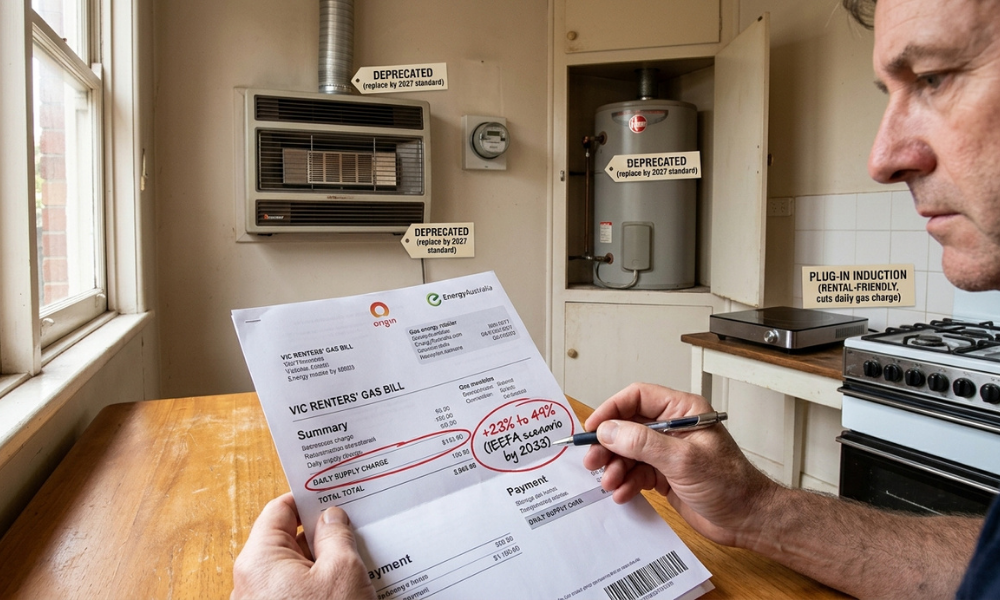
“Why is my gas bill still this high? I barely use the thing.”
If you rent in Victoria, chances are you’ve asked this at least once this year.
Here’s the uncomfortable answer: renters’ gas bills may not be done climbing.
As more homeowners swap gas for electric appliances, fewer households are left to pay for the state’s gas pipes. And someone has to foot that bill. Analysts at the Institute for Energy Economics and Financial Analysis (IEEFA) estimate Victorian gas network charges could rise by 23% to 49% by 2033 under one scenario.
Homeowners can walk away from gas. Renters? Not so much. The heater, the hot water system, the connection itself: none of it is yours to change.
But there’s some light at the end of the pipe. From 1 March 2027, Victoria’s new rental standards change what happens when gas appliances break. Let’s unpack what that means for you.
Quick summary
- Gas network costs could rise as more households leave gas and fewer customers share the bill.
- Renters are most exposed, because the landlord decides whether gas stays.
- From 1 March 2027, broken gas heaters and hot water systems in Victorian rentals must be replaced with electric ones.
Why could gas bills rise for those left on the network?
Think of the gas network like a share house with a very expensive mortgage.
Gas networks own billions of dollars’ worth of pipes, and they pay for them bit by bit through the network charges on every customer’s bill. When housemates move out, the mortgage doesn’t shrink. The people left behind just pay a bigger share.
That’s essentially what’s happening as Victorians go electric.
The networks themselves have sounded the alarm. Australian Gas Infrastructure Group, which owns two of Victoria’s three gas distribution networks, has urged the state to wind back its 2027 electrification policies, warning they’d force significant price rises. Worth noting, though: those warnings were based on the networks’ own unpublished pricing proposals.
And there’s another twist. Networks are also pushing for bigger “accelerated depreciation” allowances. Basically, that’s permission to recover more of their future costs from today’s customers in case their pipes end up stranded. The Australian Energy Market Commission is weighing rule changes that could allow more of it. IEEFA’s 23% to 49% figure is based on a scenario where networks get to set those allowances themselves.
Expert insight: Jay Gordon, an energy finance analyst at IEEFA, argues that the cost of the gas network shouldn’t fall on households alone. He points to IEEFA analysis showing Australia’s gas networks earned $1.8 billion in profits above their approved allowance between 2014 and 2022, and says shareholders should share some of the burden.
Expert tip
Look at the daily supply charge on your gas bill. If it makes up a large share of the total, your costs are driven more by staying connected than by how much gas you use.
Why are renters most exposed?
Here’s where it gets unfair.
Homeowners can decide when to ditch the gas heater, install a heat pump or cut the gas connection altogether. Renters can’t. Those calls belong to the landlord.
Energy experts call this the split incentive. The landlord pays for new appliances; you pay the bills. So if the old gas heater still clunks into life every winter, what reason does your landlord have to replace it?
Exactly.
As more homeowners electrify, renters could make up a bigger slice of the households still on gas. If network charges rise, guess who’s left holding more of the cost, without the option to leave?
And that’s before we even get to the daily supply charge you pay just to stay connected, even if you barely use gas. We dug into that in The Hidden Gas Cost Renters Still Can’t Escape.
Expert tip
When inspecting a rental, ask which appliances run on gas. An all-electric home means one less energy bill to pay.





What changes for renters from 1 March 2027?
Finally, some good news.
Victoria’s new minimum energy efficiency standards for rental homes kick in from 1 March 2027. They won’t force your landlord to rip out a gas heater that still works. But once it breaks for good, it can’t be replaced with another gas one.
| When | What landlords must do |
| From 1 March 2027 | Replace a broken gas heater with an efficient reverse-cycle air-conditioner in the main living area |
| From 1 March 2027 | Replace a broken gas hot water system with a heat pump water heater |
| From 1 March 2027, at the start of a new lease | Provide efficient cooling in the main living area, a 4-star water-efficient showerhead and ceiling insulation where there is none |
| From 1 July 2027, at the start of a new lease | Draughtproof external doors, windows and wall vents |
One nice detail: a reverse-cycle air-conditioner ticks both the heating and cooling boxes. And the savings aren’t small change. The Victorian Government estimates swapping a dead gas heater for one could save renters up to $215 a year, while moving from gas hot water to a heat pump could save up to $220.
Slowly but surely, gas will fade out of Victoria’s rental homes as old appliances give up.
Expert tip
If your gas heater or hot water system breaks after 1 March 2027, report it to your landlord in writing straight away. Failed heating and hot water count as urgent repairs.
How can renters cut gas costs now?
You don’t have to sit around waiting for your heater to die. Here’s what you can do right now:
- Check your gas bill. Compare your usage charges with the daily supply charge to see where your money goes.
- Compare energy plans. Use our energy comparison tool to check whether a cheaper gas or electricity plan is available.
- Cook with a plug-in induction cooktop. A portable induction unit can handle most everyday cooking and needs no installation.
- Use reverse-cycle air-con for heating. If your rental has a split system, it is usually cheaper to run than a gas heater.
- Cut your hot water use. Shorter showers and full loads in the washing machine reduce how much gas your hot water system burns.
- Run electric appliances on free power. Victoria’s Midday Power Saver offers free electricity from 11am to 2pm, so time cooking, laundry and heating for that window where you can.
For more ideas, see 5 Ways To Realistically Save Money on Your Bills as Renters.
Expert tip
Choose a plug-in induction cooktop that runs on a standard 10-amp power point. Most single-zone models do, so you can use one in any rental without changes.
How to talk to your landlord about going electric
Yes, you can bring it up before anything breaks. And you’ve got more bargaining chips than you might think:
- The upgrade is heavily discounted. Through Victorian Energy Upgrades, replacing a gas space heater with a reverse-cycle air-conditioner can attract a discount of up to $1,610, or up to $5,530 for a ducted system. The government says every upgrade required under the new standards qualifies.
- The rules are changing anyway. Upgrading now simply brings forward a switch the 2027 standards will eventually require.
- It avoids a winter emergency. A planned upgrade beats a rushed replacement when a heater fails on a cold night.
- It makes the property more appealing. Lower bills and year-round heating and cooling attract future tenants.
Expert tip
Put your request in writing and keep it short: what you’d like replaced, the discount available and the 2027 rule. A clear, friendly email is easier for a landlord or agent to act on.
What landlords should know
If you’re a landlord reading this, here’s the bit you can’t skip. Under Victoria’s Residential Tenancies Act, it’s a criminal offence to let a new renter move into a property that doesn’t meet minimum standards. So yes, the 2027 changes have teeth.
The smart move? Plan ahead. Replacing ageing gas appliances on your own schedule means you can compare quotes, claim the discounts above and avoid a panicked call to a tradie in the middle of July. Discounts for ceiling insulation are expected by 1 January 2027.
Worried about what this means for rents? The government says it doesn’t expect the standards to affect rental supply, pointing to research showing the 2021 rental health and safety standards didn’t push up rents or trigger more sales by rental providers.
Expert tip
Check the age of every gas appliance in your rental now. Anything more than about 10 years old is a good candidate for a planned upgrade before it fails.
Take Control of Your Home’s Energy Costs
Explore smarter energy solutions, compare quotes from trusted local installers, and discover how switching to energy-efficient systems could help lower your household bills.
Frequently asked questions
Will gas bills go up for renters in Victoria?
They could. As households switch to electric appliances, gas network costs are spread across fewer customers. IEEFA estimates Victorian network charges could rise by 23% to 49% by 2033 in one scenario, and gas networks have warned of rises too. Renters who can’t leave gas may carry more of that cost.
Can my landlord replace a broken gas heater with another gas heater?
Not from 1 March 2027. Under Victoria’s new rental standards, a gas heater that breaks and can’t be repaired must be replaced with an efficient reverse-cycle air-conditioner in the main living area. Until then, like-for-like gas replacements are still allowed, so it’s worth discussing an electric upgrade early.
Do the 2027 rules force landlords to remove working gas appliances?
No. The rules apply when a gas heater or hot water system reaches the end of its life and can’t be repaired, so working gas appliances can stay. Other new standards, such as efficient cooling and ceiling insulation, apply at the start of a new lease from 1 March 2027.
Can renters disconnect from gas?
Usually not without the landlord’s permission, because the gas connection and appliances belong to the property. Renters keep paying the daily supply charge while the home stays connected. If you rarely use gas, ask your landlord whether the remaining gas appliances could be replaced so the connection can be removed.
How much could renters save when gas appliances are replaced?
The Victorian Government estimates renters could save up to $215 a year when an end-of-life gas heater is replaced with a reverse-cycle air-conditioner, and up to $220 a year when gas hot water is replaced with a heat pump. Removing all gas appliances also ends the daily gas supply charge.
Key takeaways
- Gas network costs are spread across fewer customers as households go electric, which could push up bills for those who stay.
- Renters are most exposed, because they usually can’t remove gas appliances or disconnect from the network.
- From 1 March 2027, broken gas heaters and hot water systems in Victorian rentals must be replaced with efficient electric ones.
- Renters can cut gas costs now with plug-in induction cooking, reverse-cycle heating, plan comparisons and free midday power.
- Victorian Energy Upgrades discounts make it easier for landlords to switch before appliances fail.
Sources
- Jay Gordon, IEEFA, commentary on Victorian gas network costs and electrification, October 2026 (23% to 49% network charge scenario)
- IEEFA, Gas networks are making persistent and significant supernormal profits
- Australian Energy Market Commission, Gas networks in transition rule changes
- Victorian Government, Electric and efficiency standards for buildings
- Victorian Government, Energy efficiency for rental properties in Victoria
- Premier of Victoria, Securing Victoria’s gas supply while slashing energy bills
- Victorian Government, Victorian Midday Power Saver
- Energy Matters, The Hidden Gas Cost Renters Still Can’t Escape and 5 Ways To Realistically Save Money on Your Bills as Renters