





Victoria’s solar incentives are heading for a significant change, leaving homeowners and installers with an uncomfortable question: what happens before then?
The Victorian Government has announced that residential solar support will move into the Victorian Energy Upgrades (VEU) program from July 2027. Applications for the existing Solar Homes solar panel rebate and interest-free loan will close on 30 June 2027.
Support will continue, but the way households access it will change. Crucially, the new scheme’s eligibility rules and discount calculations remain unpublished.
For homeowners, that creates uncertainty about whether installing now or waiting will deliver better value. For installers, it could disrupt demand while businesses prepare for a different incentive system.
The biggest immediate risk may be hesitation. Households could postpone installations while waiting for benefits they cannot yet confirm.
TL;DR
- Current support continues: Eligible households can apply for Solar Homes solar PV rebates and loans until 30 June 2027.
- A new discount starts in July 2027: Residential solar will enter the VEU program, using a certificate-based incentive model.
- Waiting involves uncertainty: Future eligibility and individual discounts remain unclear, while delaying solar also postpones potential electricity savings.
What has Solar Victoria announced?
The Government announced the change on 17 October 2026. Solar Victoria published its follow-up update on 21 October.
In its communication to authorised retailers, Solar Victoria confirmed two key dates:
| Date | What changes |
|---|---|
| Until 30 June 2027 | Solar Homes solar PV rebate and interest-free loan applications remain available under existing arrangements. |
| From 1 July 2027 | A new residential solar PV activity will provide upfront discounts through the VEU program. |
The announcement concerns the solar PV rebate and associated loan application pathway. Solar Victoria says it will continue administering existing solar PV loans and hot water rebates.
Homeowners should distinguish the application deadline from their installation deadline. An approved application still carries installation requirements, so customers should confirm their individual time frame.
Will the new solar discount be bigger?
Potentially, but homeowners should avoid treating that possibility as a guaranteed saving.
The Government says the new discounts will exceed the existing $1,400 Solar Homes rebate in many cases. However, it has not provided a household calculation demonstrating who receives more, or by how much.
The announcement also places the reform within a broader government savings package. It estimates $60 million in savings over the forward estimates through reduced administrative duplication.
The Essential Services Commission will oversee industry standards, quality assurance, and regulation under the announced arrangements.
Those commitments establish the policy direction. They do not yet provide enough detail for an individual homeowner to compare today’s offer with next year’s.
A potentially larger discount is encouraging. A confirmed quote requires considerably more information.
How will the VEU solar discount work?
Solar Victoria’s retailer communication describes a market-based certificate scheme, similar in concept to federal Small-scale Technology Certificates (STCs).
Under the existing VEU framework, eligible upgrades generate Victorian Energy Efficiency Certificates. These certificates have a market value that helps fund customer discounts.
Accredited providers manage the incentive process. Installers can also participate through partnerships with accredited providers.
VEU discounts depend on the upgrade and applicable requirements. Customers generally need to involve an accredited provider before work begins.
However, those existing arrangements should not be mistaken for the final residential solar rules.
Important questions remain:
- Which households and properties will qualify?
- Will existing Solar Homes eligibility restrictions carry across?
- How will system size affect the discount?
- Will replacement systems and expansions qualify?
- How will the new incentive interact with federal STCs?
- What requirements will retailers and installers need to meet?
- What arrangements will apply to customers crossing the transition date?
Until those details emerge, any precise promise about a household’s future entitlement deserves scrutiny.
What does this mean for homeowners?
The answer depends partly on whether you qualify for support today.
If you currently qualify for Solar Homes
The current program offers a solar PV rebate of up to $1,400, subject to eligibility and purchase cost. An optional interest-free loan can match the rebate amount.
The rebate reduces the system’s cost. The loan spreads part of the payment and must be repaid.
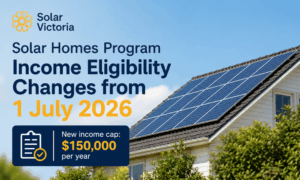
Current eligibility includes an income test, property requirements, and rules covering previous incentives and solar installations. Solar Victoria’s owner-occupier criteria specify combined taxable income below $150,000 for all owners. Customers must receive eligibility approval before installation to obtain the rebate. solar.vic.gov.au
For these households, the practical comparison involves three things: today’s system price, available support, and the cost of postponing installation. Waiting could deliver a larger discount. It could also mean paying higher electricity bills while waiting for an uncertain outcome.
If you currently miss out
This is where the announcement could have its strongest effect on buying decisions. A homeowner excluded under today’s rules may wonder whether the new scheme will provide access to support.
That is understandable. However, moving residential solar into VEU does not establish that every previously ineligible household will qualify.
The Government still needs to publish the new activity’s requirements. Homeowners should therefore avoid assuming that income limits, previous rebate restrictions, or existing-system rules will disappear.
The opportunity may broaden. The announcement alone does not confirm how far.
Should you install solar now or wait until July 2027?
There is no universal answer, and a rebate headline cannot make the decision for you. Start with a site-specific quote and realistic savings estimate. Consider your roof, daytime electricity use, tariff, export arrangements, and future electrification plans.
Then compare the potential benefit of waiting against the savings you would forgo.
For example, assume a suitable solar system could reduce your bills by $100 monthly. Waiting eight months would postpone approximately $800 in savings.
That is an example calculation, not a forecast. Your result could differ substantially.
Also, compare the additional future discount against the support available today. Comparing next year’s entire incentive against nothing can distort the decision.
Practical tip: Ask your installer to model installation now and installation later. Keep the future incentive clearly labelled as an assumption.
You can then see how much extra support would justify delaying.
Could the announcement put installers under pressure?
Yes, potentially. This is an assessment of the transition risk, rather than evidence that a slowdown has already occurred. Solar businesses face a difficult combination: a confirmed change date and incomplete details about the replacement scheme.
Customers who currently miss out may postpone purchasing in anticipation of eligibility. Others may wait because they expect a larger discount. That could weaken near-term demand, even if the new program eventually increases installations.
A quieter pipeline still carries costs
Installers cannot pause wages, insurance, vehicles, premises, and administration while customers wait for policy details. A prolonged period of deferred decisions could place particular pressure on smaller operators with limited financial reserves.
Businesses may also spend more time revising quotes and explaining uncertainty without securing corresponding installations. Those pressures could affect recruitment, apprentice opportunities, stock purchasing, and investment decisions.
Demand could become uneven
The transition could also create competing customer behaviours. Some eligible households may bring installations forward to secure current support. Others may hold off until the new program begins.
That creates the possibility of uneven workloads, followed by a concentrated increase in demand. Neither outcome is inevitable. However, businesses need information early enough to plan staffing, procurement, and customer commitments sensibly.
A transition period provides time. Published rules provide the ability to use that time effectively.
What would a smoother transition require?
Solar Victoria has committed to working with industry as it develops the new activity.
For that consultation to support practical planning, retailers and installers need timely answers on:
- Customer eligibility and discount calculations.
- Accreditation, participation, and partnership requirements.
- Treatment of approved applications and installations spanning the changeover.
- Documentation, auditing, payment processes, and processing timeframes.
- Consumer protections and responsibility for resolving problems.
Clear public messaging also matters. Households need to understand that support continues, current applications remain available, and future entitlements require confirmation.
Installers should not have to fill policy gaps with speculation to keep conversations moving.
What should Victorian households do now?
Get the numbers for your home before deciding to wait. A good solar assessment should explain system sizing, likely generation, estimated savings, installation costs, and applicable incentives.
Ask which figures are confirmed and which depend on assumptions. Request a clear breakdown separating discounts from finance.
Victoria’s new approach could expand access and improve affordability. Its success will also depend on preserving customer confidence and a capable installation industry.
For now, the strongest decision comes from comparing real options, rather than betting on an unpublished discount.
Considering solar? Energy Matters can connect you with solar quotes to help assess your options and available support.
Frequently asked questions
Is Victoria ending solar rebates immediately?
No. Solar Homes solar PV rebate and interest-free loan applications remain available until 30 June 2027 under existing arrangements. Residential solar support will then move into VEU from 1 July 2027. Customers should confirm application approval and installation requirements before committing to a purchase.
Will I qualify under VEU if Solar Homes previously excluded me?
That remains unconfirmed. The new residential solar activity’s eligibility requirements have not yet been published. Previous exclusion does not establish future eligibility. Homeowners should wait for specific rules before assuming that income thresholds, property conditions, or previous incentive restrictions will change.
Will the new discount exceed $1,400?
The Government expects discounts to exceed $1,400 in many cases. However, that does not guarantee a larger discount for every household. Individual outcomes will depend on the final scheme design, applicable requirements, and the offer available when the customer purchases their system.
What happens to existing Solar Victoria loans?
Solar Victoria says it will continue administering existing solar PV interest-free loans. The closure of new applications does not mean existing debts disappear. Borrowers should continue meeting their repayment obligations and contact Solar Victoria with questions about their particular loan arrangements.
Could waiting for the new scheme cost me money?
Potentially. Delaying solar also delays any electricity savings your system would provide. Compare those forgone savings against the possible additional incentive, rather than the entire future discount. A site-specific quote and realistic savings assessment can help establish whether waiting makes financial sense.
Information checked on 22 October 2026. Commentary describes potential impacts, rather than confirmed changes in customer demand.