

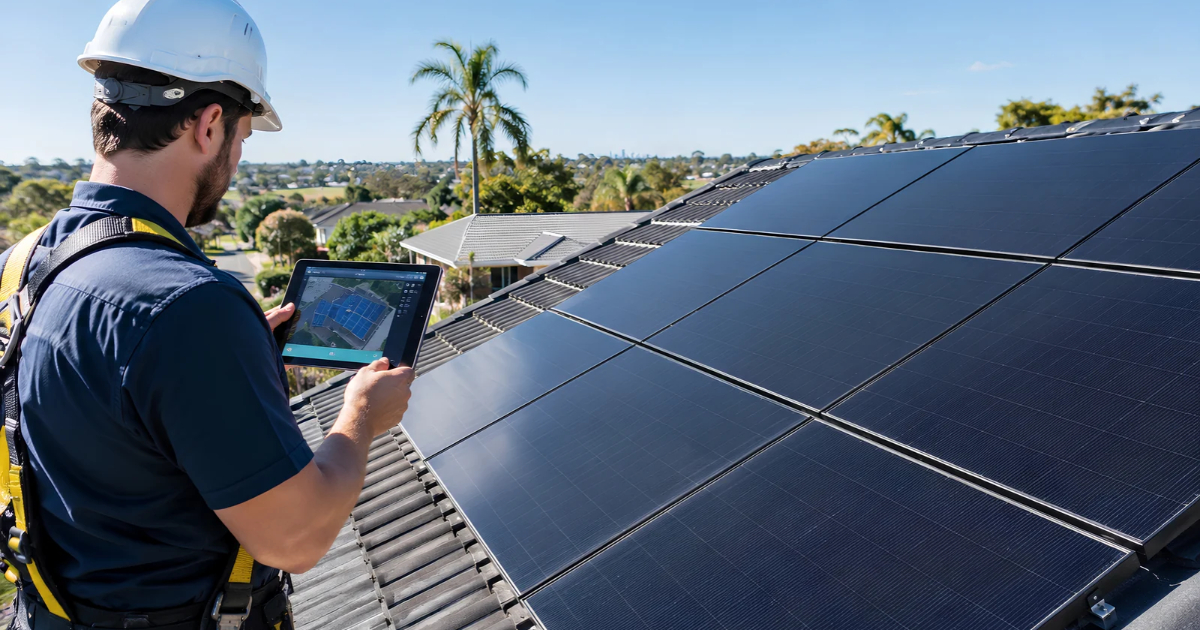
Australia’s rooftop solar market is entering a new phase. The Clean Energy Council reported approximately 254,664 rooftop solar installations in 2025, adding around 2.6 GW of capacity, as households increasingly considered batteries and ways to use more of their own electricity.
With millions of systems already installed across the country, choosing the right design matters as much as choosing quality equipment.
This is where AI solar system design Australia is becoming an important topic for homeowners. AI tools can assess roof space, estimate solar generation and compare system configurations in minutes, but can they genuinely outperform an experienced installer?
For households exploring home solar systems, the answer depends on how they use the technology. At Energy Matters, we help Australians make informed clean energy decisions, not just chase the newest technology. Understanding AI’s strengths and limitations is a practical first step toward a smarter solar investment.
Quick answer
- AI can improve solar system design by analysing roof layouts, shading, energy consumption, weather patterns and electricity tariffs faster than manual methods.
- Human installers remain essential for assessing real-world roof conditions, electrical safety, Australian standards, network requirements and installation quality.
- The best results come from combining both. AI-assisted design, checked and refined by a qualified Australian solar professional, can help households find a system that better matches their energy needs and budget.
What is AI solar system design and why should Australian homeowners care?
AI solar system design uses algorithms, data analysis and sometimes computer vision to develop a proposed solar installation for a particular property. Instead of relying entirely on manual calculations, an AI solar design tool can evaluate multiple configurations and compare their estimated performance.
For Australian homeowners, the benefits are straightforward. A better-designed system can generate more usable electricity, reduce unnecessary upfront costs, and make it easier to decide whether a battery is worth it.
The key facts
- Roof analysis: AI can use aerial imagery, roof measurements and shading estimates to identify potential panel locations.
- Energy modelling: Software can estimate solar output against historical weather data and household consumption.
- Equipment selection: Automated solar system design tools can compare panel arrangements, inverter capacities and battery options.
- Financial projections: Models can estimate self-consumption, grid imports, feed-in revenue and potential bill savings.
- Professional verification: A qualified designer must check assumptions, safety, electrical requirements and installation feasibility.
AI does not automatically produce a better design simply because it processes information quickly. Its accuracy depends on the quality of its inputs, the sophistication of its models and the expertise used to validate the result.
Use Energy Matters’ easy-to-use solar power and solar battery storage system calculator to determine the right size for your solar system with storage. Our solar calculator will generate performance information and potential savings.
We can send this information to 3 pre-vetted, trusted local installers so they can provide obligation-free solar quotes and help you take the first step toward true energy independence!

Expert insight: Good solar design starts with the household, not the software. An algorithm can compare thousands of possible configurations, but it needs realistic electricity usage, roof information and tariff assumptions to produce a useful recommendation.
Why this matters right now in Australia
Australia’s solar market is becoming more complex as households consider batteries, electric vehicles, changing electricity tariffs and flexible energy plans.
The Clean Energy Regulator reported that, in its lag-adjusted estimates, households installed approximately 2.8 GW of small-scale solar capacity in 2025. It also reported that the average system size increased from 9.9 kW in 2024 to 10.3 kW in 2025.
These trends make system sizing increasingly important. Homeowners need to look beyond the number of panels on their roof and consider when they’ll use electricity, how much surplus generation is likely, and whether future electrification will change demand.
How AI solar system design works in Australia
AI-assisted design generally combines property data, solar modelling and financial analysis. Some platforms automate only parts of this process, while others integrate several stages into a single workflow.
The technical explanation
A typical AI solar design workflow involves five stages.
- Assess the property. The tool examines roof geometry, orientation, available space and potential obstructions using supplied measurements, maps or imagery.
- Estimate sunlight. Weather records and solar irradiation models help estimate the energy available throughout the year.
- Match electricity demand. Historical bills, smart meter data or household usage estimates help determine when the property consumes electricity.
- Test system configurations. The software compares panel placement, system capacity, inverter options and possible battery sizes.
- Estimate costs and benefits. It models generation, self-consumption, grid imports and exports, and projected financial returns.
For example, a household that uses most of its electricity after sunset may benefit from a different configuration than one with someone working from home during the day.
A sophisticated model can test both scenarios and show how different panel sizes or battery capacities change the results.
Australian examples and data
The opportunity is significant because rooftop solar is already a major part of Australia’s electricity system. The Australian Government’s latest electricity statistics report that rooftop solar supplied approximately 12.2% of total Australian electricity generation in 2025.
Meanwhile, the Australian Energy Market Operator (AEMO) publishes electricity market and planning information that helps explain changing demand patterns and the increasing role of distributed energy resources.
However, national data does not replace a site-specific assessment. A solar design tool must account for the property’s local weather, roof conditions, network connection limits and electricity tariff.
Homeowners should also distinguish between AI-powered design and conventional solar design software Australia already uses. A program can automate panel layouts and generation estimates without using advanced AI. The key question is whether the tool improves the final design quality.
Expert insight: Automated solar system design is particularly useful for rapidly comparing alternatives. It’s most valuable when the software provides transparent assumptions, and the designer checks the results against actual site conditions.
AI vs human installer: Which produces the better design?
The most useful comparison is not whether AI or a person wins every time. It is which tasks each can perform best, and how effectively they work together.
| Design task | AI-assisted software | Experienced human professional |
| Compare hundreds of layouts | Fast and consistent | Slower when done manually |
| Estimate annual generation | Strong with good data | Can validate assumptions and model choice |
| Detect shading | Useful with accurate imagery | Can inspect trees, structures and changing conditions |
| Assess roof condition | Limited by available data | Can identify physical problems during inspection |
| Understand household needs | Analyses supplied consumption data | Can clarify habits and future plans |
| Check electrical compliance | Can flag potential issues | Must verify applicable requirements |
| Estimate financial returns | Can model multiple scenarios | Can challenge unrealistic assumptions |
| Confirm installation feasibility | Cannot reliably assess every site remotely | Can coordinate practical installation requirements |
Where AI has an advantage
AI can compare options consistently without becoming tired or spending hours manually adjusting layouts. It can also combine large datasets to spot patterns a quick initial assessment may miss.
This is particularly useful when comparing roof orientations, panel quantities, battery capacities, or different electricity-usage scenarios.
Where human installers have an advantage
A site visit can reveal problems that photographs and maps cannot reliably capture. These include roof deterioration, restricted access, unusual cabling routes, structural concerns and obstructions that change throughout the day.
A qualified professional can also discuss practical considerations such as future renovations, household routines and equipment placement.
The Clean Energy Council’s published solar installation guidance emphasises that reliable system performance depends on both careful design and correct installation practice. Solar Accreditation Australia (SAA) now operates the relevant installer and designer accreditation scheme.
What about solar AI design accuracy?
Judge solar AI design accuracy by how closely the final system’s actual performance matches reasonable, weather-adjusted expectations, not by how impressive a software demonstration looks.
Common sources of error include:
- Incorrect roof dimensions or panel orientation.
- Trees, chimneys or neighbouring buildings missing from the model.
- Weather assumptions that do not reflect local conditions.
- Inaccurate household consumption estimates.
- Outdated electricity tariffs or feed-in rates.
- Failure to account for inverter clipping, equipment losses or export limits.
No single verified accuracy percentage applies to every AI solar design tool in Australia. Ask providers for validation results, the assumptions behind their estimates and examples of real installations.
Expert insight: The strongest approach is AI-assisted design with human sign-off. Software should speed up the design process and make it more evidence-based, while a qualified professional remains responsible for confirming the proposed system is appropriate and compliant.

What does AI solar system design mean for your electricity bills?
AI cannot guarantee lower electricity bills. However, it can help identify a system configuration that better uses the solar energy your household generates.
Short-term impact
The most immediate potential benefit is avoiding a poorly sized system.
A household that installs too little solar may continue buying substantial amounts of electricity from the grid. A household that installs more panels than it can economically use may export large quantities of surplus electricity for a relatively low feed-in credit.
A well-designed system balances these considerations using the household’s energy profile, available roof space and tariff structure.
AI can also help homeowners compare whether a battery is worthwhile. The Australian Government’s Cheaper Home Batteries Program offers eligible installations a discount based on battery capacity and applicable small-scale technology certificates. Program settings changed in May 2026, so buyers should confirm current eligibility and discount calculations before signing a contract.
Long-term implications
The value of solar changes as household needs evolve. Buying an electric vehicle (EV), replacing gas appliances with electric alternatives or working from home can all alter electricity consumption.
AI-assisted modelling can test these future scenarios before installation. It may help you decide whether a slightly larger solar array, a battery-ready inverter, or a planned EV charging arrangement offers better long-term value.
Powering up your EV with solar
If you’re thinking of buying an EV, adding an EV charger to your solar system is a smart way to “fuel” your car with clean, renewable energy.
Nevertheless, financial projections remain estimates. Electricity prices, export limits, equipment degradation, maintenance costs and household behaviour can all affect actual returns.
For a broader strategy, consider energy-efficiency improvements, which can reduce consumption and increase the value of the electricity your system produces.
Expert insight: A strong design optimises how a household uses the electricity and the cost of meeting its remaining needs. The largest system isn’t automatically the most economical, so assess a battery against actual usage and tariff conditions.
What Australian homeowners can do right now?
You do not need to understand machine learning to benefit from AI solar design. You need a clear picture of your energy needs, a way to compare credible proposals and an installer who can explain the reasoning behind the recommendation.
Actionable steps
- Gather your electricity bills. Twelve months of bills is a useful starting point. Interval meter data, where available, can provide a more detailed picture of when you use electricity.
- Document your property. Record roof orientation, major shading sources and any planned renovations. Treat online roof assessments as preliminary, not definitive.
- Compare different system sizes. Ask for estimated annual generation, expected self-consumption, grid imports and exports for each option.
- Test battery scenarios. Compare solar-only, solar-plus-battery and battery-ready options where suitable.
- Check the financial assumptions. Ask which electricity tariff, feed-in rate, electricity price increases and maintenance costs have been used.
- Verify credentials and compliance. Confirm that the proposed designer and installer have the appropriate accreditation and electrical licensing for the work.
- Compare written solar quotes. Use Energy Matters’ solar quote service to explore suitable installer options.
- Assess future energy needs: Factor in prospective additions like EV chargers, heat pumps, or a solar hot water system.
Questions to ask your installer or retailer
Before accepting an AI-generated proposal, ask:
- Which AI solar design tool or modelling platform was used?
- Has the roof layout been verified against real site conditions?
- How are shading, panel degradation and inverter losses included?
- Are the generation estimates based on local weather data?
- What percentage of solar generation is expected to be used in the home?
- Have network export restrictions been checked with the relevant distributor?
- How would adding an EV charger or battery change the recommendation?
- Who is responsible for checking the design and meeting Australian requirements?
- What assumptions determine the projected payback period?
A reputable provider should be able to explain the design without hiding behind a software-generated report.
State-by-state considerations for AI solar system design in Australia
AI can compare designs across locations, but a national model cannot assume every state has identical network rules, tariffs or incentives.
| State | What the design should consider |
| Victoria (VIC) | Check distributor connection requirements, applicable export limits and current Solar Victoria programs. |
| New South Wales (NSW) | Consider local network export arrangements, time-of-use tariffs and any current battery or virtual power plant incentives. |
| Queensland (QLD) | Account for high summer solar production, heat, storm exposure and distributor-specific connection requirements. |
| South Australia | Pay close attention to export limits, flexible export arrangements where available and the value of storing midday generation. |
| Western Australia | Check Western Power or Horizon Power requirements, depending on location, alongside local tariffs and battery incentives. |
Expert insight: Local rules are not a minor detail. A design that looks financially attractive on paper may need revision if network export restrictions, equipment requirements or state incentive conditions differ from the model's assumptions.
Expert predictions for 2027 and beyond
AI solar system design is likely to become more integrated with household energy management as software providers combine solar forecasting, battery optimisation, EV charging and electricity tariff analysis.
Several developments are worth watching.
- More personalised designs. Models will increasingly use interval consumption data and household-specific scenarios rather than generic consumption profiles.
- Improved roof analysis. Better imagery and computer vision may help automate preliminary roof assessments, although physical inspections will remain important.
- Solar and battery coordination. Design platforms may increasingly optimise panel capacity and battery size together, rather than treating them as separate purchases.
- Tariff-aware recommendations. Software could compare electricity plans, export limits and time-of-use pricing to estimate which system configuration best suits a household.
- Smarter ongoing optimisation. Connected inverters, batteries, and energy management systems may use forecasts to adjust charging and consumption based on expected solar generation.
Recent Australian reporting reflects the shift towards integrated household energy systems. ABC News reported in February 2026 that rooftop solar installations had declined from their 2024 level as attention increasingly shifted towards home batteries.
The Guardian has also examined the economics of batteries for households that cannot install rooftop solar, highlighting why property constraints and realistic financial modelling matter.
These developments suggest that future solar design will need to account for more than panel output. It will increasingly involve the relationship between generation, storage, consumption and the electricity grid.
However, predictions about AI capabilities should not be mistaken for guarantees. Better software will still depend on reliable data, transparent modelling and appropriate professional oversight.
Frequently asked questions
Can AI design a complete solar system for an Australian home?
Yes. Some AI-assisted platforms can produce preliminary layouts, generation estimates and equipment recommendations. However, qualified professionals should review the final design for roof conditions, electrical safety, applicable Australian standards, network requirements, and installation feasibility.
Is an AI solar design tool more accurate than a human installer?
Not necessarily. AI can process large datasets and compare configurations quickly, while experienced installers can identify physical constraints and practical issues that software may miss. Accuracy depends on data quality, modelling assumptions and professional validation. Combining AI analysis with expert review is generally more reliable.
Can AI help me save money on solar panels and batteries?
It can help compare system sizes, battery options and estimated bill savings to identify potentially better-value configurations. However, the results depend on your consumption, electricity tariff, equipment costs, solar generation and available incentives. Treat projected savings and payback periods as estimates, not guaranteed outcomes.
Is AI solar system design suitable for older Australian homes?
Yes, as a starting point. AI can assess available roof imagery and model potential panel arrangements, but older properties may need additional checks for roof condition, structural suitability, shading and electrical infrastructure. An on-site assessment is especially important for properties with complex rooflines or those requiring electrical upgrades.
What should I look for in solar design software in Australia?
Look for realistic local weather modelling, accurate shading analysis, transparent financial assumptions, support for current equipment and the ability to account for network export requirements. Ask whether an appropriately accredited professional reviews the design and whether you can compare actual system performance with the original forecast.
Key takeaways
- AI can quickly compare solar layouts, generation estimates, and battery configurations.
- Solar AI design accuracy depends on reliable data, realistic assumptions and professional validation.
- Human expertise remains essential for roof inspections, electrical safety and network compliance.
- Household consumption, tariffs and export limits matter more than simply installing the largest system.
- Compare proposals through Energy Matters and confirm the designer's credentials before committing.
The hybrid future of Australian solar design
So, can AI design a better solar system than a human installer? The answer lies in collaboration, not replacement.
AI solar tools offer unmatched precision in shade analysis, orientation, and generation forecasting. However, human installers bring practical experience, structural safety checks, and the regulatory knowledge needed for a safe, compliant installation.
When upgrading your home with solar, you don't have to choose between AI and human expertise. The best results come from combining advanced AI solar system design software with the hands-on skills of Solar Accreditation Australia (SAA)- accredited installers.
Ready to harness smart clean energy for your home? Energy Matters connects you with trusted, accredited solar professionals in your local area.
Source and References
- Australian Government, Department of Climate Change, Energy, the Environment and Water: Rewiring the Nation program overview
- Australian Energy Market Operator: 2026 Integrated System Plan
- Clean Energy Finance Corporation: 2025-26 annual report
- NSW Government: Hunter Transmission Project approval, July 2026
- Victorian Government: Victorian renewable energy zone orders
- WA Government: South West Interconnected System Transmission Plan FAQ
- WA Government: Distributed Energy Resources Roadmap