



The wholesale cost of electricity in Australia can change every 5 minutes – and dramatically. Home solar power systems are increasingly playing a role in softening the impact of wild upward swings.
Prices in the National Energy Market, the wholesale market from which power is purchased by electricity retailers in most Australian states, is generally unregulated but does have a cap – an incredible $12,500 per megawatt hour (MWh), which breaks down to $12.50 per kilowatt hour (kWh).
Fluctuations in the price of wholesale electricity depends on conditions; particularly when those conditions create the need for expensive peak power stations to be fired up to address demand.
During the summer months of December through to February, a greater frequency of price spikes occurs due to air conditioner use. In May through July, price spikes can happen due to the use of electric space heaters.
On February 1 last year in Victoria, the average price for wholesale electricity at 1.30pm was $5,332.68 per megawatt hour – or $5.33 per kilowatt hour. While that seems incredibly expensive, it pales beside the summer of 2008 when the half hourly spot price in South Australia exceeded $9900/MWh on 41 occasions.
While it’s the summer months where the big spikes often occur; during winter, demand, flooding, generator outages and other issues can have a marked effect on the cost of wholesale electricity.
According to a paper published by the ACCC, wholesale electricity exceeded $5000/MWh on 42 occasions during June 2007 in New South Wales, Queensland and Snowy regions.
Since 2001, wholesale electricity prices have climbed above $5,000 per megawatt hour hundreds of times:
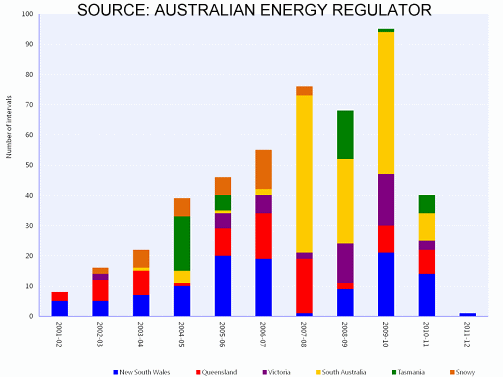
New South Wales: 112 instances
Queensland: 80 instances
Victoria: 48 instances
South Australia: 144 instances
Snowy distribution: 46 instances
Tasmania: 36 instances
In more recent years, these spikes would have been more costly if it weren’t for the solar panels increasingly appearing on rooftops throughout the nation.
Households with grid-connected solar power systems not only reduce demand on the mains grid, but also export the surplus power they create to the grid – and at times when it’s needed most.
During periods when wholesale prices exceed $5 per kilowatt hour; even in the most expensive scenario electricity contributed by some solar households has a ‘wholesale’ cost of just 66c per kilowatt hour.
The cost of solar electricity is influenced by whatever solar feed in tariff incentive the solar power system is covered by. The 66c applies to only those households participating in New South Wale’s short-lived Solar Bonus Scheme who signed on during the brief period when a 60c rate was active, which was boosted to 66c in some cases by an additional electricity retailer contribution.
In most cases, the cost of electricity contributed by home solar power systems is far less and can be as little as a few cents per kilowatt hour; putting solar firmly at no.1 in electricity generation merit order ranking during these periods. This electricity has the additional benefit of being clean energy rather than the comparatively carbon intensive form generated by peak power plants.