





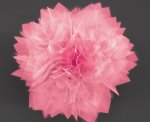
Flower-like semi-conductor structures created by researchers at North Carolina State University hold promise for a new generation of solar cells and energy storage devices.
The germanium sulfide (GeS) nanoflowers’ petals are just 20-30 nanometers thick and offer a large surface area on a small footprint.
“This could significantly increase the capacity of lithium-ion batteries, for instance, since the thinner structure with larger surface area can hold more lithium ions,” says Dr. Linyou Cao, an assistant professor of materials science and engineering at NC State and co-author of a paper on the research.
“By the same token, this GeS flower structure could lead to increased capacity for supercapacitors, which are also used for energy storage.”
The flower structure is created by heating germanium sulfide power in a furnace until it vaporizes. The vapor is then pushed into a cooler area of the furnace, where it settles in layers just 20 – 30 nanometers thick and 100 micrometers long. The sheets branch out from one another as additional layers are added, creating the floral pattern.
Germanium sulfide is also suitable for converting solar energy into power, making it attractive for use in solar cells. Unlike some other substances, it is relatively cheap and non-toxic.
The full paper describing the process for creating the germanium sulfide nanoflowers can be viewed on ACS Nano.
Professor Linyou Cao holds a B.S. from Fudan University, a M.S. from Peking University and a Ph.D from the Department of Materials Science and Engineering at Stanford University. The Cao group focuses on nanoscale photophysics and photochemistry, researching the fundamental properties of photons and charge carriers in nanostructured materials.
The Cao group recently also developed a technique allowing structures based on amorphous silicon only 70 nanometers thick to absorb 90% of incoming solar radiation.
Source/image source