






Nanotechnology keeps offering new and exciting breakthroughs in solar efficiency, boosting light absorption at an atomic level and potentially changing the solar industry.
The latest discovery in nanotech comes out of the University of Copenhagen, where a team of researchers have found that a single nanowire – a crystalline cylindrical structure about 10,000 times thinner than a human hair – can concentrate sunlight up to 15 times normal intensity; a discovery they say could lead to solar cells made using super-efficient nanowires.
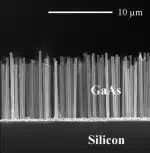
Scientists from the Nano-Science Center at the Niels Bohr Institut, University of Copenhagen, along with Ecole Polytechnique Fédérale de Lausanne, Switzerland, grew nanowire crystals from a silicon substrate. Because the diameter of the nanowire is smaller than the wavelength of light directed at it, the team observed “resonances” in the intensity and concentration of the sunlight.
“Thus, the resonances can give a concentrated sunlight, where the energy is converted, which can be used to give a higher conversion efficiency of the sun’s energy,” says PhD Peter Krogstrup, part of the Niels Bohr team.
“It turns out that the nanowires naturally concentrate the sun’s rays into a very small area in the crystal by up to a factor 15.”
The aim of the work is to use this concentrating effect to exceed the theoretical limit for photovoltaic efficiency – the Shockley-Queisser Limit, which states that only 33.7 percent of all available sunlight falling on a single p-n junction solar cell can be converted to electricity. It has since been noted that multi-layer cells can far outperform this limit by concentrating sunlight.
The team admits that while the findings are promising, it will take some years before rooftops are covered in nanowire enhanced solar panels.
“It’s exciting as a researcher to move the theoretical limits, as we know. Although it does not sound like much, that the limit is moved by only a few percent, it will have a major impact on the development of solar cells, exploitation of nanowire solar rays and perhaps the extraction of energy at an international level,” says Krogstrup.