






In the not too distant future, amputees could regain the benefits of a sense of touch through motorised prosthetic limbs featuring solar powered synthetic skin.
After developing a graphene based ‘electronic skin’, also known as tactile skin, researchers at the University of Glasgow have been tinkering with using solar energy to power it.
Their synthetic skin not only has applications for helping amputees performing difficult tasks such as gripping soft and fragile materials with the correct amount of pressure, but also in construction line robotics.
The skin is an energy miser, only requiring 20 nanowatts of power per square centimetre (one nanowatt is equal to one billionth of a watt).
Graphene comprises of a single layer of carbon atoms that form honeycomb shapes. It’s an incredibly strong material and a superior conductor of electricity. These attributes have seen it pursued for the next generation of solar cells and energy storage. In the case of this invention, it’s not the graphene being used to generate energy – it’s what lies beneath.
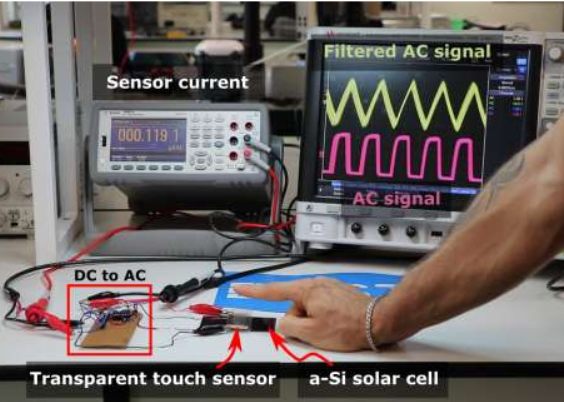
The potential to harness sunlight or even ambient light as an energy source has been made possible due to graphene’s optical transparency, which allows around 98% of light to pass directly through it. This has enabled the integration of solar cells under the skin to provide power to the sensors.
The DC current created by the solar cells is transformed by a circuit connected to the touch sensor into an AC signal. The signal varies when pressure is applied and those readings form the basis of how the prosthetic reacts.
A paper published in the journal Advanced Functional Materials describes how the researchers went about integrating solar cells into electronic skin coating a prosthetic hand.
One of the next steps for the researchers is to integrate battery energy storage in order to create truly energy autonomous, flexible and transparent tactile skin. They are also developing the technology to use solar cells to power the motors used to operate the prosthetic hand.
“We’ve already made some encouraging progress in this direction and we’re looking forward to presenting those results soon,” said Dr Ravinder Dahiya, from the University of Glasgow’s School of Engineering,
“We are also exploring the possibility of building on these exciting results to develop wearable systems for affordable healthcare.”
The researchers aren’t the first to delve into solar powered skin. In 2011, Stanford University’s Zhenan Bao created an artificial electronic “super skin” powered by stretchable polymer solar cells.