



Updated on 04 September 2026
With more than 5.5 million gas connections across Australia—including an estimated 5.4 million residential connections—gas remains a major part of the country’s household energy landscape. For homeowners replacing gas appliances with efficient electric alternatives, knowing how to cancel gas connection services in Australia can be an important final step towards a more efficient, all-electric home.
The process is not as simple as switching off a gas appliance. Depending on your state, you may need to arrange a temporary disconnection or permanent abolishment through your gas retailer, with different requirements and fees applying across Victoria, NSW, Queensland, South Australia and Western Australia. This guide explains how to cancel gas, when you may need to remove a gas meter in Australia, what a gas disconnection fee can involve, and how to get off gas permanently while avoiding unnecessary costs and delays.
Quick summary
- To cancel a gas connection in Australia, contact your gas retailer and request either a temporary disconnection or permanent abolishment, depending on whether you may use gas again.
- If your goal is to get off gas permanently, ask specifically about permanent abolishment and whether this includes meter removal and isolation of the service at the gas main.
- Costs vary significantly by state, distributor, property and type of work. Always request the total charge, including retailer and distributor fees, before approving the job.
What is cancelling a gas connection and why does it matter for Australian homes?
Cancelling a gas connection is more than simply switching off your cooktop or hot-water system. Your home can remain physically connected to the gas network — and you may continue paying a daily supply or availability charge — even when your gas consumption is zero. The Australian Government specifically distinguishes between temporary disconnection and permanent abolishment.
Key terminology
Understanding the language used by retailers and distributors makes the process much easier.
- Gas disconnection: Usually a temporary service that stops gas supply while leaving infrastructure in place.
- Gas abolishment: A permanent process that removes or decommissions the gas connection.
- Meter removal: Physical removal of the gas meter; it does not always mean the entire service pipe has been removed.
- Supply charge: The ongoing fee for maintaining access to the gas network, even if you use little or no gas.
- Retailer: The company that bills you and normally submits the request to the distributor.
- Distributor: The network company that owns and operates the local gas infrastructure.
The distinction matters because disconnect gas Australia requests can have very different long-term consequences from permanent abolishment.





Why it matters in 2026
For households moving towards electrification, continuing to pay gas supply charges after replacing gas appliances can undermine some of the financial benefits of the transition.
The Australian Government’s household electrification guidance says disconnection or abolishment costs money upfront but can save money over time because the household no longer pays the gas supply fee. It also warns that gas work should only be performed by appropriately qualified professionals.
Expert tip
If you have already removed or permanently replaced your gas appliances, ask your retailer for the permanent abolishment option rather than simply asking to “turn off” gas. The terminology can materially affect what work is performed.
How cancelling a gas connection works in Australia
The basic process is similar nationwide, but the network responsible for the physical work depends on your address.
Step-by-step
1. Audit your gas appliances
Before cancelling gas, identify everything connected to the supply:
- Cooktop or stove
- Gas oven
- Gas hot-water system
- Gas heater
- Outdoor gas appliances
- Any pool or spa equipment
- Other fixed gas appliances
Do not request permanent abolishment until you have a replacement plan for every appliance you still need.
2. Choose temporary disconnection or permanent abolishment
Temporary disconnection can make sense if you might reconnect later.
Permanent abolition is generally more appropriate when you intend to get off gas permanently, particularly after replacing all gas appliances with electric alternatives.
3. Contact your gas retailer
Your retailer is generally the first point of contact. The Australian Government recommends contacting the retailer to arrange disconnection or abolition and close the gas account. Ask for:
- The exact service being requested
- Distributor charge
- Retailer administration fee
- Meter-removal cost, if applicable
- Any additional site or access charges
- Estimated completion date
- Final meter-reading arrangements
- Confirmation of when supply charges stop
4. The retailer lodges the network request
The retailer normally communicates with the gas distributor, which performs the physical network work.
For example, Jemena states that customers should contact their energy retailer, which then raises the request for abolition with Jemena.
5. The distributor performs the work
Depending on the service, technicians may isolate the connection, remove the meter and/or disconnect the service at the street.
6. Confirm the final bill
Do not assume the account is closed simply because the gas is physically disconnected. Check the final bill and confirm that future gas supply charges have stopped.
Real-world examples
Example 1: Replacing a gas cooktop only
You still use gas hot water and heating. A gas connection remains necessary, so cancelling the entire connection would be premature.
Example 2: Fully electrifying the home
You replace the gas cooktop with an induction cooktop, install an efficient electric or heat-pump hot-water system, and replace gas heating with reverse-cycle air conditioning. Permanent gas abolishment may now make sense.
Example 3: Renovating the property
If major construction or demolition is planned, a permanent gas-service solution may be required for safety reasons. In NSW, Jemena specifically notes that an order of abatement is required for certain major renovation, rebuilding, and demolition situations.
Expert tip
Photograph your gas meter and record the meter number and final reading before the technician arrives. Keep the retailer’s confirmation and final invoice as evidence that the gas account has been properly closed.
Costs and savings when you cancel gas
The biggest misconception is that there is one standard Australian gas disconnection fee. There isn’t.
The total cost depends on the state, distributor, type of service, property configuration, meter arrangement and retailer charges.
Upfront costs
Indicative examples illustrate the difference:
| Location/service | Indicative network charge or information | What it means |
| Victoria | Permanent customer abolishment capped at around $220 under the current Victorian framework | Retailer charges and other fees may apply |
| NSW – Jemena | $250 ex GST standard residential abolishment from 1 July 2026 where standard conditions apply | More complex work can be individually priced |
| NSW – Jemena | $84 ex GST temporary disconnection for a volume residential connection under the published tariff | Temporary rather than permanent |
| South Australia – AGN | Meter removal $102.30 incl GST in a current retailer fee schedule; service-pipe removal $180.40; street cut-off quoted | Actual permanent work can involve multiple components |
| ACT | Permanent abolishment commonly involves a significantly higher site cost than temporary disconnection | Obtain a current retailer/distributor quote |
| Queensland | Customer-requested disconnection is available through the retailer/distributor process | Permanent work and charges depend on network and site |
Important: These figures are examples, not guaranteed consumer prices. Distributor tariffs and retailer pass-through charges can change, and some services are quoted individually.
Victoria’s government guidance, for example, lists regulated distributor charges for service abolition, temporary disconnection and meter removal and explains that retailer handling or meter-reading fees may also apply. Jemena’s current 2025–30 access arrangement also lists different NSW charges depending on the circumstances of the abolition.
South Australia’s current retailer fee schedule provides another illustration: AGN charges listed from 1 July 2026 include separate amounts for meter removal and service-pipe removal, while cutting the service in the street may require a quote.
Savings calculation
The basic calculation is:
Annual gas supply-charge savings = daily gas supply charge × 365
For example, if your gas supply charge is $0.90 per day:
$0.90 × 365 = $328.50 per year
If permanent abolishment costs $500 and eliminates $328.50 of annual supply charges, the simple supply-charge payback is approximately:
$500 ÷ $328.50 = 1.52 years
Your actual savings may be higher if electrification also reduces appliance operating costs, but electricity consumption and new appliance costs must be included in the calculation.
Payback period
A simple payback formula is:
Payback period = total cancellation cost ÷ annual avoided gas costs
Consider:
- Gas supply charge
- Gas consumption
- Replacement appliance electricity use
- Solar generation
- Electricity tariffs
- Appliance efficiency
- Maintenance
- Future energy prices
Victoria provides a useful example of the potential broader savings. Government analysis indicates that an existing dual-fuel household moving to an all-electric home could save around $1,190 a year, and around $2,230 a year for households that already have solar, although individual results vary.
Expert tip
Don’t judge the economics solely by the gas abolishment fee. Compare the whole-home energy cost before and after electrification, including supply charges, appliance efficiency and any solar generation.
State-by-state considerations
Victoria
Victoria (VIC) has one of Australia’s most developed household electrification policies. The state has three main gas distributors: Australian Gas Networks, Multinet and AusNet Services. Victorian households can generally choose between:
- Service abolition — permanent disconnection and removal of the gas meter.
- Disconnection — temporary closure.
- Meter removal — removal of the meter while the service pipe remains, commonly relevant to some apartment situations.
Victorian Government guidance says the household applies through its retailer, which then passes the request to the distributor.
Best approach: If you have completely replaced your gas appliances, ask for permanent service abolition and obtain the full retailer-inclusive price.
New South Wales
New South Wales (NSW) has several gas networks, including Jemena’s network in Sydney and surrounding areas.
Jemena currently distinguishes between temporary gas disconnection and permanent abolition. Its permanent service removes the meter and isolates the connection from the gas main, while the customer-owned service pipe may remain on the property.
From 1 July 2026, Jemena’s published access arrangement includes a $250 ex-GST standard residential abolishment charge where the specified standard conditions apply; other circumstances can attract substantially different pricing. NSW customers should therefore ask:
- Is my address on the Jemena network?
- Is permanent abolishment available?
- What is the complete retailer-inclusive cost?
- Does my renovation require permanent abolishment?
Queensland
Queensland‘s gas arrangements depend on the local network. APA Allgas operates a gas distribution network in parts of Queensland and states that customer-requested gas disconnections are arranged through the retailer. Queensland customers should confirm whether their request is:
- Temporary disconnection
- Permanent removal/abolishment
- Meter removal
- A service alteration associated with renovation
If you’re unsure which network serves the property, your retailer can identify it. For disputes that cannot be resolved directly with the provider, Queensland’s Energy and Water Ombudsman provides free and independent dispute-resolution services for eligible small customers.
South Australia
South Australian customers generally deal with a retailer for customer-requested disconnection work, with Australian Gas Networks among the relevant gas network operators.
ESCOSA explains that most South Australian households purchase gas through national retailers, while some customers are supplied through smaller networks.
Current South Australian fee schedules demonstrate why you should request a complete quote rather than relying on a single advertised gas disconnection fee. Meter removal, service pipe removal, and street-level work may be separate components.
Western Australia
Western Australia operates outside the National Electricity Market and has different consumer and network arrangements to those of the eastern states. Gas customers should therefore confirm the responsible retailer and distributor before requesting permanent disconnection.
The state’s gas arrangements are particularly important because natural gas remains a major part of Western Australia’s overall energy mix, accounting for about 53.5% of primary energy use in 2023–24. Ask your retailer for:
- Current disconnection procedure
- Whether permanent abolishment is available
- Meter-removal requirements
- Service-pipe treatment
- Total fees
- Final account closure process
Expert tip
State-by-state rules are only half the story. Your local distributor and exact property configuration can determine the actual service, cost and timeframe. Always obtain a written quote before authorising permanent work.
Comparison table: Gas disconnection vs alternatives
| Option | Supply stopped? | Meter remains? | Permanent? | Best suited to |
| Keep gas connected | No | Yes | No | Homes still using gas |
| Temporary disconnection | Yes | Usually | No | Short-term non-use |
| Meter removal | Yes | No | Not necessarily | Certain apartments/site arrangements |
| Permanent abolishment | Yes | Usually removed | Yes | Fully electrified homes |
| Replace appliances but retain gas | No | Yes | No | Partial electrification |
| Full electrification + abolishment | Yes | Usually removed | Yes | Homeowners wanting to get off gas permanently |
The safest option depends on your circumstances. The Australian Government notes that permanent abolishment may not be available in some apartment buildings because gas infrastructure can be shared between multiple properties.
How to get started: Step-by-step guide
Step 1: List every gas appliance
Make sure you have a replacement plan for every appliance before requesting permanent cancellation.
Step 2: Decide whether you need temporary or permanent disconnection
If you may need gas later, temporary disconnection could be appropriate. If your objective is to get off gas permanently, investigate abolishment.
Step 3: Contact your retailer
Use the number on your gas bill and say clearly: “I want to permanently cancel my gas connection and would like a quote for gas service abolishment.”
That wording helps distinguish your request from simply stopping gas usage.
Step 4: Ask for an itemised quote
Request:
- Distributor charge
- Retailer fee
- Meter-removal cost
- Service-pipe work
- Street-level work
- Special access costs
- Final meter-read fee
Step 5: Prepare the property
Ensure technicians can safely access the meter and relevant connection points.
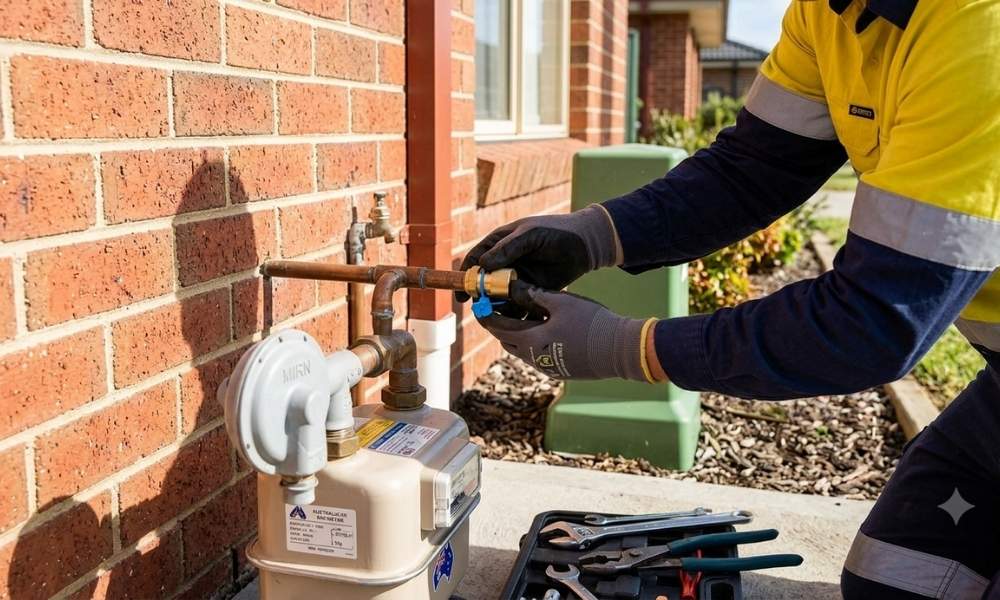
Never attempt to remove a gas meter yourself. Jemena explicitly warns that only authorised personnel should perform gas disconnection or abolishment work.
Step 6: Electrify the home
Depending on your needs, consider:
- Induction cooking
- Reverse-cycle air conditioning
- Heat-pump hot water
- Efficient electric appliances
- Rooftop solar
- Home solar battery storage
Use Energy Matters’ easy-to-use solar power and battery storage calculator to determine the size of your solar system with storage! Our solar calculator will generate performance information and potential savings.
We can send this information to 3 of our pre-vetted, trusted local installers in your area so they can provide obligation-free solar quotes and take the first step toward true energy independence!

For homeowners planning a broader transition, Energy Matters can help you explore home solar systems and solar panels as part of a more efficient household energy strategy.
Step 7: Confirm cancellation
After the physical work, check your next bill. Make sure the gas account is closed and the supply charge has stopped.
Expert tip
Treat gas cancellation as one part of a larger electrification project. Coordinating appliance replacement, hot water, solar, and electrical upgrades can yield better results than tackling each upgrade separately.
Common mistakes to avoid
1. Simply stopping gas usage
Zero consumption does not necessarily mean zero cost. A connected property can continue attracting supply charges.
2. Asking only for “disconnection”
In some networks, disconnection means temporary closure. If you want permanent removal, use the term abolishment where applicable.
3. Removing the meter yourself
Gas infrastructure is safety-critical. Use the retailer and authorised network personnel.
4. Ignoring shared gas infrastructure
Apartment buildings and strata properties can have shared gas services. Permanent removal from one property may not be technically equivalent to removing an entire building connection.
5. Forgetting gas hot water
Replacing a gas cooktop does not make a home gas-free if the hot-water system remains connected.
6. Comparing only the upfront fee
A $700 abolition may look expensive, but continuing to pay a $1-a-day supply charge costs approximately $365 each year.
7. Not checking the final bill
Always verify that your account has been closed and that future supply charges have stopped.
8. Electrifying without considering electricity demand
Replacing several gas appliances with electric models can increase electricity consumption. A whole-home energy assessment can help identify whether solar, batteries or efficiency improvements should be part of the plan.
For broader household improvements, explore energy efficiency strategies before selecting replacement equipment.

Ready to upgrade your appliances and take your energy savings to the next level?
Energy Matters believes that understanding and utilising these new energy ratings in Australia is a crucial step towards a greener home. By prioritising home appliance efficiency, you can reduce your energy bills and minimise your environmental footprint.
Energy Matters recommends switching to energy-efficient appliances now for smarter savings and a more environmentally friendly lifestyle.
Expert tip
If you are installing solar as part of your transition, use an appropriately qualified professional. The Clean Energy Council’s consumer guidance states that Approved Solar Retailers use Solar Accreditation Australia (SAA) Accredited Installers and emphasises the importance of appropriate accreditation for safe system design and installation.
Frequently asked questions
1. How do I cancel my gas connection in Australia?
Contact your gas retailer and request either a temporary disconnection or permanent abolishment. If you want to permanently stop paying gas supply charges, ask whether permanent abolishment is available at your property and request a complete itemised quote.
2. Can I remove my gas meter in Australia?
Yes, gas meters can be removed as part of authorised network work, but customers should not remove them themselves. Depending on the state and network, meter removal may be part of permanent abolishment or a separate service.
3. How much is a gas disconnection fee in Australia?
There is no single national gas disconnection fee. Charges vary by state, distributor, retailer, service type and property. Temporary disconnection is generally cheaper than permanent abolition, while complex work may require an individual quote.
4. Does cancelling gas save money?
It can. Once the gas connection is permanently abolished, you can generally avoid the ongoing gas supply or availability charge. The financial benefit depends on the connection fee, daily supply charge, gas usage and the cost of replacement electric appliances.
5. Is it worth getting off gas permanently?
For many households, removing permanent gas can make sense once all gas appliances have been replaced. The decision should consider appliance replacement costs, electricity consumption, solar generation, supply charges, safety and your expected time in the property.

Key takeaways
- Induction cooktops are more energy-efficient than gas (85–90%+ vs 32–40%) and generally cheaper to run, especially with solar.
- Victoria has banned new gas connections for homes requiring a planning permit since 1 January 2024, with more states expected to tighten rules over time.
- Rebates for switching are available through VEU (VIC), the Energy Savings Scheme and Home Energy Saver (NSW), and numerous local councils.
- A full kitchen switch typically costs $2,000–$8,000 and pays for itself in about 3–5 years.
- Gas cooktops emit combustion by-products that contribute to indoor air quality concerns, including a measurable association with childhood asthma.
Make your home more efficient after cancelling gas
Cancelling gas is often the final step in a broader home-electrification journey rather than an isolated energy decision. Once gas appliances have been replaced, the next opportunity is to make your electricity supply work harder through efficiency improvements, solar generation and smarter energy use.
Energy Matters can help homeowners investigate the next stage of that transition, from solar quotes and home solar systems to solar hot water systems and EV chargers.
Powering up your EV with solar
If you’re thinking of buying an EV, adding an EV charger to your solar system is a smart way to “fuel” your car with clean, renewable energy.
Ready to take control of your home energy?
If you’re ready to get off gas permanently, don’t stop at cancelling the connection. Talk to Energy Matters about your home’s solar and electrification options, request a tailored solar quote, and take the next step towards a more efficient home in Australia.
Sources and References
- Australian Government: Household Electrification: Australian Government: Electrification
- Australian Government: Low Energy Buildings Implementation Plan 2026–27
- Victorian Government: Victorian Government: Disconnecting from Fossil Gas
- Jemen: Jemena: Gas Disconnections & Abolishments | Jemena: 2025–30 Access Arrangement
- South Australian Government / ESCOSA: ESCOSA Energy Consumers
- Australian Energy Regulator: Australian Energy Regulator
- Clean Energy Council: Clean Energy Council