
Australia leads the world in rooftop solar adoption, with over 3.6 million homes generating clean energy. As electric vehicles (EVs) rapidly fill Aussie driveways, homeowners are looking at V2H vs V2G vs V2L Australia technologies to transform their cars into giant mobile batteries.
Understanding how to store and share this energy can drastically cut your electricity bills and protect your home during power outages. Explore current EV models to see which vehicles support these cutting-edge features today.
Powering up your EV with solar
If you’re thinking of buying an EV, adding an EV charger to your solar system is a smart way to “fuel” your car with clean, renewable energy.
Key takeaways
- V2H is focused on supplying your home from your EV.
- V2G enables controlled energy export to the electricity grid.
- V2L provides portable electricity directly to appliances.
- Compatibility between the EV, charger, electrical system and energy provider is essential.
- Australia’s V2G market is developing rapidly, but requirements and availability vary by location.
What are V2H, V2G and V2L, and why do they matter for Australian homes?
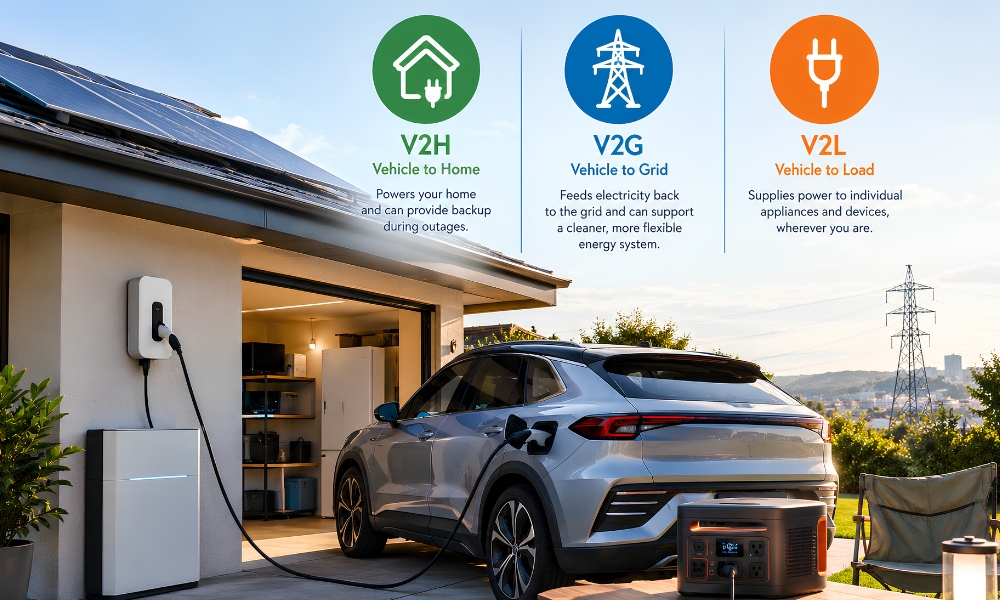
The terms describe different ways an EV battery can supply electricity. The important distinction is where the stored energy goes: your home, the grid, or a connected electrical load.
ARENA’s National Roadmap for Bidirectional EV Charging identifies bidirectional charging as an emerging opportunity for Australian consumers and the wider electricity system. Its roadmap highlights interoperability, standards, consumer value and smart-grid integration as important requirements for commercial adoption.


Key terminology
- Vehicle-to-Home (V2H) allows an EV battery to supply electricity to a house through compatible bidirectional charging equipment.
- Vehicle-to-Grid (V2G) takes the concept further by allowing controlled electricity export to the electricity network.
- Vehicle-to-Load (V2L) is different. Rather than feeding a home’s electrical system or the grid, the EV supplies compatible appliances through a vehicle outlet or V2L adapter.
Why it matters in 2026
Australia is developing the market for bidirectional EV charging, but compatibility remains critical. ARENA’s 2026 Vehicle-Grid Network work continues to identify interoperability testing, certification, cybersecurity and vehicle-maker participation as important requirements for wider V2G deployment.
Integrating your EV with home solar systems creates an intelligent, self-sustaining energy ecosystem.
Expert tip
Do not assume an EV advertised as “bidirectional” automatically supports every application. Check the exact vehicle, charger, software, electrical installation and network requirements.
How V2H, V2G and V2L work in Australia
Step-by-step
A typical V2H setup can work like this:
- Rooftop solar generates electricity during the day.
- Excess solar charges the compatible EV.
- A bidirectional charger controls electricity flowing from the EV back to the home.
- Stored energy can help supply household loads later.
- Where the system is designed and approved for backup operation, the EV may also provide power during an outage.
With V2G, the energy-management system can coordinate charging and discharge according to electricity prices, network requirements or an approved Virtual Power Plant (VPP) arrangement in Australia. AEMO’s forecasting work recognises V2H and V2G as emerging charging categories and accounts for the fact that vehicles are not always available because they are being driven.
With V2L, the process is much simpler. Plug a suitable appliance, camping setup, power tool or other compatible load into the EV’s V2L outlet or adapter.
Real-world examples
Imagine an Australian household with rooftop solar and an EV. V2H could let the household use stored solar energy after sunset, while V2G could potentially let the EV participate in an energy service that exports electricity when permitted.
V2L is more practical for portable applications, such as powering equipment at a campsite or providing temporary electricity to appliances where appropriate.
Expert tip
If your main objective is blackout resilience, investigate V2H and the complete backup architecture. Don’t automatically treat V2L as a substitute for a compliant whole-home backup system.

Costs and savings
The economics depend heavily on the EV, charger, switchboard, solar system, electricity tariff and whether the installation can participate in a VPP or other energy program.
Indicative costs
| Feature | V2H | V2G | V2L |
| Main purpose | Power your home | Export to grid | Power appliances |
| Dedicated bidirectional charger | Usually required | Required | Usually no |
| Grid export | No | Yes | No |
| Whole-home backup potential | Yes, if correctly configured | Not inherently | No |
| Portable power | Limited | Limited | Yes |
| Indicative additional equipment | Around $6,000 to $10,000+ for compatible bidirectional charging, installation dependent | Around $6,000 to $10,000+ where suitable equipment is available | Often included with vehicle or requires an adapter |
| Market maturity in Australia | Emerging | Emerging and expanding through trials | Available on selected EVs |
| Main financial opportunity | Avoid purchased electricity | Energy-market/grid-service participation | Avoid buying separate portable power equipment |
These are indicative figures rather than quotes. Energy Matters’ published V2H guidance similarly places compatible bidirectional charger costs in the several-thousand-dollar range.
Savings calculation
For V2H, a simple calculation compares the cost of electricity avoided with the cost of installing the system. The value can increase when solar energy would otherwise receive a low feed-in tariff and the household can use that stored energy later.
V2G has a different equation because potential value can include export payments, demand-response incentives or VPP participation. However, income is not guaranteed and depends on the retailer, aggregator, network, market rules and availability of compatible equipment.
Payback period
There is no universal V2H or V2G payback period. A household with high evening electricity consumption, solar generation and a suitable EV may achieve greater value than a household that drives most days and rarely has the vehicle available at home.
Expert tip
Calculate the value using your actual electricity consumption, solar generation, tariff and driving pattern rather than assuming the EV battery will replace a home solar battery storage one-for-one.
Use Energy Matters’ easy-to-use solar power and solar battery storage system calculator to determine the right size for your solar system with storage. Our solar calculator will generate performance information and potential savings.
We can send this information to 3 pre-vetted, trusted local installers in your area so they can provide obligation-free solar quotes and help you take the first step toward true energy independence!

State-by-state considerations
Victoria: The Victorian Energy Upgrades program provides incentives or discounts for selected energy-saving products, while the Solar Homes program provides eligible households with solar-related support. Check current eligibility before including any incentive in a V2H business case.
New South Wales: NSW offers programs that support EV adoption and energy upgrades. The Home Energy Saver program can provide eligible households with a discount of up to $4,000 or a zero-interest loan of up to $15,000 for specified upgrades, including EV chargers.
Queensland: Queensland’s EV transition includes fleet and charging initiatives, but homeowners should distinguish general EV or charger support from incentives specifically covering bidirectional equipment.
South Australia: SA has particularly relevant technical requirements. Its 2025 EVSE guideline states that chargers installed after 1 July 2024 must have specified smart-charging capabilities, and the principles also apply to equipment capable of vehicle-to-grid discharge.
Western Australia: WA’s Residential Battery Scheme currently excludes EVs from its battery rebate because EV-to-grid connections remain under development. WA has nevertheless conducted V2G trials, including an Exmouth trial led by Horizon Power.
For the latest rebates and incentives, check Energy Matters’ energy rebates guide and the Australian Government’s current rebates and assistance information.
V2H vs V2G vs V2L comparison
| Question | V2H | V2G | V2L |
| Where does power go? | Home | Electricity grid | Individual loads |
| Best suited to | Solar households and backup | Grid participation and flexible energy use | Portable power |
| Can support blackout backup? | Yes, with suitable system | Not automatically | Only individual connected loads |
| Bidirectional charger? | Yes | Yes | Generally no |
| Requires grid participation? | No | Yes | No |
| Key consideration | Home electrical integration | Approvals, market access and compatibility | EVs’ V2L output and load limits |
In simple terms, the difference between V2H and V2G is destination and purpose: V2H keeps energy within the home, while V2G can export energy to the grid. V2G differs from V2L in that V2G interacts with the electricity network, while V2L supplies appliances directly.
V2H and V2L also differ significantly. V2H is an integrated home-energy application, whereas V2L is essentially portable electricity from the EV.
How to get started
- Check your EV. Confirm whether it supports V2H, V2G, V2L or more than one function. Energy Matters’ current EV models guide can help with the initial shortlist.
- Check charging equipment. Review Energy Matters’ types of EV chargers.
- Assess your switchboard and home. A qualified installer should determine whether you need electrical upgrades.
- Check network and retailer requirements. V2G has additional export and participation considerations.
- Compare tariffs and incentives. Current programs can change, so verify eligibility before committing.
- Compare quotes. Get system-specific pricing rather than relying on generic online estimates.
Expert tip
Think about your primary objective first. Backup power, electricity bill management, grid participation and portable power can lead to four very different system designs.
Common mistakes to avoid
- Assuming every EV supports bidirectional charging.
- Buying a charger before confirming vehicle compatibility.
- Treating V2L as whole-home backup.
- Assuming V2G export is automatically permitted.
- Ignoring switchboard, wiring and protection requirements.
- Calculating savings without considering battery availability and driving needs.
- Assuming government rebates cover every type of bidirectional equipment.
- Choosing technology without checking warranty and manufacturer conditions.

Frequently asked questions
Is V2H better than V2G for a home?
V2H and V2G serve different purposes. V2H is designed to use an EV battery within the home, while V2G enables controlled export to the electricity grid. The appropriate option depends on your energy goals, equipment and local requirements.
What is V2L explained simply?
V2L means Vehicle-to-Load. It lets a compatible EV supply electricity directly to appliances or equipment, usually through an onboard outlet or adapter, without a dedicated bidirectional home charger.
Does V2G work in Australia?
V2G is progressing through Australian trials and early deployments, but availability depends on compatible vehicles, chargers, networks, standards and participating energy providers. ARENA expanded a major V2G project in 2026 from 50 to 1,000 participating households.
Can V2H replace a home battery?
An EV can provide substantial stored energy, but it is not automatically a direct replacement for a home battery. Vehicle availability, compatible charging equipment, backup configuration, warranty conditions and household energy requirements all matter.
What is the difference between V2H and V2G?
V2H sends stored EV energy to your home, while V2G sends electricity to the grid under an appropriate grid-connected arrangement. V2H primarily focuses on household energy use and backup, while V2G can also provide grid services.
Choose the right EV energy solution for your home
The choice between V2H, V2G and V2L starts with what you actually want your EV to do. V2H can support household energy management and backup, V2G is designed for grid interaction, and V2L offers straightforward portable power.
Australia’s bidirectional charging ecosystem is still developing, so independent assessment and current compatibility information matter. ARENA’s national roadmap and ongoing trials show that the technology is progressing, while regulatory and technical requirements continue to evolve.
Ready to explore your options? Get free solar quotes from SAA-accredited installers through Energy Matters and compare an EV charging and home-energy solution suited to your property.
Source and References
- ARENA (Australian Renewable Energy Agency): National Roadmap for Bidirectional EV Charging in Australia, Vehicle Grid Network – Industry Roundtable 2 Insights Report, ARENA expands Amber project to accelerate vehicle-to-grid rollout in Australia, National Roadmap for Bidirectional EV Charging in Australia
- Department of Infrastructure, Transport, Regional Development, Communications, Sport and the Arts: Bureau of Infrastructure and Transport Research Economics Statistical Report
- AEMO: Draft 2026 Forecasting Assumptions Update December 2025
- Department of Climate Change, Energy, the Environment and Water: Home Energy Saver, Government of South Australia: Technical Regulator Guideline, Rebates and assistance
- Government of Western Australia: WA Residential Battery Scheme