



Australian households increasingly want to manage electricity costs without sacrificing comfort. While solar panels and home batteries can reduce reliance on the grid, artificial intelligence (AI) adds a new layer of control, helping households decide when to generate, store, and use electricity. For homeowners exploring ways to manage household energy more efficiently, the opportunity to reduce electricity bills in Australia is becoming an important part of the clean energy conversation.
From intelligent battery charging to automated air conditioning, AI-powered energy management can make everyday electricity use more flexible.
Quick answer
- AI can help lower household electricity costs by learning when a home uses power, predicting solar generation and automatically scheduling appliances, batteries and EV charging.
- Solar and battery owners have the most opportunities to benefit, particularly when their energy management system can respond to electricity prices, weather forecasts and household demand.
- Savings depend on your energy plan, equipment and habits. AI does not automatically make electricity cheaper, but it can help households use more of their own solar power and avoid expensive consumption periods.


What is AI and why should Australian homeowners care?
Artificial intelligence in home energy management refers to software that analyses electricity consumption, solar generation, weather conditions and, where available, electricity prices to make smarter decisions about energy use. Unlike a basic programmable timer, an AI-enabled system can adapt its operating schedule as conditions change.
For Australian households, this is particularly relevant because rooftop solar, batteries, electric vehicles (EVs) and smart appliances are becoming increasingly common. The opportunity is not simply to generate more electricity, but to use it at the right time and reduce unnecessary grid purchases.
Powering up your EV with solar
If you’re thinking of buying an EV, adding an EV charger to your solar system is a smart way to “fuel” your car with clean, renewable energy.
Expert insight
The CSIRO’s 2026 FlexCost analysis highlights flexible electricity demand, including smart battery and EV charging, as an important part of a lower-cost energy system. For homeowners, the practical takeaway is that managing when you use electricity can be as important as reducing how much you use.
The key facts
- AI can forecast household energy demand and expected solar generation.
- Smart systems can schedule flexible appliances, such as pool pumps, hot water systems and EV chargers.
- Compatible batteries can charge and discharge according to household needs, solar availability, and electricity tariffs.
- Some systems can participate in virtual power plants (VPPs), coordinating household batteries to support the wider electricity network.
- AI is not a substitute for efficient appliances, adequate insulation or a well-designed solar system.
The term smart energy AI covers a range of products, from relatively simple automated controls to sophisticated energy management platforms. Homeowners should check exactly which features a product offers rather than assuming every system uses machine learning or makes independent decisions.
Why this matters right now in Australia
Australia has a large and growing base of rooftop solar installations. In September 2026, The Guardian reported that rooftop solar supplied more than half of national electricity demand during a record period when solar and wind together met 80.4% of demand on the National Electricity Market. The report also noted that more than 4.3 million Australian households had rooftop solar.
However, abundant daytime solar does not necessarily translate into low household bills. Homes that cannot use or store their excess generation may export it for a relatively small feed-in credit, then buy electricity again in the evening when demand and prices may be higher.
The Australian Energy Regulator’s 2026–27 Default Market Offer also illustrates why timing matters. From 1 July 2026, standing-offer prices fell in several regions, but the change varied by state and tariff type. The regulator’s benchmark is not a guarantee that every household’s market offer will fall by the same amount.
How AI can reduce electricity bills in Australia
AI-based home energy management combines information from connected devices, sensors and energy retailers to optimise the timing of electricity consumption. The system’s effectiveness depends on how much control it has over the household’s energy equipment and how accurately it can predict future conditions.
How the technology works
A typical system follows five steps:
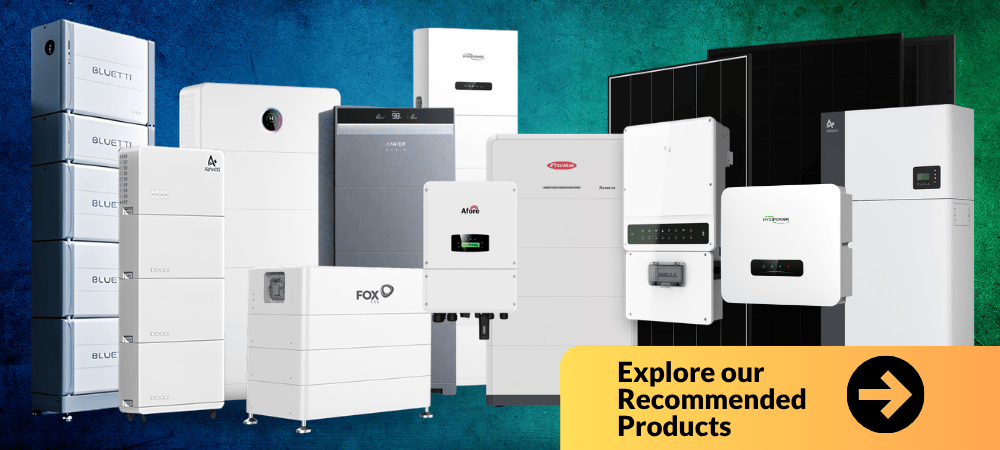
- Collects information: Smart meters, solar inverters, batteries and connected appliances provide data on electricity use and generation. Check our page for our recommended solar products.
- Learns household patterns: Machine-learning home energy software may identify when occupants typically use heating, cooling, hot water, and other appliances.
- Predicts future conditions: Weather forecasts and historical data help estimate solar output, energy demand and, where supported, electricity prices.
- Makes operating decisions: The system may recommend or automatically schedule charging, heating, cooling and battery operation.
- Adjusts its approach: It can use new consumption data and changing conditions to refine future schedules.
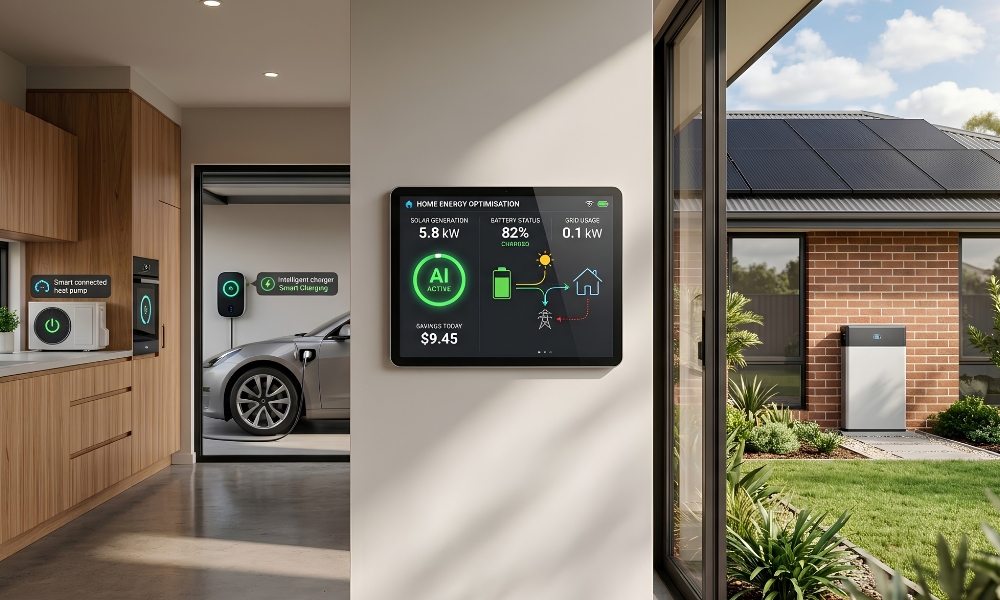
For example, on a sunny weekday, an AI-enabled system could forecast that a household will generate excess solar power around midday. It might then schedule the EV charger and hot water system to use that surplus rather than drawing electricity from the grid later.
This is a form of AI electricity optimisation. However, the actual automation depends on the equipment, software permissions, tariff rules and any minimum battery reserve settings.
Australian examples and data
The Australian electricity market is increasingly accommodating flexible consumer energy resources, including rooftop solar, batteries and EVs. AEMO’s flexible trading arrangements are intended to support more ways for customers and service providers to manage, share and trade electricity from these resources.
One example is a household with rooftop solar, a battery and a compatible smart energy controller. The system may prioritise household consumption during daylight, store excess generation for evening use and maintain a chosen battery reserve for backup.
Another example is an EV-owning household on a time-of-use tariff. A compatible system can schedule vehicle charging during lower-priced periods or when excess solar is available, subject to the driver’s departure time and the vehicle’s charging requirements.
The CSIRO’s June 2026 FlexCost report identifies coordinated batteries, smart EV charging and flexible appliance use as important demand-side resources. It also reports that more than 500,000 home batteries had been deployed in Australia, while participation in VPPs remained limited and uneven.
Use Energy Matters’ easy-to-use solar power and solar battery storage system calculator to determine the right size for your solar system with storage. Our solar calculator will generate performance information and potential savings.
We can send this information to 3 pre-vetted, trusted local installers in your area so they can provide obligation-free solar quotes and help you take the first step toward true energy independence!

Expert insight
A smart system is only as useful as the equipment and tariff it can work with. Before investing in AI controls, homeowners should confirm that the controller can communicate with their inverter, battery and major appliances, and that its operating strategy matches their retailer’s pricing structure.
What does AI mean for your electricity bills?
The financial benefits of AI-enabled energy management come from reducing unnecessary grid consumption, using stored energy effectively and taking advantage of suitable electricity tariffs. Potential savings vary considerably, so don’t promise a specific dollar figure without analysing a household’s consumption and tariff.
Short-term impact
In the first few months, homeowners may notice changes in when their appliances operate and how much electricity they import from the grid. A properly configured system can shift flexible loads to periods when solar generation is high, or electricity is cheaper.
Potential short-term benefits include:
- Using less grid electricity for daytime appliances when solar generation is available.
- Lower exposure to peak-period rates when battery storage and tariff settings are suitable.
- More convenient appliance operation through automated schedules.
- Better visibility of energy consumption through monitoring dashboards.
- More informed decisions about whether to change electricity plans.
The system may also reveal that some household energy use is not flexible. Refrigerators, essential medical equipment and other continuously operating devices cannot simply be switched off when prices rise.
Long-term implications
Over time, artificial intelligence energy savings may come from more consistent energy habits and better coordination between household equipment. A system that continually learns consumption patterns may improve scheduling without requiring homeowners to adjust daily.
The value of that automation becomes more apparent as households add technologies such as EVs, heat pumps and home batteries. Nevertheless, savings must be weighed against the cost of additional hardware, software subscriptions, battery degradation and any fees or restrictions attached to a VPP contract.
A battery that is repeatedly charged from the grid at expensive times or discharged before the household’s evening peak can undermine the expected financial benefits. Homeowners should therefore review system performance against actual bills, not just the energy app’s estimated savings.

Comparing energy management options
| Option | Main function | Potential bill benefit | What to consider |
| Basic energy monitor | Displays electricity consumption | Helps identify waste and high-use appliances | Usually requires the homeowner to act |
| Programmable smart controls | Runs appliances to a schedule | Shifts flexible loads into solar or cheaper periods | Schedules may not adapt to changing conditions |
| AI-enabled energy management | Predicts and adjusts energy use | Can improve the timing of consumption and storage | Requires compatible equipment and reliable data |
| Solar and battery system | Generates and stores electricity | Reduces electricity purchased from the grid | Upfront cost, system size and battery efficiency |
| Virtual power plant | Coordinates participating batteries | May provide incentives or payments for battery participation | Contract terms, availability and control over stored energy |
Expert insight
The Australian Energy Regulator’s 2026–27 price decision demonstrates that electricity prices and their changes differ across regions and tariffs. AI can help respond to price signals, but actual savings depend on your plan and how the system is configured.
What Australian homeowners can do right now?
You do not need to replace every appliance or install a complex automation system to benefit from smarter energy management. Start by understanding your household’s electricity use, then decide which activities you can shift to cheaper or solar-rich periods.
Actionable steps
- Review your electricity bills and usage data.
Check your current usage, supply charges, peak and off-peak rates, and solar feed-in tariff. If you have a smart meter, ask your retailer how to access interval consumption data, which can show when your home uses the most electricity. - Identify appliances with flexible operating times.
Pool pumps, dishwashers, washing machines, EV chargers and some hot water systems can often operate outside peak periods. Check the manufacturer’s instructions and household requirements before automating them. - Consider a compatible home energy management system.
A home energy management system (HEMS) can coordinate equipment through a central controller or cloud-based platform. Compare the system’s compatibility, data access, automation features and ongoing fees before purchasing. - Make the most of existing rooftop solar.
If you already have solar panels, identify how much excess generation you export during the day. Moving suitable electricity use into those hours can improve self-consumption without necessarily needing a battery. - Assess whether a battery makes financial sense.
A battery may allow you to store surplus solar energy for use after sunset. Compare the installed price, usable capacity, round-trip efficiency, warranty, expected cycling and available incentives before committing. - Review your system’s results every few months.
Compare your actual grid imports, exports and bills against the period before automation. Consider seasonal changes, weather, tariff changes and household occupancy when interpreting the results.
Embrace the energy-efficiency revolution by upgrading your solar system with Energy Matters, adding a battery, solar inverters, and more.
Energy Matters recommends switching to energy-efficient appliances now for smarter savings and a more environmentally friendly lifestyle.
Questions to ask your installer or retailer
Before investing in AI home energy management in Australia, ask:
- Does the system support my existing inverter, battery, smart meter and appliances?
- Does it use actual machine learning, rule-based automation or a combination of both?
- Can I set minimum battery reserves and override automatic decisions?
- Does the controller optimise for my current electricity tariff and feed-in rate?
- Can it schedule my EV charger, hot water system and air conditioning?
- Is there a monthly software fee or a separate charge for cloud services?
- What happens if my internet connection or the manufacturer’s cloud platform goes offline?
- How does the system protect my energy consumption data?
- Can I change retailers or VPP providers without losing key features?
- What evidence can the installer provide to support any projected savings?
Get an AI-ready solar and battery system
Planning an upgrade? Compare suitable solar and battery options, then ask an accredited installer about compatible smart energy controls and your household’s potential savings.
Expert reference: The Clean Energy Council provides consumer information and guidance on choosing solar and battery equipment. Check product approval and installer credentials before proceeding.
State-by-state considerations
Electricity tariffs, network arrangements and household incentives differ across Australia.
| State | What homeowners should consider |
| Victoria (VIC) | Check the Victorian government’s current solar and battery support arrangements, retailer offers and applicable distribution network requirements. |
| New South Wales (NSW) | The state has a battery incentive framework that includes VPP participation. Eligibility, battery size limits and contract conditions matter. |
| Queensland (QLD) | Check current state energy programs, electricity tariffs and distributor requirements, particularly if you want to automate exports or battery operation. |
| South Australia (SA) | Consider time-of-use pricing, solar export conditions and any applicable battery or VPP arrangements. Smart controls may help manage consumption timing. |
| Western Australia (WA) | The South West Interconnected System has different market arrangements from the National Electricity Market. Check Synergy tariffs, export limits and applicable state programs. |
Expert predictions for 2027 and beyond
The next stage of smart home energy will likely involve closer coordination between batteries, EVs, flexible appliances, and electricity retailers. The focus will increasingly be on enabling households to respond to changing grid conditions while retaining control over their own energy needs.
AEMO and the Australian Government are developing demand-side planning work to better understand how household resources can contribute to a lower-cost electricity system. AEMO’s first Demand-side Statement of Opportunities is scheduled for a draft report by the end of 2026 and a final report by mid-2027.
Several developments are worth watching:
- More integrated home energy platforms: Systems may increasingly manage solar, batteries, EV charging and flexible appliances through a single interface.
- Smarter electricity tariffs: As flexible trading arrangements develop, more households may be able to choose how their energy resources participate in the market.
- More virtual power plants: Aggregated household batteries may be used more actively to support the grid, although participation and payment conditions will vary.
- Better forecasting: Improved weather, demand and price predictions could make automated scheduling more responsive to changing conditions.
- More consumer protections and transparency: As automated systems become more involved in energy trading, clear contracts, privacy safeguards and understandable performance reporting will be important.
Expert insight
The main opportunity for homeowners is to treat AI as a practical management tool, rather than a guaranteed source of bill reductions. The strongest results will depend on reliable equipment, a suitable tariff, good energy efficiency and the ability to retain control over automated decisions.
Frequently asked questions
1. Can AI really reduce electricity bills in Australia?
Yes, AI can help reduce electricity costs by scheduling flexible appliances, improving solar self-consumption and managing compatible batteries. Savings depend on the home’s energy use, solar generation, electricity tariff, and system costs. AI is a management tool, not a guarantee of lower bills.
2. Do I need solar panels to use AI home energy management?
No. Some smart energy management systems can monitor grid electricity use and automate compatible appliances without rooftop solar. However, households with solar panels and batteries may have more opportunities to benefit because they can coordinate generation, storage and consumption.
3. How much can an AI energy management system save?
No single reliable savings figure applies to all Australian households. Savings depend on existing consumption, tariffs, equipment and the amount of flexible electricity use. The ACCC reported in July 2026 that households with solar and batteries had annual bills around $329 to $909 lower than grid-only customers, but these figures are not AI-specific savings estimates.
4. Can AI automatically control my solar battery?
Some compatible systems can automatically manage battery charging and discharging based on solar forecasts, household demand, and electricity prices. The homeowner may be able to set operating preferences, such as minimum backup reserves. Check the battery manufacturer’s compatibility list and the controller’s available settings before purchasing.
5. Is AI home energy management available across Australia?
Yes, energy monitoring, smart controls and compatible home energy management systems are available to Australian households, although product availability and retailer integration vary. The electricity market arrangements in WA also differ from those in the National Electricity Market, so homeowners should check local compatibility and tariffs.
6. Will AI replace the need for a home battery?
No. AI can optimise how existing equipment operates, but it cannot store electricity without a storage device. Households may still benefit from automated appliance scheduling without a battery, particularly when they have rooftop solar or a suitable time-of-use tariff. Whether a battery is worthwhile depends on its cost and the home’s energy needs.
Key takeaways
- AI can help lower electricity costs by shifting flexible consumption to periods with available solar power or cheaper electricity.
- Solar and battery compatibility matters. Before upgrading, check whether your existing equipment can communicate with the energy management system.
- Your electricity tariff determines much of the potential value. Review peak rates, off-peak rates, supply charges and solar feed-in credits.
- Government incentives can reduce battery installation costs. Check the current federal Cheaper Home Batteries Program and applicable state schemes before signing a contract.
- Measure real results. Compare actual electricity bills and grid imports over time, accounting for weather, seasonal changes and household usage.
The bottom line
AI is creating new ways for Australian homeowners to manage electricity consumption, coordinate solar and battery systems and make more informed energy decisions. While the technology cannot guarantee savings, it can help households get more value from their existing equipment and prepare for increasingly flexible electricity markets.
For homeowners considering their next energy upgrade, start with a system designed around their actual consumption, tariff, and future needs. Contact Energy Matters today to explore your solar and battery options, compare quotes and take the next step towards a smarter, more efficient home.
Get a free solar and battery quote
Find out how an appropriately sized solar and battery system, with smart energy management, can help reduce your household’s electricity costs.
Compare options from accredited Australian installers and ask about equipment compatibility, available incentives and realistic savings for your home.
Sources and References
- CSIRO: FlexCost analyses the cost of accessing consumer energy resources
(June 2026) - AEMO: Demand-side Statement of Opportunities
- Australian Energy Regulator: Final Default Market Offer 2026–27
- ACCC: Growing home battery uptake and consumer protections
- NSW Government: Residential battery incentives