


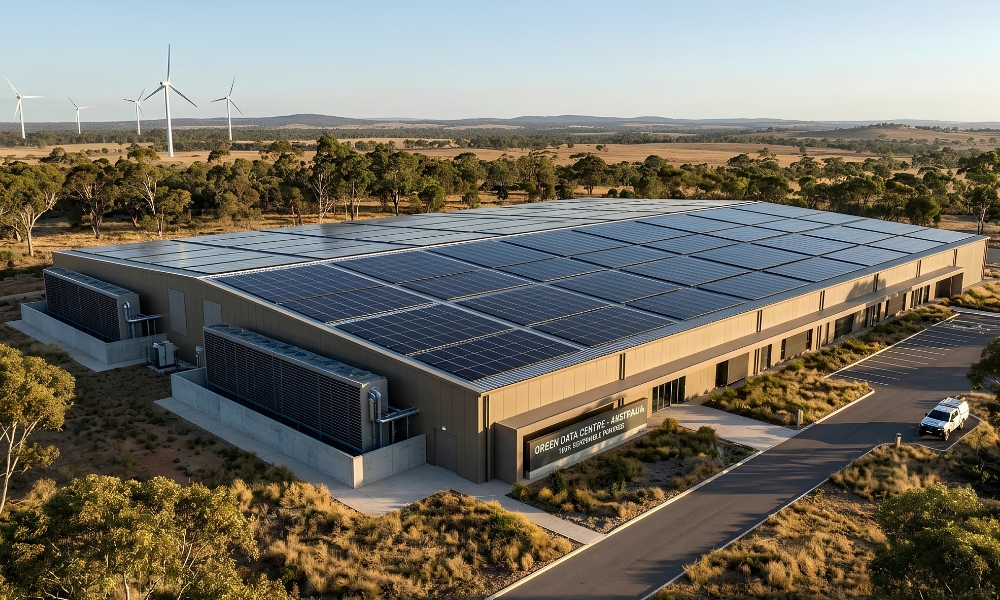
Australian data centres draw about 5 terawatt-hours of electricity a year, and the grid operator expects that to reach 34 TWh by 2035-36. That is why green data centres in Australia, and the renewable power behind them, now matter well beyond the tech sector. Much like commercial solar → helps a business lock in cheaper power, hyperscale operators are signing deals with new wind and solar farms to keep their servers running.
So who is genuinely powering their servers with renewables, and who is mostly making promises? This guide separates fact from marketing and explains what it means for your bills. Ready to cut your own power costs? Compare free solar quotes → with Energy Matters today.
Quick answer
- Australia’s expanding data centre industry is driving new electricity demand through cloud computing, artificial intelligence, and digital services.
- Google, Microsoft and Amazon Web Services are investing in renewable electricity and clean energy procurement to reduce emissions from their operations, including in Australia.
- For Australian households, the transition creates both challenges and opportunities, from pressure on electricity networks to potential growth in renewable generation, battery storage and energy infrastructure.


What are green data centres in Australia, and why should homeowners care?
A green data centre is a facility that stores and processes digital information while working to reduce its environmental impact. It typically combines renewable electricity, energy-efficient → computing equipment, advanced cooling, responsible water use and measures to manage electronic waste.
For green data centres in Australia, renewable energy is crucial because a facility can be highly efficient yet still contribute to emissions if it relies on fossil-fuel electricity.
Energy Matters perspective: Understanding where electricity comes from is essential to Australia’s clean energy transition, whether the consumer is a household or a hyperscale technology company. Explore energy efficiency solutions → that can help reduce electricity use at home.
Energy Matters recommends switching to energy-efficient appliances → now to save money and live more sustainably.
The key facts
According to the Australian Energy Market Operator (AEMO), Australia had 162 operational data centres nationally in its 2026 reporting, with most concentrated in Sydney and Melbourne. Data centres accounted for around 2% of grid-supplied electricity consumption, and demand is expected to rise significantly as AI workloads expand.
Why this matters right now in Australia
Data centres operate continuously, day and night, with an average load factor of 90%. This round-the-clock consumption draws power during midday peak generation hours and during tight evening periods.
As these tech companies buy up utility-scale renewable supply, grid network operators must accelerate storage deployment. Homeowners who understand these shift patterns can take full advantage of rooftop generation to shield their utility bills.
Expert insight: Assess renewable energy claims by looking beyond a company’s annual electricity purchases. The strongest approach supports additional clean generation, storage, and a more consistent low-carbon electricity supply when demand is highest.
How green data centres in Australia are powered by renewables
A renewable-powered data centre usually combines grid electricity with commercial agreements that support solar and wind power → projects. Some operators also invest in solar battery storage →, demand management and more efficient cooling to reduce their environmental footprint.
The distinction matters because a power purchase agreement does not necessarily mean that a particular facility receives solar electricity directly at every moment.
Use Energy Matters’ easy-to-use solar power and solar battery storage system → calculator to determine the right size for your solar system with storage. Our solar calculator will generate performance information and potential savings.
We can send this information to 3 pre-vetted, trusted local installers in your area so they can provide obligation-free solar quotes and help you take the first step toward true energy independence!

How the technology works
- Solar and wind generation: Renewable projects supply electricity to the grid. Long-term power purchase agreements, or PPAs, can provide revenue certainty that helps developers finance new generation.
- Battery storage and firming: Batteries store electricity when supply is plentiful and discharge it when demand rises. Other firming resources and grid connections help maintain reliability when renewable output fluctuates.
- Efficient computing and cooling: Efficient servers, better airflow, liquid cooling and intelligent workload management can reduce energy wasted on computing and temperature control.
Australian examples and data
Three global technology companies are particularly important to the Australian renewable electricity market.
Google data centre solar and renewable procurement
In 2023, Google announced a collaboration with AirTrunk and renewable developer OX2 to advance its sustainability goals and add renewable electricity to Australia’s grid. The company has also set a global target to match its electricity consumption with carbon-free energy every hour by 2030.
Microsoft renewable energy Australia
Microsoft signed a 15-year PPA for the Walla Walla Solar Farm in New South Wales, a project with approximately 300 MW of peak capacity. In July 2026, Microsoft said the agreement was fully operational and reiterated its commitment to supporting Australia’s energy transition.
Amazon AWS renewable energy
In April 2026, Amazon announced nine additional Australian renewable energy agreements, adding 430 MW of capacity across New South Wales and Victoria. The company said its portfolio would reach 990 MW across 20 projects once fully operational, including wind, solar and battery storage.
This investment supports its data centre and cloud infrastructure expansion, although contracted renewable capacity does not equal round-the-clock renewable supply at every facility.
Comparing renewable energy approaches
| Approach | Main benefit | Limitation |
| Solar PPAs | Adds renewable generation and supports project financing | Output falls at night |
| Wind PPAs | Can generate outside daylight hours | Output varies with weather |
| Solar plus batteries | Shifts some renewable electricity to later periods | Storage duration and capacity are limited |
| Grid electricity with certificates | Helps companies account for renewable purchases | Does not guarantee physical renewable supply at every hour |
| On-site solar and storage | Can reduce grid imports and support resilience | Land, roof area and storage capacity may be insufficient for large loads |
Expert insight: A credible, sustainable data centre strategy for Australia should measure electricity consumption, emissions, water use, and the timing of clean energy supply. Renewable certificates and annual matching can be useful, but they do not automatically eliminate fossil fuel generation from the grid.
What do green data centres mean for Australian electricity bills?
The expansion of data centres could affect household electricity bills, but the outcome depends on how new electricity generation, storage and network infrastructure are funded.
If large technology companies support additional renewable generation and pay to connect their facilities, they can help expand electricity supply without passing all costs to households. However, if demand grows faster than infrastructure, network congestion and higher wholesale prices could put pressure on consumers.
Short-term impact
Large data centres can require substantial upgrades to transmission lines, substations and local distribution networks. The costs of these upgrades, along with generation availability during peak demand, can influence electricity market outcomes.
In August 2026, the NSW Government released a Data Centre Policy Framework designed to address energy, water and environmental impacts. Its proposed regulatory reforms aim to ensure data centre operators fund the additional electricity infrastructure required to support their growth, rather than shifting those costs to households and small businesses.
Long-term implications
Well-planned investment could support new wind and solar farms →, battery storage, regional jobs and a more flexible electricity grid. It could also help developers finance projects that might otherwise struggle to secure long-term buyers.
Poorly coordinated expansion could have the opposite effect, particularly if new electricity demand outpaces renewable generation and network investment.
For households, the key question is not whether data centres use electricity, but whether their growth brings enough additional supply and infrastructure to serve everyone reliably and affordably.

What Australian homeowners can do right now?
Households cannot directly choose how a hyperscale data centre is powered, but they can take practical steps to improve their own energy independence.
Rooftop solar, appropriately sized batteries and efficient appliances can help reduce grid consumption. The right combination depends on household electricity use, roof orientation, local tariffs, and whether you use energy during the day or evening.
Actionable steps
- Review your electricity usage. Check your bills and smart meter data to identify when your household uses the most power.
- Assess rooftop solar. Review your roof’s suitability, shading, system size and expected generation before choosing equipment.
- Consider battery storage. A battery can shift daytime solar generation into the evening, especially where export payments are low and evening consumption is high.
- Improve energy efficiency. Efficient heating and cooling, insulation, and well-managed appliances can reduce how much electricity you need to buy.
- Compare retail electricity plans. Check daily supply charges, time-of-use rates, solar feed-in tariffs → and any battery or virtual power plant incentives.
- Plan for future electrification. If you expect to add an electric vehicle, heat pump → or induction cooktop, consider how these loads will affect your solar and battery requirements.
Energy Matters provides information to help Australians explore renewable energy options, including solar panels →, solar hot water systems → and EV chargers →.
Powering up your EV with solar
If you’re thinking of buying an EV, adding an EV charger to your solar system is a smart way to “fuel” your car with clean, renewable energy.
Questions to ask your solar installer or electricity retailer
Before investing, ask:
- How much electricity is my proposed solar system expected to generate across the year?
- What proportion of my household’s electricity use could solar cover?
- Would a battery provide enough additional savings to justify its upfront cost?
- What warranties, maintenance requirements and replacement costs apply?
- Am I eligible for state incentives, a virtual power plant or a demand-response program?
- How would changes to my electricity tariff affect the estimated payback period?
State-by-state considerations for green data centres in Australia
Data centre developments are concentrated in major technology and business hubs, but renewable energy availability, grid capacity, and planning rules vary by state.
The following overview reflects reported developments and policies as of October 2026. Some measures remain subject to implementation, consultation or further regulatory decisions.
| State | Renewable energy context | What households should know |
| Victoria (VIC) → | Strong wind and solar development, renewable energy zones and new data centre requirements | The Victorian Government announced in September 2026 that new data centres must bring their own renewable energy supply and storage. |
| New South Wales (NSW) → | Significant data centre investment, large-scale solar and wind, and battery projects | The NSW Data Centre Policy Framework sets expectations for additional energy and water infrastructure, with electricity cost-recovery reforms progressing. |
| Queensland (QLD) → | Strong solar resources and growing interest in large AI facilities | Grid capacity, regional infrastructure, water availability and the final design of national requirements will be important. |
| South Australia (SA) → | High renewable generation and growing use of storage to manage variability | Additional flexible demand and storage could help integrate new electricity loads, subject to local network capacity. |
| Western Australia (WA) → | A separate main electricity system, the South West Interconnected System, and substantial solar and wind potential | Renewable procurement and grid planning need to account for the state’s distinct electricity market and network conditions. |
Key takeaways
- Data centre demand is growing: AEMO estimates Australian data centres consumed 3.9 TWh of electricity in FY2025 and forecasts substantial further growth.
- Big technology companies are investing: Google, Microsoft, and Amazon are supporting renewable energy projects, with Amazon announcing a portfolio that will reach 990 MW of contracted renewable capacity once all 20 projects are operational.
- Renewable claims need context: Annual matching doesn’t guarantee a data centre runs entirely on renewable electricity every hour.
- Government policy is evolving: Federal and state initiatives increasingly focus on additional renewable generation, storage, infrastructure costs, and environmental impacts.
- Households can act today: Review electricity use, compare solar quotes, and assess battery suitability to make informed energy decisions.
Get started with smarter solar energy: Find the right solar and battery solution for your home
The future of green data centres in Australia: renewable energy depends on how effectively technology companies, governments and energy providers coordinate new electricity demand with clean generation, storage and reliable networks. Google, Microsoft and Amazon are helping finance renewable projects, while Australia’s emerging policy requirements could strengthen the link between digital infrastructure and additional clean energy supply.
For homeowners, this transition reinforces the value of understanding electricity use and exploring practical ways to reduce grid dependence. Energy Matters helps Australians compare renewable energy solutions and make informed decisions about solar and batteries.
Ready to take control of your energy costs? Get a free solar and battery quote from SAA-accredited installers through Energy Matters and explore the right solution for your home.
Sources and References
- AEMO: Digital demand surge, Australian data centre electricity demand and forecasts.
- Australian Government: AI infrastructure consultation, proposed national standards and renewable electricity requirements.
- NSW Government: Data Centre Policy Framework, planning, electricity and water expectations.
- Victorian Government: Data centre policy announcement, announced requirements for new data centres.
- Google: Australian renewable energy collaboration, renewable procurement.
- Microsoft: Walla Walla solar agreement, Australian solar investment.
- Amazon Australia: April 2026 renewable energy announcement, renewable project portfolio.
- ABC News: Data centre energy demand and the energy transition, Australian reporting on energy system concerns.
- The Guardian Australia: Renewable energy requirements for data centres, policy debate and proposed obligations.