




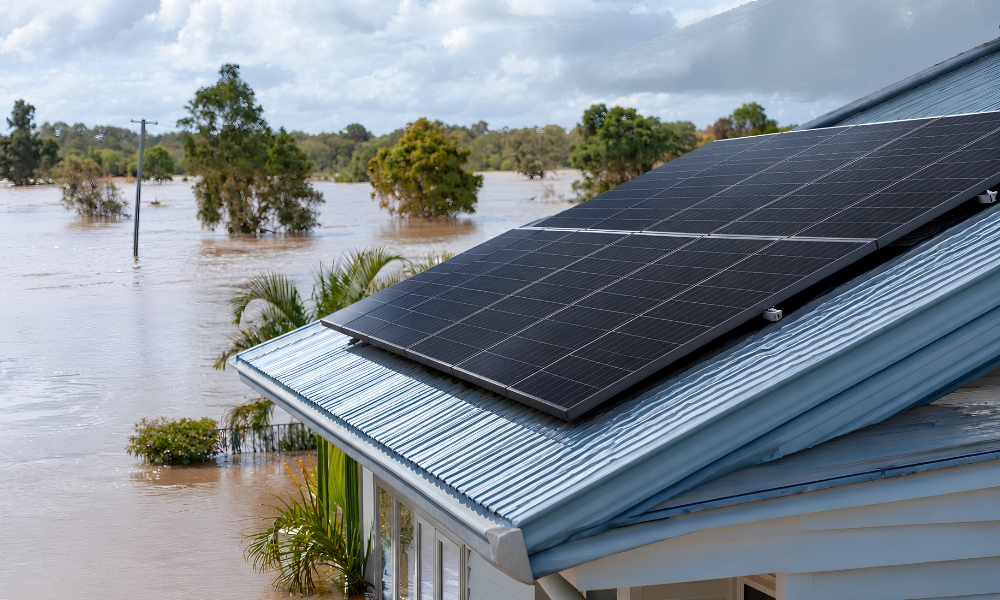
Australia’s increasingly costly flood disasters make flood-proofing solar panels in Australia an important consideration for homeowners, particularly those in flood-prone regions. Although no residential solar system can be guaranteed flood-proof, thoughtful design, appropriate equipment placement and a clear emergency plan can reduce damage and improve recovery.
For homeowners exploring home solar systems→, the goal is not simply to generate clean electricity. It is to build a system that suits the property’s local hazards and remains safe to maintain over its lifetime.
Quick answer: How can you protect solar panels from floods?
- Elevate vulnerable equipment. Where permitted and technically suitable, install inverters, battery systems, isolators and other electrical components above the property’s assessed flood level.
- Prioritise electrical safety. Floodwater can damage solar equipment even when panels remain on the roof. Never touch wet electrical equipment or attempt to restart a flooded system yourself.
- Plan before the next flood. Have a qualified installer assess local flood risk, mounting arrangements, drainage, equipment placement, and insurance requirements before you install or upgrade your system.



What is flood-proofing solar panels and why should Australian homeowners care?
Flood-proofing solar panels in Australia means designing, installing and maintaining a solar photovoltaic (PV) system to reduce the risk of flood-related damage and electrical hazards. It involves more than choosing waterproof panels. You also need to consider inverters, batteries, cabling, switchboards, mounting hardware, and the home’s electrical infrastructure.
The key facts: Flood-proofing solar panels in Australia
- Rooftop panels may sit above floodwater, but ground-level electrical equipment can still be inundated.
- Floodwater can carry sediment, salt, sewage and contaminants that accelerate corrosion or damage electrical connections.
- A system that looks dry or undamaged may still contain dangerous electrical faults.
- Elevating equipment helps reduce exposure, but it does not make a system completely flood-proof.
- Flood resilience depends on the property’s risk, system design, installation quality and post-flood inspection.
Expert insight: Consider flood resilience during system design, not as an emergency afterthought. The Australian Government’s climate change and flood risk guidance recommends accounting for future climate conditions when assessing flood risk.
How flood-proofing solar panels works in Australia
Flood-proofing a solar system combines appropriate equipment placement, sound electrical design, suitable mounting and a clear emergency response plan. The right approach depends on whether the property faces river flooding, flash flooding, coastal inundation, stormwater overflow or a combination of hazards.
Technical explanation
Solar panels generate direct-current electricity whenever sufficient light reaches them. Turning off the household supply does not necessarily make the panels or their wiring safe to touch.
A typical system includes several components with different flood vulnerabilities.
- Solar panels: Water exposure can damage modules, connectors, or cables. Debris impact and prolonged immersion can increase risk.
- Inverters: These convert the panels’ electricity into usable household power. Many are installed on external walls, in garages, or in other areas that may flood.
- Batteries: Floodwater can damage electrical and electronic components, compromise enclosures and create serious safety concerns, particularly with lithium-based storage systems.
- Switchboards and isolators: Water ingress can compromise insulation and protection devices, even after visible water has receded.
- Cabling and connectors: Damaged insulation, submerged connections, and corrosion can cause faults that are not immediately apparent.
An appropriate flood-resilient solar design may include relocating vulnerable equipment to higher, accessible locations, subject to manufacturer requirements and applicable electrical standards. Installers should also consider cable routes, mechanical protection, drainage, structural integrity and safe access for future maintenance.
Australian examples and data
The 2025 NSW floods demonstrate the scale of the challenge. Guardian Australia reported that flood damage affected an estimated 10,000 properties across affected areas, while more than 1,000 buildings were initially assessed as uninhabitable.
These figures are not solar-specific damage statistics. However, they show why property-level disaster planning needs to include household energy equipment.
The Clean Energy Regulator requires solar and battery installations that claim small-scale technology certificates to meet applicable standards, product, and accreditation requirements. Homeowners should ask their installer to explain the requirements that apply to their proposed system.
Expert insight: No single elevation height or equipment configuration suits every flood-prone home. A qualified installer should use local flood information and the property’s assessed risk rather than relying on a generic rule.


What does solar panel flood damage mean for your electricity bills?
Flood damage can affect household electricity costs in two ways. First, a damaged system may stop generating electricity, forcing the household to buy more power from the grid. Second, repairs or replacements may add unexpected costs.
Short-term impact
If floodwater damages an inverter or electrical protection equipment, households may need to keep solar generation switched off until the system is inspected and declared safe.
Households with solar batteries may also lose their stored-energy supply. Even a battery designed to provide backup power during an ordinary grid outage must not be assumed safe or functional after flooding.
Potential short-term costs include:
- Higher electricity bills while the system is offline.
- Electrician inspection and testing fees.
- Replacing damaged inverters, batteries, cabling, or switchboards.
- Temporary accommodation or other expenses where the home itself is affected.
- Insurance excesses and costs not covered by the policy.
Long-term implications
The cost of solar panel water damage depends on the extent of exposure, the components affected, the availability of replacement parts and the insurer’s assessment. A system may require partial repairs, extensive electrical work or complete replacement.
Preventive measures can cost less than major repairs, but homeowners should compare actual installation quotes rather than assume a particular upgrade will pay for itself. Elevating equipment, for example, may involve additional cabling, structural work and compliance checks.
Expert insight: A battery is not a flood-resilience guarantee. Ask whether backup power will be available during an outage, where the equipment is installed, and what happens if the battery or inverter is exposed to floodwater.
| Option | Potential benefit | Important limitation |
| Elevate vulnerable equipment | Reduces exposure to shallow floodwater | Must comply with electrical, access and manufacturer requirements |
| Install rooftop solar | Keeps panels away from many ground-level flood events | Roof damage, debris and submerged cables remain risks |
| Install a battery | Can provide backup during suitable outages | Flood exposure can make batteries unsafe or unusable |
| Improve drainage | May reduce local water accumulation | Cannot prevent major riverine or regional flooding |
| Review insurance | Clarifies financial protection and exclusions | Coverage varies by policy and circumstances |
Homeowners planning upgrades can also explore energy-efficiency improvements→ to reduce electricity demand while their solar system operates.
Energy Matters recommends switching to energy-efficient appliances→ now to save money and live more sustainably.
What Australian homeowners can do right now?
You do not need to wait for a flood warning to make your solar system more resilient. Start with a property risk assessment, then work through equipment placement, emergency procedures and insurance.
Actionable steps
- Check your property’s flood risk. Consult your local council’s flood maps, planning information and relevant state government resources. Consider overland flow and flash flooding, not just nearby rivers.
- Review existing equipment locations. Identify whether the inverter, battery, switchboard, isolators or cable connections could be exposed to floodwater.
- Request a professional assessment. Ask a suitably accredited solar designer or installer to assess whether relocating equipment or making other changes is practical.
- Review warranties and insurance. Ask your insurer about flood damage, electrical equipment, batteries, exclusions and evidence required for a claim. Check manufacturer warranties separately.
- Keep essential records accessible. Store installation certificates, equipment specifications, photographs, warranties and installer contact details in a safe location.
- Prepare an emergency plan. Know how to follow official evacuation advice and how to contact your electricity distributor and a licensed electrician.
- Arrange inspections after flooding. Do not restart equipment or assume it is safe because it appears dry.
The Clean Energy Regulator provides information on installer accreditation and compliance for solar and battery systems. Use Energy Matters’ easy-to-use solar power and solar battery storage system→ calculator to determine the right size for your solar system with storage. Our solar calculator will generate performance information and potential savings.
We can send this information to 3 pre-vetted, trusted local installers in your area so they can provide obligation-free solar quotes→ and help you take the first step toward true energy independence!
Questions to ask your installer or retailer about flood-proofing solar panels in Australia
Before signing a contract, ask:
- Have you checked the property's flood maps and likely inundation risks?
- Which system components could be exposed to floodwater?
- Can the inverter, battery and associated electrical equipment be positioned higher without compromising compliance or manufacturer requirements?
- What additional costs will flood-resilient installation involve?
- How will cables, mounting equipment and electrical connections be protected?
- What documentation will I receive after installation?
- What inspection and replacement procedures apply after a flood?
- Which flood-related costs does the equipment warranty cover, and which may require insurance?
State-by-state considerations for flood-resilient solar
Flood risk varies across Australia, and a flood-resilient solar installation should reflect local conditions. State government assistance programs, planning requirements and electrical safety guidance can also change, so verify current rules before starting work.
| State | Key flood considerations | Where to check |
| Victoria (VIC)→ | Riverine flooding, flash flooding and stormwater inundation | VIC emergency and electrical safety guidance |
| New South Wales (NSW)→ | Coastal catchments, river flooding and flash floods | NSW flood recovery advice |
| Queensland (QLD)→ | Intense rainfall, tropical lows, river flooding and coastal inundation | Queensland Electrical Safety Office |
| South Australia (SA)→ | River flooding, local drainage problems and coastal exposure | Bureau of Meteorology flood warnings |
| Western Australia (WA)→ | River and flash flooding, intense rainfall and local drainage issues | Bureau of Meteorology flood warnings |
Expert predictions for 2027 and beyond
Flood resilience will likely become a more important part of residential solar planning as Australia adapts to climate hazards, electrification, and growing battery adoption. The precise pace of change will depend on standards, building practices, insurer requirements and future government policy. Three developments deserve attention.
1. Greater emphasis on climate-aware design
The Australian Government's updated flood-risk guidance encourages consideration of future climate scenarios when assessing flood risk. This approach supports more informed decisions about equipment locations and a property's suitability for particular installations.
2. More attention to battery safety
Battery installations must meet applicable standards, product requirements, and state or territory rules. The Clean Energy Council's battery guidance references the introduction of SA TS 5398:2025, a technical specification for the safety of electrical energy storage equipment. Homeowners should check which requirements apply at the time of installation.
3. Better integration of solar, storage and home resilience
Homeowners will increasingly need to consider solar generation, storage, household electricity demand and emergency planning together. A properly configured battery may provide backup during some grid outages, but it will not necessarily operate during every outage and must never be used if flood exposure has made it unsafe.
Other technologies can complement this planning. A solar hot water system, efficient appliances and appropriately configured EV chargers may help households manage energy use, but each installation still needs to suit the property's physical conditions.
Explore solar hot water systems→ and EV chargers→ as part of a broader home energy plan.
Powering up your EV with solar
If you're thinking of buying an EV, adding an EV charger to your solar system is a smart way to "fuel" your car with clean, renewable energy.

Frequently asked questions about flood-proofing solar panels in Australia
1. Can solar panels survive a flood?
Solar panels may survive some flood events, especially if they stay above water and avoid impact damage. However, surviving visible inundation does not guarantee electrical safety. Floodwater can affect cables, connectors, inverters, and mounting structures, so a qualified professional should inspect the system before you use it again.
2. What happens if a solar inverter gets wet?
A flooded inverter may suffer insulation failure, corrosion or damage to internal electronic components. Do not touch, open, dry or restart the equipment yourself. Keep clear and arrange an inspection by a licensed electrician, who can determine whether the inverter can be safely repaired or must be replaced.
3. Should I turn off my solar system before a flood?
Follow emergency advice and the shutdown procedure provided for your particular system, but never enter floodwater or approach wet electrical equipment to operate a switch. Solar panels can continue generating electricity in daylight. Your safety comes first, so evacuate when instructed and leave electrical isolation to qualified professionals where necessary.
4. Are solar batteries safe after being submerged?
Treat a submerged battery as potentially hazardous, even if its casing appears intact. Floodwater can compromise electrical components and create risks that are not immediately visible. Do not touch, charge or restart it. Contact emergency services if there is an immediate danger, and seek advice from the relevant emergency authority and qualified battery professionals.
5. Does home insurance cover solar panel flood damage?
Coverage depends on your policy, the flood circumstances, and the equipment insured. Some policies cover solar panels and batteries as part of the building, while others may have specific conditions, limits or exclusions. Contact your insurer before installation to clarify cover, excesses, replacement costs and the documentation needed to support a claim.
Key takeaways
- Assess flood risk before installation. Check local council maps and consider flash flooding, overland flow and drainage issues.
- Prioritise equipment placement. Discuss elevated inverters, batteries and electrical connections with a qualified installer.
- Never assume flood-exposed equipment is safe. Solar panels can remain electrically active even when household power is disconnected.
- Check insurance and compliance. Confirm policy terms, equipment warranties, installer accreditation and applicable electrical standards.
- Plan for recovery. Keep system records accessible and arrange professional inspection before restarting equipment after a flood.
Ready to plan a flood-resilient solar system?
Flood-proofing solar panels in Australia starts with understanding your property and choosing a system designed for its specific risks. Good planning can reduce avoidable damage, protect household safety, and support a more resilient clean energy investment.
Ready to build a disaster-resilient home? Partner with trusted solar experts → to upgrade your system or install a new, climate-ready array today. Take action now to protect your energy independence before the next storm season arrives.
Sources and References
- Australian Government Department of Climate Change, Energy, the Environment and Water: Climate change and flood risk
- Clean Energy Regulator: Solar battery installers and designers
- Clean Energy Council: Approved batteries and battery safety
- Energy Safe Victoria: Floods and energy safety
- NSW Government: Storm and flood clean-up advice
- ABC News: How much rain has NSW had and how did it lead to unprecedented flooding?
- Guardian Australia: The true size of Australia's devastating Queensland floods
- Safe Work Australia: Guide to managing the risks of rooftop solar installation work