





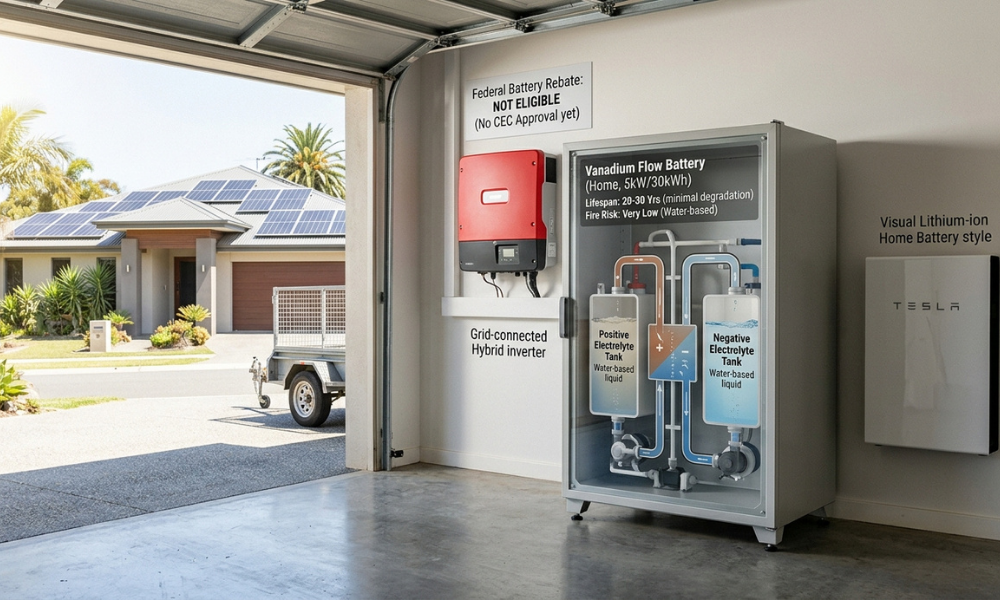
A battery that lasts 25 years, barely loses capacity and can’t catch fire.
Sounds like the dream, right?
That’s the pitch behind flow batteries, and it’s why more Australians are curious about them. If you’ve been searching “flow battery home Australia 2026”, you’re not alone.
But here’s the honest answer: for most homes, flow batteries aren’t ready yet.
The only home flow battery once sold in Australia is gone. The companies working on new models are still testing. And none of them qualifies for the federal battery rebate.
That doesn’t mean the technology is a dud. It just means it’s probably not your next upgrade.
So let’s look at what flow batteries are, how they stack up against lithium, and who might actually want one right now.
Quick summary
- Flow batteries offer long life, minimal degradation and very low fire risk, but they’re bigger and less efficient than lithium.
- No grid-connected home flow battery is currently on sale in Australia, and none qualify for the Cheaper Home Batteries rebate.
- For now, they mainly suit off-grid properties with space to spare.
What is a flow battery?
Think of a regular battery as a sealed lunchbox. Everything’s packed inside, and once it’s full, that’s all it can hold.
A flow battery is more like two water tanks hooked up to a pump. The energy is stored in liquid electrolytes kept in separate tanks. When you charge or use it, pumps push those liquids through a cell stack, where the chemical reaction happens.
The neat part? Storage and power are separate. As Electrek explains, bigger tanks mean more storage (kWh), while bigger cell stacks mean more power (kW).
There are two main types you’ll hear about in Australia:
- Vanadium redox flow batteries (VRFBs) use vanadium in both tanks. Australia has substantial vanadium reserves, so this is the type most local companies are backing.
- Zinc-bromine flow batteries were made locally by Redflow, the Brisbane company behind the ZCell home battery.
Expert tip
Flow battery specs list two numbers. A 5kW/30kWh unit can run up to 5kW of appliances at once and store 30kWh in total, so check both against your household’s needs.
Why are flow batteries so appealing for homes?
Because they fix the two things people worry about most with lithium.
- They last. Vanadium flow batteries can deliver 20 to 30 years of service with little or no degradation. Lithium batteries slowly lose capacity as they age.
- They don’t burn. The electrolyte is water-based, so, as Australian Flow Batteries puts it, there’s no thermal runaway to design around.
- They can be fully drained. Discharging a flow battery all the way doesn’t shorten its life, unlike many other battery types.
- The electrolyte can be reused. Vanadium electrolyte can be recovered and reused at the end of the battery’s mechanical life.
Expert tip
Long life only pays off if you stay put. A battery that outlasts two lithium systems is worth most to homeowners planning to stay 15 years or more.




Flow battery vs lithium: how do they compare?
Here’s how a vanadium flow battery stacks up against a typical lithium home battery:
| Vanadium flow battery | Lithium-ion battery | |
| Lifespan | 20 to 30 years, minimal degradation | Usually warranted for around 10 years, with gradual capacity loss |
| Round-trip efficiency | Around 75% to 80% | Around 90% |
| Size | Much larger, often fridge-sized or bigger | Compact, wall- or floor-mounted |
| Fire risk | Very low, water-based electrolyte | Low when certified, but thermal runaway is possible |
| Federal battery rebate | Not currently eligible | Eligible if on the CEC approved list |
| Grid-connected home models on sale | None currently | Widely available |
So what does that efficiency gap mean in real life? For every 10kWh of solar you store, a flow battery gives back around 7.5 to 8kWh. A lithium battery gives back closer to 9kWh. Day after day, that adds up.
Expert tip
Compare batteries on their cost per kWh delivered over their whole life, not just the sticker price. Lifespan, efficiency and degradation all change the real cost.
Can you buy a home flow battery in Australia in 2026?
Not easily.
For years, Redflow’s ZCell was the only residential flow battery available in Australia. Then Redflow went into voluntary administration in August 2024 after failing to raise funds, and ceased trading on 18 October 2024 when no buyer was found.
VSUN Energy, part of ASX-listed Australian Vanadium, has spent years working on a grid-connected home flow battery. By its own admission, it doesn’t yet have a residential-ready product. What it has done is supply a 5kW/30kWh vanadium flow battery for an off-grid home in regional Western Australia.
Meanwhile, Perth-based Australian Flow Batteries has taken delivery of a 5kW/13kWh Volterion unit to gather real-world data and help build the case for flow battery certification and standards in Australia.
Expert tip
If anyone offers you a home flow battery, ask three things: is it on the CEC approved list, who installs and services it locally, and what happens to your warranty if the supplier leaves Australia.
Why aren’t flow batteries eligible for the battery rebate?
This is the big one.
The federal Cheaper Home Batteries Program takes around 30% off the cost of an eligible battery, but only if it’s on the Clean Energy Council’s approved product list, according to the Clean Energy Regulator. And right now, the Clean Energy Council says its program only assesses lithium-based batteries.
No listing, no rebate. That means a flow battery starts well behind a discounted lithium battery on upfront cost, before you even get to size and efficiency. Our battery rebates guide explains what you can claim on eligible batteries.
Expert tip
Before paying a deposit on any home battery, check the exact model on the CEC approved list. If it isn’t there, you won’t get the federal discount.
Who should consider a flow battery now?
For a typical suburban home with rooftop solar, a rebated lithium battery is still the practical choice in 2026. But a flow battery might be worth a look if:
- You’re off-grid or on a rural property and need storage you can cycle hard every day for decades.
- You have plenty of space, like a shed or plant room, for a larger unit.
- Fire safety is a top priority and you want to avoid lithium chemistry altogether.
- You’re happy to pay more upfront, without a rebate, in exchange for a much longer life.
Expert tip
Off-grid buyers should ask for a full system design, including backup generation. A flow battery is only one part of a reliable stand-alone power system.
When could home flow batteries be ready?
Nobody can put a date on it. But a few things need to happen first:
- A path to approval. Flow batteries need a way onto the CEC approved list, which would open the door to rebates.
- Proven home products. Grid-connected units need to be tested, certified and backed by local installers and service.
- Lower costs. Local supply could help here. Australian Vanadium and Vecco Group have already set up vanadium electrolyte plants in Australia.
The work is happening. AFB’s testing is aimed squarely at certification and standards. So keep an eye on flow batteries, but don’t put off a battery today waiting for them to arrive.
Expert tip
If you’re buying lithium now, choose a battery with a long warranty and strong local support. It will serve you well while flow technology matures.
Find the Right Home Battery for Your Energy Needs
Explore reliable solar battery options, compare quotes from trusted local installers, and discover how much you could save with an eligible home battery rebate.
Frequently asked questions
Can I buy a flow battery for my home in Australia in 2026?
Not easily. No grid-connected home flow battery is currently on sale in Australia. Redflow, which made the ZCell, ceased trading in 2024, and VSUN Energy says its residential model isn’t ready yet. Some off-grid homes have installed vanadium flow batteries through specialist suppliers.
Are flow batteries eligible for the Cheaper Home Batteries Program?
Not at the moment. To qualify, a battery must be on the Clean Energy Council’s approved product list, and the CEC currently assesses lithium-based batteries only. That means flow batteries miss out on the federal discount of around 30%, making them far more expensive upfront than rebated lithium batteries.
How long do vanadium flow batteries last?
Vanadium flow batteries can last 20 to 30 years with little or no loss of storage capacity, because the electrolyte doesn’t wear out the way lithium cells do. Pumps and other moving parts may need servicing or replacing over that time, but the battery’s capacity stays largely the same.
Are flow batteries safer than lithium batteries?
Flow batteries use a water-based electrolyte that doesn’t burn, so there’s little or no risk of thermal runaway. Certified lithium batteries are also safe when installed correctly, but flow batteries remove fire risk almost entirely, which appeals to off-grid and safety-conscious buyers.
Why are flow batteries bigger than lithium batteries?
Flow batteries store energy in liquid electrolyte held in tanks, and that liquid holds far less energy per litre than lithium cells. To store the same amount of energy, a flow battery needs much more space, which is why home units are often fridge-sized or larger.
Key takeaways
- Flow batteries offer 20 to 30 years of life, minimal degradation and very low fire risk.
- They are larger and less efficient than lithium, returning around 75% to 80% of stored energy.
- No grid-connected home flow battery is on sale in Australia in 2026, after Redflow ceased trading in 2024.
- Flow batteries aren’t eligible for the Cheaper Home Batteries rebate, because the CEC only assesses lithium-based batteries.
- For now, they mainly suit off-grid properties, while most homes are better served by a rebated lithium battery.
Sources
- Clean Energy Regulator, Cheaper Home Batteries Program: solar batteries
- Clean Energy Council, Battery programs
- VSUN Energy, Residential vanadium flow batteries
- Australian Flow Batteries, New arrival at AFB
- One Step Off The Grid, VSUN cracks home battery market with off-grid vanadium flow system
- Energy-Storage.News, Flow battery maker Redflow out of business, 21 October 2024
- Energy-Storage.News, Residential vanadium flow battery systems under development for Australia’s solar-storage market
- Electrek, The backup battery choice you didn’t know you had: li-ion, or vanadium flow?
- MDPI Batteries, Advancements and applications of redox flow batteries in Australia
- Energy Matters, Battery system rebates