




“Can my super pay for solar?”
It’s a fair question. Your self-managed super fund (SMSF) is your money, solar is a solid long-term asset, and energy prices aren’t exactly getting friendlier.
If you’ve been searching for answers on SMSF solar investment in Australia, here’s the short version: yes, your fund can invest in solar and clean energy. Just not in the way most people first imagine.
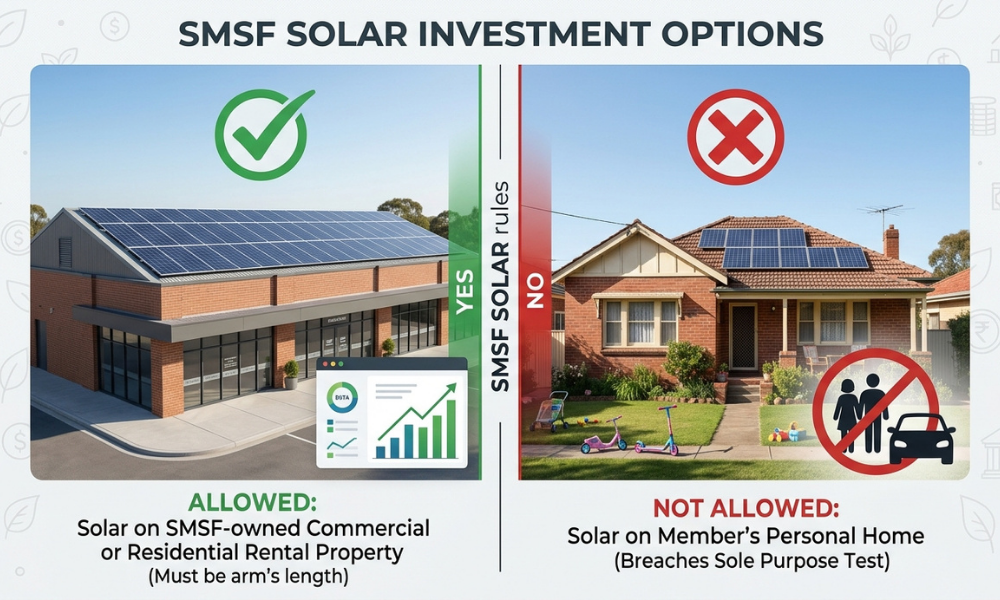
You can’t use your SMSF to put panels on your own roof. You can’t borrow through your fund to add solar to an investment property either. Get it wrong, and your fund could lose its tax concessions.
Get it right, though, and there are a few legitimate ways to add solar and renewables to your retirement savings. Let’s walk through what’s allowed, what isn’t and what to check before you invest.
Important: This article is general information only and isn’t financial, tax or legal advice. SMSF rules are complex, and every fund is different. Speak with a licensed financial adviser, SMSF specialist or accountant before making any investment decision.
Quick summary
- An SMSF can invest in solar and clean energy, as long as the investment passes the sole purpose test and fits the fund’s investment strategy.
- You generally can’t use your SMSF to put solar on your own home, and SMSF borrowing can’t be used to add solar to a fund property.
- Options include solar on fund-owned property paid from fund cash, listed renewable companies, clean energy funds and direct infrastructure offers.
Can an SMSF invest in solar?
Short answer: yes.
An SMSF can hold almost any investment, as long as it follows the rules. For solar and clean energy, three things matter most:
- The sole purpose test. According to the ATO, your fund must be maintained for the sole purpose of providing retirement benefits to members, or to their dependants if a member dies before retirement.
- Your investment strategy. Trustees must have an investment strategy that considers risk, return, diversification, liquidity and members’ needs.
- Your trust deed. The fund’s governing rules must allow the investment.
So the real question isn’t whether solar is allowed. It’s whether a particular solar investment ticks all three boxes.
Expert tip
Before looking at specific investments, pull out your fund’s trust deed and investment strategy. If clean energy isn’t covered, update the strategy first and record the decision in trustee minutes.
Can you use your SMSF to put solar on your own home?
Sorry, but generally no.
The ATO says a fund fails the sole purpose test if it gives someone a benefit before retirement, such as personal use of a fund asset. Solar panels paid for by your SMSF, sitting on your own roof and cutting your own power bills? That’s about as clear an example as it gets.
The consequences aren’t small either. Breaching the sole purpose test can cost your fund its concessional tax treatment, and trustees can face civil and criminal penalties.
If you want solar at home, pay for it personally. Federal incentives for solar panels and the Cheaper Home Batteries Program can help bring the cost down.
Expert tip
If anyone pitches a way to fund solar on your home through your super, treat it as a red flag and get independent advice before going any further.
Can an SMSF install solar on a property it owns?
This is where it gets more interesting.
If your SMSF owns an investment property, like a commercial building or a residential rental, adding solar may be possible. It can make the property more appealing to tenants, which may help the fund over the long run.
But there’s a big catch if the property was bought with a loan.
Many SMSFs buy property through a limited recourse borrowing arrangement (LRBA). Money borrowed under an LRBA can’t be used to improve the property, and solar counts as an improvement.
This isn’t just theory. In 2024, Treasurer Jim Chalmers responded to a petition asking for the rule to change, confirming that energy efficiency upgrades such as solar can’t be funded through an LRBA. He also noted that an SMSF’s own accumulated funds can be used for these improvements.
So your options typically look like this:
- Pay from the fund’s own cash. If the SMSF has enough cash, it can pay for the solar system directly, as long as this suits the investment strategy.
- Have the tenant pay. Some arrangements let the tenant fund improvements instead.
If the property is leased to your own business, everything must stay on commercial, arm’s-length terms. Your adviser can check how adding solar affects the lease and the rent.
Expert insight
In his response to the petition, the Treasurer explained that borrowing inside super adds risk to retirement savings, so LRBA money can’t be used to improve the asset securing the loan. The government considers the current settings strike the right balance.
Expert tip
The ATO’s ruling SMSFR 2021/1 explains the difference between a repair and an improvement for SMSF property, as SMS Magazine reports. Ask your adviser to check where your solar project falls before spending any money.



What other clean energy investments can an SMSF make?
Not every trustee owns property, and that’s fine. There are other ways to add clean energy to your fund:
- Listed renewable energy companies. Shares in ASX-listed businesses involved in renewables, storage or electrification.
- Clean energy ETFs and managed funds. These spread your money across many companies, which can help with diversification.
- Green bonds. Fixed income products that raise money for environmental projects.
- Direct solar infrastructure offers. Some providers market solar farm or commercial solar investments specifically to SMSF trustees, often promoting stable income.
Each option carries very different levels of risk, liquidity and cost. A listed ETF can usually be sold within days. A direct solar project might lock your money up for years.
Expert tip
Look past the label. A fund called “clean energy” or “sustainable” may hold companies you wouldn’t expect, so read the holdings list and product disclosure statement before you invest.
What should trustees check before investing?
Before putting fund money into solar or clean energy, run through these checks:
- Does it fit the investment strategy? The strategy should cover risk, return, diversification, liquidity and members’ needs.
- Is the fund still diversified? The ATO has previously written to thousands of SMSFs about concentrated portfolios, and expects trustees to show they’ve considered the risks of limited diversification.
- Can the fund access cash when it needs to? Think about paying expenses and pensions as members retire.
- What are the fees and risks? Read the product disclosure statement and check the provider’s track record.
- Is anyone getting a benefit now? If a member or related party benefits before retirement, the sole purpose test could be breached.
- Have you had independent advice? The ATO recommends speaking with a licensed adviser if you need help forming a compliant strategy.
Expert tip
Document everything. Keep trustee minutes explaining why each investment suits the fund. Your auditor will want to see them.
Explore Solar Savings for Your Home or Investment Property
Considering solar for your property? Compare quotes from trusted local installers, explore available rebates, and find a system that suits your energy needs and budget.
Frequently asked questions
Can my SMSF pay for solar panels on my house?
Generally no. Using SMSF money to install solar on your own home would give you a personal benefit before retirement, which is likely to breach the sole purpose test. That can cost your fund its tax concessions and expose trustees to penalties, so pay for home solar personally instead.
Can an SMSF borrow to install solar on an investment property?
No. Money borrowed through a limited recourse borrowing arrangement can’t be used to improve the property, and solar counts as an improvement. However, the fund can use its own accumulated cash to pay for solar on a property it owns, subject to its investment strategy and the other SMSF rules.
What are the main ways an SMSF can invest in clean energy?
Common options include solar on fund-owned property paid from fund cash, shares in listed renewable energy companies, clean energy ETFs and managed funds, green bonds and direct solar infrastructure offers. Each has different levels of risk, liquidity and fees, so the right mix depends on the fund’s investment strategy.
Do SMSF clean energy investments need to be in the investment strategy?
Yes. Every SMSF must have an investment strategy that considers risk, return, diversification, liquidity and members’ needs. Any solar or clean energy investment should fit that strategy, and trustees should record their reasons in minutes so the fund’s auditor can see how the decision was made.
Who should I talk to before investing my SMSF in solar?
Speak with a licensed financial adviser, SMSF specialist or accountant before investing. They can check whether the investment passes the sole purpose test, suits your fund’s investment strategy and trust deed, and is structured correctly, especially if property or borrowing is involved.
Key takeaways
- An SMSF can invest in solar and clean energy if the investment passes the sole purpose test and fits the fund’s investment strategy.
- Using your SMSF to put solar on your own home is generally not allowed.
- SMSF borrowing can’t be used to add solar to a fund property, but the fund’s own cash can.
- Listed companies, clean energy ETFs, green bonds and direct infrastructure offers are other ways to invest.
- Get independent, licensed advice and document every decision in trustee minutes.
Sources
- Australian Taxation Office, Sole purpose test
- Australian Taxation Office, Your SMSF investment strategy
- SMSF Adviser, 2 years on, the petition for LRBA changes is answered
- SMSF Adviser, ATO outlines compliance guidelines for diversification probe
- SMS Magazine, LRBA can’t fund complete asset change
- Azure Group, Limited recourse borrowing arrangements for SMSFs
- Energy Matters, Battery system rebates