






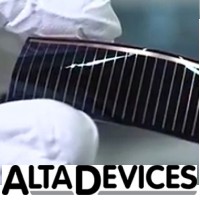
Alta Devices has broken a conversion efficiency record with a dual junction thin-film solar cell, achieving a very impressive 31.6%.
The claim was confirmed by the U.S. National Renewable Energy Agency’s Centre for Photovoltaics, and beats Alta’s previous record of 30.8 percent efficiency for a 1-sun dual junction cell established in March, 2013.
The company said the improvement was made by modifying its basic single-junction gallium arsenide (GaAs) solar cell – which also holds a world record efficiency conversion level of 28.8 percent.
By adding an ultra-thin second layer (or junction) of Indium Gallium Phosphide (InGaP) to the base GaAs cell, the device was able to absorb more high energy photons.
Unlike crystalline silicon cells used in solar power panels for conventional PV systems, GaAs solar cells are used in niche markets; favoured for their lightweight, flexible nature combined with durability.
Applications include smart devices, the Internet of Things (IoT), wearable battery packs and, in particular, powering unmanned aerial vehicles (UAVs). It is in this market that Alta Devices’ Chief Marketing Officer Rich Kapusta sees the biggest promise.
“Our goal has always been to enable solar power to be useful in configurations and applications that have never before been possible,” he said. “The UAV application is an important example of how this happens.”
UAVs have become big business, with fixed-wing drones used by militaries and civil institutions for aerial observation around the world. Big data companies Facebook (Aquila) and Google plan to launch high altitude long endurance (HALE) UAVs to bring internet connectivity to developing countries where access is spotty or non-existent.
A record conversion efficiency of 31.6 percent equates to a power-to-weight ratio of around one gram per watt, meaning a standard HALE drone utilising Alta’s technology would require less than half of the surface area and only weigh a quarter as much while providing the same amount of power as other thin film solar technologies.
“These savings open UAV designers to a variety of alternative design options. Additional batteries can be installed on the vehicle, providing longer operational life spans and flight times than originally considered,” the company states.
“Alternatively, payload functionality can be tailored for higher speed or longer distance wireless communications.”