
If you want to cut your power bills and reduce your carbon footprint, now is the right time to act. Energy efficiency programs in Australia are administered by both federal and state governments and offer rebates, discounts, and low-cost loans to households and businesses.
From the national Cheaper Home Batteries Program to state schemes like Victoria’s VEU, the support available has never been greater. This guide walks you through every key program so you can make the most of what’s on offer.

On this page
National energy efficiency programs in Australia
Cheaper Home Batteries Program
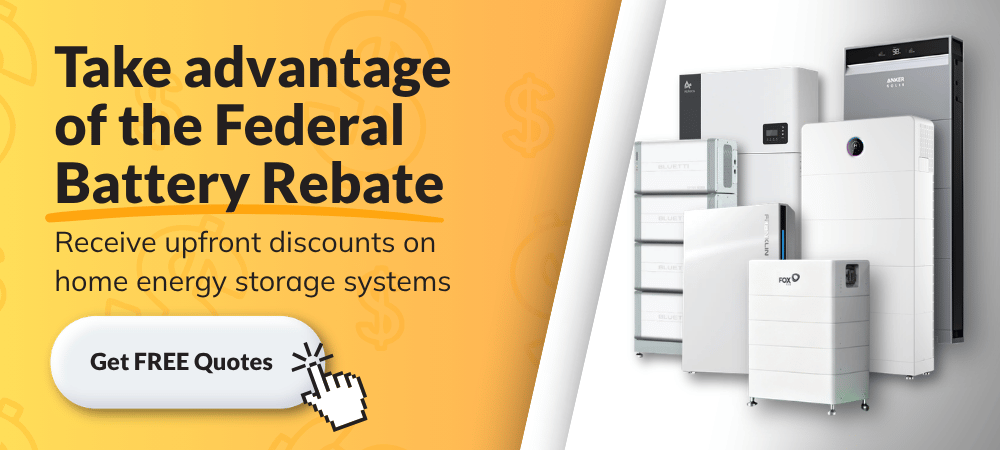
The Cheaper Home Batteries Program is one of the most significant energy efficiency programs in Australia right now. The Australian Government expanded it from an estimated $2.3 billion to $7.2 billion over four years, aiming to help over two million Australians install a battery by 2030.
Key facts about the program:
- Households and small businesses get around a 30% discount on eligible battery systems (5 kWh to 100 kWh)
- Batteries must be paired with a new or existing rooftop solar system
- From 1 May 2026, a tiered STC factor applies: full rate for systems up to 14 kWh, reduced rate for larger systems
- Installers must be accredited by Solar Accreditation Australia (SAA) and use CEC-approved products
- VPP (Virtual Power Plant) capability is required for grid-connected systems
- The program has already supported more than 160,000 battery installations and added 3.6 GWh of storage to the national grid. Acting before May 2026 may secure a higher rebate. Find full eligibility details on our Federal Battery Rebate: Cheaper Home Batteries Program page.
Household Energy Upgrades Fund
The Household Energy Upgrades Fund (HEUF) offers low-cost finance for Australian homeowners who want to make energy-efficient improvements. The $1 billion fund is designed to help households install:
- Rooftop solar panels
- Home battery systems
- Energy-efficient heating and cooling
- Hot water heat pumps and insulation
The fund is expected to assist over 110,000 households and can save families up to $1,600 per year on energy bills. It works alongside the Cheaper Home Batteries Program, meaning you can stack benefits.
Energy Bill Relief Fund
Extended for the 2025–26 financial year, this program provides a $150 credit directly to electricity bills for most Australian households. The credit appears automatically on utility bills as ‘Australian Government Energy Bill Relief’. Residents in embedded networks — such as apartments or caravan parks — may need to apply through their state government portal.
National Energy Performance Strategy
The National Energy Performance Strategy is Australia’s long-term framework to reduce energy demand and improve efficiency across all sectors. Backed by $15.2 million in funding through 2026, the strategy covers three pillars:
- Energy efficiency — using less energy to achieve the same outcomes
- Demand flexibility — changing when and how energy is used
Solar STC Rebate
Australia’s Small-scale Technology Certificate (STC) scheme remains the primary solar rebate for households. As of 1 January 2026, the deeming period dropped from 6 years to 5 years, resulting in a roughly 15–20% reduction in the upfront discount compared to 2025. This reduction will continue annually until the scheme ends in 2030, so installing solar sooner locks in more value.


State-Based Energy Efficiency Programs in Australia
Victoria: Victorian Energy Upgrades (VEU)
The Victorian Energy Upgrades (VEU) program is one of the most robust state schemes in the country. It provides point-of-sale discounts on high-efficiency appliances, including:
- Air conditioners and heat pumps
- Hot water systems
- LED lighting upgrades
- Ceiling insulation — added as a new rebate activity from 14 April 2026 (initially for social housing, expanding to all eligible residential homes from 1 October 2026)
Businesses and households in Victoria can access these discounts through registered VEU providers.
New South Wales: Energy Savings Scheme and PDRS
NSW runs two key schemes for residential and commercial energy users:
- Energy Savings Scheme (ESS): Provides discounts for home energy-efficiency retrofits, including lighting, HVAC, and insulation upgrades.
- Peak Demand Reduction Scheme (PDRS): Updated in 2026 to allow homeowners to claim up to 6 years of VPP incentives upfront when connecting a battery to a Virtual Power Plant. Note: standard battery incentives under PDRS are currently suspended to avoid overlap with the federal Cheaper Home Batteries Program.
- Air conditioning Energy Savings Certificates (ESCs) also saw a 20% increase, following an extension of their calculated lifetime from 10 to 12 years.
South Australia: Retailer Energy Productivity Scheme (REPS)
The South Australian Retailer Energy Productivity Scheme (REPS) is an ongoing initiative in which energy retailers meet annual productivity targets by delivering energy-efficiency upgrades to households and businesses. It focuses particularly on low-income households. New REPS targets for 2026–2030 were published in the SA Government Gazette in December 2025.
Activities include energy-efficiency improvements and demand-response measures, helping to reduce both energy costs and grid pressure during peak periods.
Community Energy Upgrades Fund
In early 2025, the Australian Government launched the Community Energy Upgrades Fund, providing $50 million in grants to 58 local governments. Projects funded include:
- Solar panel installations on community buildings
- Electrification upgrades for public facilities
- EV charging infrastructure
This program targets public assets such as libraries, leisure centres, and council buildings, reducing running costs and demonstrating energy leadership at the local level.
Smart meters: A game changer for energy efficiency
The nationwide rollout of smart meters is continuing in 2026. Smart meters allow households to:
- Track real-time energy use and identify waste
- Shift consumption to off-peak periods with lower tariffs
- Participate in demand response programs and VPPs
- Integrate seamlessly with solar and battery storage systems
As electrification accelerates — including EV charging, heat pumps, and induction cooking — smart meters are becoming a critical tool for managing home energy budgets.

How to access Energy Efficiency Programs in Australia
Navigating multiple federal and state programs can feel confusing. Here are the steps to get started:
- Check your eligibility: Visit energy.gov.au to use the rebate sorter tool and find programs available in your state.
- Get multiple quotes: Compare quotes from CEC-accredited and SAA-approved installers before committing.
- Stack your incentives: Combine federal programs (like the battery rebate and HEUF) with state schemes (like VEU or ESS) to maximise savings.
- Act early: STC values for solar and battery rebates decrease over time. Installing sooner means a higher discount.
- Use a trusted broker: Energy Matters connects you with vetted local installers and can guide you through the rebate process from start to finish.
Did you know Energy Matters is Australia’s largest renewable news, blog and educational resource? Subscribe to Energy Matters’ weekly newsletter and keep updated even with incentives, rebates and recommended solar product offers.
Energy Matters: Your partner in efficiency
Navigating the world of government rebates and technical jargon can be difficult. That is where Energy Matters comes in. We have spent years helping Australians find the best deals on solar, batteries, and efficient appliances.
We believe that every Australian deserves access to affordable, clean energy. Our network of pre-vetted installers ensures that you get high-quality components and professional service every time.
Stop overpaying for your electricity. Contact Energy Matters now to speak with our experts about the latest rebates available in your area!