





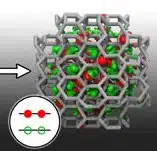
Researchers at the University of California (UC), Davis state an exotic form of silicon could produce major gains in solar cell efficiency.
When a particle of light hits a silicon crystal, it generates a negatively charged electron and a positively charged hole. This is known as the photovoltaic effect. It’s the collection of these electron-hole pairs that generates electric current.
While the theoretical conversion efficiency limit of conventional solar cells is 33%; by generating more than one electron hole par per each particle of light (photon), UC computer simulations indicate the maximum efficiency could be boosted to 42 percent.
“In fact, there is reason to believe that if parabolic mirrors are used to focus the sunlight on such a new-paradigm solar cell, its efficiency could reach as high as 70 percent,” says Stefan Wippermann, a postdoctoral researcher at UC Davis.
According to a University of California press release, the researchers simulated the behaviour of a structure of silicon called silicon BC8 (Si-BC8), which is created under high pressure and is stable at normal pressures.
The computer simulations were run through the National Energy Research Scientific Supercomputing Center at the Lawrence Berkeley Laboratory and demonstrated that nanoparticles of silicon BC8 generate multiple electron-hole pairs per photon..
Results of the team’s work, performed in partnership with researchers in Hungary, were published on January 25 in the journal Physical Review Letters. The work was funded by a National Science Foundation Solar Collaborative grant.
The theoretical limit mentioned above is commonly referred to as the Shockley–Queisser limit. According to Wikipedia, the limit places maximum solar conversion efficiency around 33.7% The Shockley–Queisser limit applies to cells with a single p-n junction; but cells with multiple layers can outperform this limit to a theoretical maximum of 86% using concentrated sunlight.
The Shockley–Queisser limit was first calculated by William Shockley and Hans Queisser at Shockley Semiconductor in 1961.
Image credit: Stefan Wippermann/UC Davis