





Understanding the National Electricity Market Price and Demand is essential for every Australian household and business. These two factors directly affect your electricity bills and energy decisions.
In this guide, we break down how the National Electricity Market Price and Demand work, what drives price changes, and how you can reduce your energy costs with smarter solutions from Energy Matters.
On this page
What is the National Electricity Market (NEM)?
The National Electricity Market (NEM) is Australia’s wholesale electricity market. It connects five regions:
The National Electricity Market Price and Demand are determined in real time. Electricity is bought and sold every five minutes based on supply and demand conditions.
How the National Electricity Market Price and Demand work
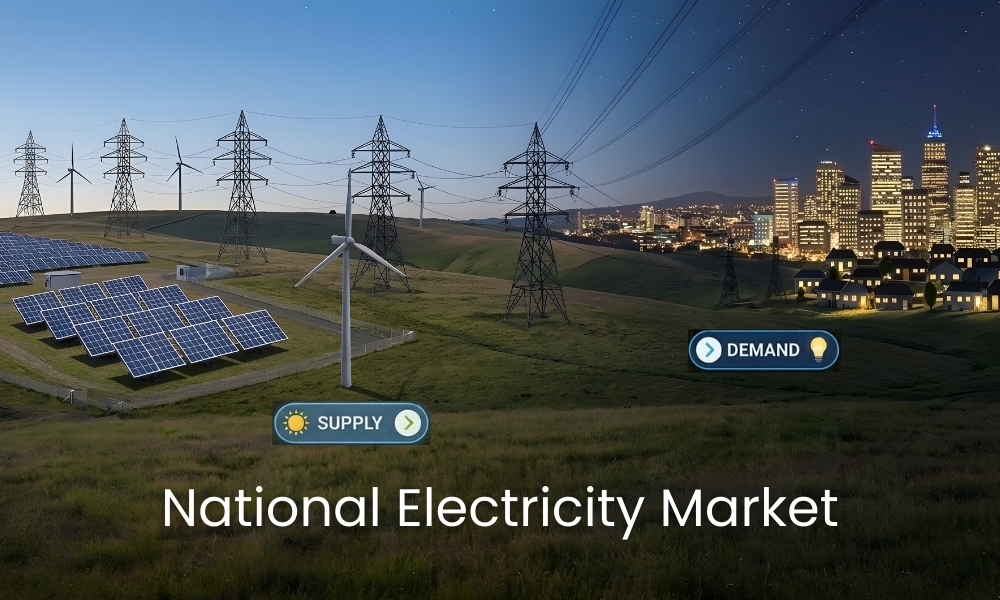
The National Electricity Market Price and Demand are driven by a balance between electricity generation and consumption.
When demand increases, prices rise. When supply exceeds demand, prices fall. This system ensures electricity is delivered efficiently while reflecting real-time market conditions.
Key process
- Generators submit bids to supply electricity
- The market operator selects the lowest-cost supply
- Prices are set every five minutes
- Demand levels determine final pricing




Did you know Energy Matters is Australia’s largest renewable news, blog and educational resource? Subscribe to Energy Matters’ weekly newsletter and keep updated even with incentives, rebates and recommended solar product offers.
Key factors affecting the National Electricity Market Price and Demand
1. Weather conditions
Hot summers increase air conditioning use. Cold winters drive heating demand. Both situations push the National Electricity Market Price and Demand higher due to increased energy consumption.
2. Supply availability
Power plants may go offline for maintenance or faults. Renewable energy output can also fluctuate. Reduced supply leads to higher National Electricity Market Price and Demand pressures.
3. Renewable energy contribution
Solar and wind energy are cheaper when the supply is strong. However, when renewable output drops, prices in the National Electricity Market Price and Demand can spike.
4. Fuel costs
Coal and gas prices affect electricity generation costs. Higher fuel prices increase the National Electricity Market Price and Demand across the grid.
5. Transmission constraints
Electricity must travel through transmission networks. If networks are congested, the National Electricity Market Price and Demand may increase due to limited supply flow.
The role of renewable energy
Renewables are now the cheapest form of new-build generation in Australia. In the last quarter of 2025, renewable energy supplied over 50% of the NEM’s power for the first time. This shift is fundamental to stabilising the National Electricity Market Price and Demand over the long term.
Solar power
Rooftop solar is a “grid-killer” in the best way possible. It reduces the amount of energy households need to buy from the market. This lowers overall demand during the day and forces wholesale prices down for everyone.
Wind energy
Wind often performs best at night or during stormy weather when solar isn’t available. This complementary relationship helps keep the market steady.
Storage and firming
To manage the National Electricity Market Price and Demand, we need “firming” technology. This includes large-scale solar battery storage systems and pumped hydro. These technologies absorb excess energy and supply it when demand is high.
Use Energy Matters’ easy-to-use solar power and battery storage calculator to determine the size of your solar system with storage! Our solar calculator will generate performance information and potential savings.
We can send this information to 3 of our pre-vetted, trusted local installers in your area to receive obligation-free solar quotes and take the first step toward true energy independence!

How to lower your bills amidst market changes
Understanding the market is the first step. Taking action is the second. Here are practical ways to navigate the current NEM landscape:
- Shift your usage: Try to run heavy appliances, such as dishwashers and washing machines, between 10:00 AM and 2:00 PM, when solar energy is most abundant.
- Invest in efficiency: Small changes in energy efficiency, like switching to LED lighting or improving insulation, cut down your overall energy demand.
3. Install solar and batteries: This remains the most effective way to decouple your household from the National Electricity Market Price and Demand fluctuations.
4. Compare retailers: Don’t stay on a “loyalty” plan. Retailers often adjust their rates in response to wholesale market movements.
Energy Matters provides a FREE energy bill comparison service whereby customers can use a recent energy bill (gas and/or electricity) to find better deals and make the switch in a few simple steps.
Looking for a better energy deal?
Role of Energy Matters
The National Electricity Market Price and Demand significantly influence electricity costs across Australia. By understanding their function, you can make smarter energy choices.
Why choose Energy Matters?
- Trusted solar experts
- Custom energy solutions
- Cost-saving strategies
- Ongoing support
Don’t let rising prices control your bills. Contact Energy Matters today and switch to solar for long-term savings and energy independence. Energy Matters helps Australians manage rising energy costs by providing solar systems, batteries, and expert solar advice.