






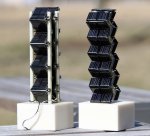
A team from Massachusetts Institute of Technology (MIT) have developed a 3D solar module structure that can generate up to twenty times the electricity from a given area compared to normal solar panel layout.
In a traditional solar panel, the cells are laid out flat on a substrate. The MIT team came up with a very different approach by creating towers of solar cells in a three-dimensional configuration that they say can generate power output ranging from double to more than 20 times that of fixed flat panels with the same base area.
While others have attempted 3-D arrangements of solar cells, the MIT team’s study is the first to approach the problem “with a systematic and predictive analysis” according to Jeffrey Grossman, the Carl Richard Soderberg Career Development Associate Professor of Power Engineering at MIT and lead author of a paper on the development.
The major reason for the boost in performance is the 3-D structures’ vertical surfaces can harvest more sunlight in the mornings, evenings and during winters when the sun is closer to the horizon. This results in power that is more predictable and uniform, with the potential of making integration into the mains electricity grid less complex than conventional systems.
While the way the cells are arranged makes the unit more expensive than a flat panel, the increase in power production could offset the cost. In relation to terrestrial based solar farms, it could also translate to generating the same amount of power from far less land, or more electricity from the same amount of land.
“Even 10 years ago, this idea wouldn’t have been economically justified because the modules cost so much,” says Professor Grossman.
The price of solar panels has dropped dramatically since that time, with up to 65 percent of the cost of implementing PV nowadays associated with installation, permission for use of land and other aspects besides the cells themselves.
The challenge remains to mass produce the elements for the 3D design in a cost-effective manner. A commercial version of the towers would be one that could be shipped flat and then unfolded on-site.
The team’s findings, which are based on computer modelling and outdoor testing of real modules, have been published in the journal Energy and Environmental Science.
Source/image source