






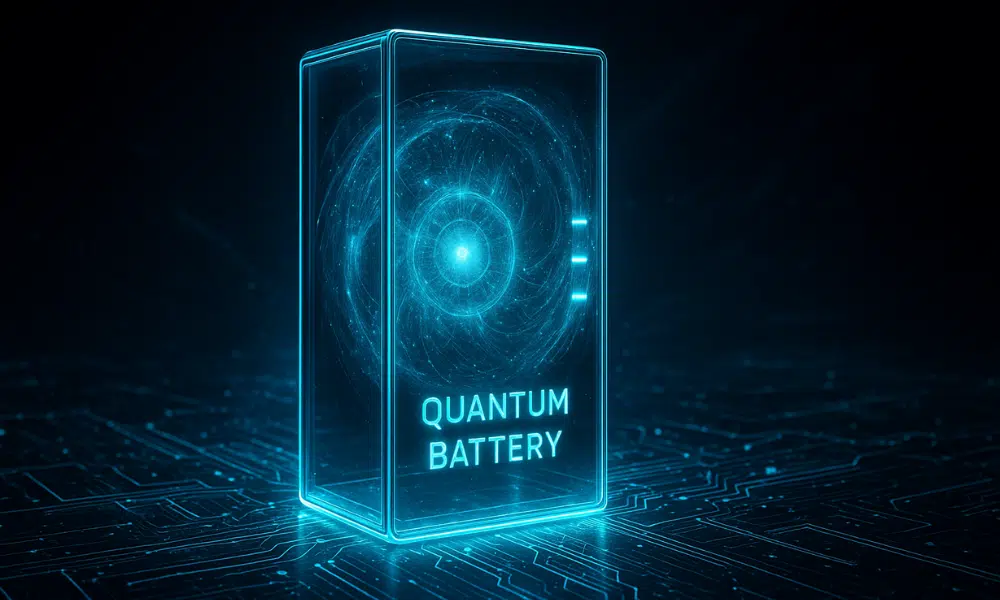
Home battery storage is surging, with many thanks attributed to the Cheaper Home Batteries Program. Electric Vehicles are also slowly replacing their ICE (Internal Combustion Engine) counterparts, and the benefits of home charging are much to thank for this. With the world steaming ahead with electric alternatives and battery adoption, research and development of new battery tech is underway. Quantum batteries are one such technology that is as exciting as the name suggests.
Imagine charging your device almost instantaneously, thanks to quantum physics. It sounds like sci‑fi. But recent breakthroughs from RMIT and CSIRO suggest this futuristic tech is inching closer to reality1.
What are quantum batteries?
Traditional batteries store energy through chemical reactions – ions shuttling in and out. Quantum batteries use quantum effects like superposition and entanglement to charge faster and potentially store more energy2. The idea is to trap photons in microscopic cavities to excite molecules, storing energy in long-lived quantum states.
Global and Aussie breakthroughs
Room‑temperature prototype (January 2025)
In January 2025, an international team demonstrated a room‑temperature, scalable quantum battery. Their multilayer microcavity prototype performed a full charge‑hold‑discharge cycle using polariton interactions3. It marked the first time this had been done without extreme cooling.
1,000‑fold lifespan boost (July 2025)
In July 2025, researchers at RMIT and CSIRO revealed a battery that held its charge 1,000 times longer than previous versions4. Instead of storing energy in short-lived states, they added a chemical layer that used molecular triplet states to dramatically slow energy loss.
PhD candidate Daniel Tibben explained that the battery now retains energy for microseconds, instead of nanoseconds, and the next step is targeting seconds5.
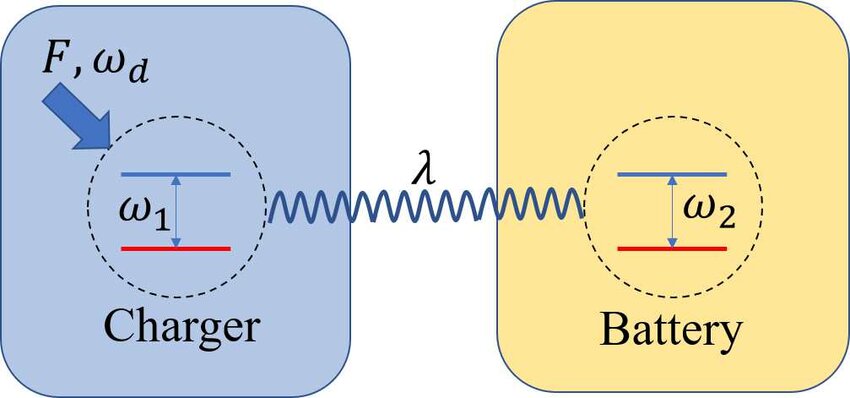
The diagram above shows a charger (left) and battery (right), each as two-level systems (energy levels ω₁ and ω₂). The charger is excited by an external field, then energy passes to the battery through quantum coupling (λ). Reservoirs on each side represent energy dissipation.
How quantum batteries work
| Component | Role |
| Charger | Excited by light to a higher energy state |
| Microcavity | Traps light for strong interaction with molecules |
| Polariton states | Hybrid light–matter states enabling fast charging |
| Molecular triplet states | Store energy longer by reducing self-discharge |




Why this matters for Australia and the world
- Fast charging: Quantum superabsorption could enable nearly instant recharging, even after a cloudy afternoon.
- Compact storage: Quantum entanglement might one day pack more energy into smaller batteries.
- Global positioning: Australia’s early research wins give us an edge in next-gen battery development6.
- Clean tech potential: These batteries may support more efficient solar systems, smart devices, and microgrids.
Challenges ahead
- Energy retention: Even microsecond storage won’t run your toaster. Researchers now aim for one‑second retention.
- Scalability: Building tiny photonic cavities in bulk is still a big engineering challenge.
- Usability: We’ll need converters to turn quantum energy into standard electricity.
- Commercialisation: We’re likely a decade or more away from real-world applications.


Where to next?
The CSIRO quantum battery team is refining materials and testing new designs7. They’re using ultrafast laser tools to probe interactions and increase efficiency. Globally, others are pushing parallel efforts, but Australia’s breakthroughs are front and centre.
The Aussie angle
Quantum battery research aligns with the Federal Government’s National Battery Strategy, which aims to boost sovereign battery capability8. With $550 million allocated, Australia’s push into lithium and beyond includes this cutting-edge field.
Institutions like RMIT and CSIRO are already paving the way. We’re not just mining battery materials, we’re inventing the next generation.
Conclusion: Sci-fi in slow motion
Quantum batteries won’t be powering your fridge any time soon. But achieving room‑temperature function and boosting charge life by 1,000 times are massive steps.
Once we crack the seconds‑long storage barrier and figure out how to scale it up, quantum batteries could bring lightning-fast charging, dense energy storage, and major gains for solar, EVs, and backup systems.
For now, it’s sci‑fi in slow motion. But one day, this Aussie‑led tech might be the spark behind your clean energy future.
- “New research extends quantum battery life from nanoseconds to microseconds,” Australian Manufacturing ↩︎
- “Quantum batteries: using quantum mechanics to charge faster,” CSIRO Quantum Battery Research ↩︎
- “Room-temperature polariton-based quantum battery prototype,” arXiv preprint (Jan 2025) ↩︎
- “Australian scientists develop photonic quantum battery with 1000-fold storage gain,” RMIT News ↩︎
- “We’re inching closer to a working quantum battery,” Renew Economy ↩︎
- “RMIT, CSIRO lead the world in quantum battery advancements,” Manufacturers’ Monthly ↩︎
- “Photon-powered quantum battery pushes boundaries of energy storage,” Interesting Engineering ↩︎
- “National Battery Strategy: Powering Australia’s Future,” Department of Industry, Science and Resources ↩︎