





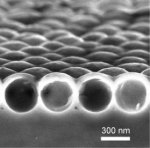
A team of engineers from Cui Lab at Stanford University have created tiny hollow spheres of photovoltaic nanocrystalline-silicon to channel light; a development that could dramatically reduce thin film solar panel materials usage and processing cost.
A whispering gallery is a structure designed in such a way to carry sound over long distances – a phenomenon also occurring in some caves. In a paper published in Nature Communications, the Stanford researchers say they have harnessed physics to do for light what whispering galleries do for sound.
While nanocrystalline-silicon has a high electrical efficiency and is robust, it is a relatively poor absorber of light. This mean thick layering of nanocrystalline-silicon are needed; impacting on manufacturing time and cost.
The Stanford engineers have created spheres called nanoshells, which trap light and circulate it rather than allowing it to pass through; meaning more energy can be harvested from it.
The nanoshells are created using tiny balls of silica (glass) and coating them with silicon. The glass center is then removed using hydrofluoric acid, leaving the light-sensitive shell. While this sounds like a time consuming process, a micron-thick flat film of solid nanocrystalline-silicon can take several hours to deposit, while nanoshells with similar light absorption performance take just minutes. The structure also uses substantially less material – around 5% that of solid nanocrystalline-silicon
“The nanometer spherical shells really hit a sweet spot and maximize the absorption efficiency of the film. The shells both allow light to enter the film easily and they trap it so as to enhance the absorption in a way larger-scale counterparts cannot. That is the power of nanotechnology,” said Jie Yao, a post-doctoral researcher in Cui’s lab.
The researchers believe other more expensive solar cell materials can be fashioned into nanoshells and combined with the resulting product being flexible and able to harvest light from many angles, the development showcases the potential for utilizing advanced nanophotonic structures to boost solar cell efficiency.
Source/image source