






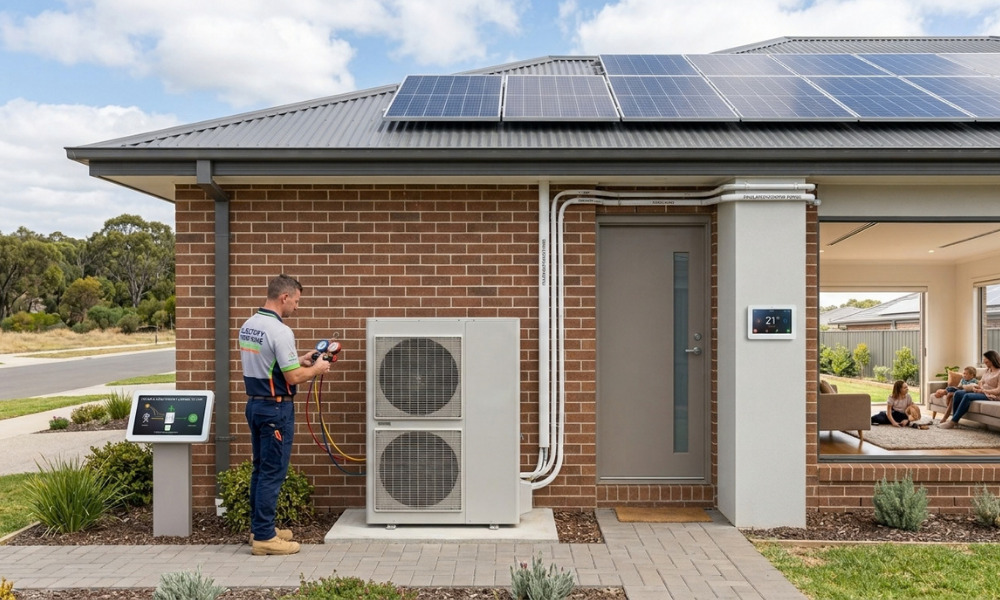
Almost 5 million Australian homes are still connected to mains gas, and space heating is typically the single biggest reason why. Space heating accounts for around a third of residential energy use in Australia and New Zealand, and in many homes it’s the largest gas expense of all. If you’re planning to electrify your home, a central heat pump is the upgrade that delivers the biggest win first: it cuts your biggest gas load, doubles as your air conditioner, and sets up everything else in your electrification journey.
This guide breaks down why heating should be your starting point, how central heat pumps stack up against gas, and how to choose the right system for your home.
Quick Summary
- Space heating is usually the largest gas expense in an Australian home, making it the highest-impact appliance to electrify first
- A central heat pump replaces both your gas heater and your air conditioner, running at up to 300–600% efficiency compared to 61–90% for gas
- Pairing your heat pump with solar (and rebates) significantly cuts both the running cost and the upfront investment
What is a central heat pump?
“Central heat pump” covers two main whole-home systems:
- Ducted reverse-cycle (air-to-air): one outdoor unit connected to ductwork that heats or cools your entire home, similar in layout to ducted gas heating.
- Hydronic heat pump: heats water that’s circulated through radiators or underfloor pipes for steady, even warmth.
Both are different from a heat pump hot water system, which only heats your water, not your home, so it’s worth knowing the difference before you request quotes.
Expert Tip: Ask installers for the system’s Zoned Energy Rating Label. It shows heating capacity and efficiency at both 7°C and 2°C outdoor temperatures, which matters far more in cooler parts of Australia than the headline star rating alone.
Why heating is the highest-impact electrification move
It’s the biggest bill item. In homes with gas heating, space heating and cooling account for around 40% of total energy consumed at a residential property, according to a Commonwealth Government-sourced heating factsheet.
One system replaces two. A central heat pump swaps out your gas heater and your air conditioner, delivering year-round comfort from a single install rather than running two separate systems.
The efficiency gap is significant. Heat pumps operate between 300% and 600% efficiency, compared to gas heating systems operating between 61% and 90% efficiency, because a heat pump moves existing heat from the outside air rather than generating it from burnt fuel. One analysis found reverse-cycle air conditioners in Australia collectively recover more renewable energy from the air than all of the country’s rooftop solar installations combined.
Uptake is accelerating. Clean Energy Regulator data showed an estimated 60,000 air-source heat pumps installed in the first half of 2023, a 70% jump on the previous year, reflecting how fast Australian households are moving toward this technology.
Expert Tip: According to the Clean Energy Regulator, because most of a heat pump’s heat is transferred rather than generated, its energy output is normally several times greater than the electricity used to power it, and pairing it with rooftop solar improves that equation further.
Does a heat pump actually save money on gas?
Modelling from Monash University’s Electrification Hub found a quality heat pump for a four-person household costs between $145 and $175 a year to run during off-peak times, compared to $435 to $635 for an equivalent gas heating system, roughly a two-to-three-times difference in annual running cost.
Common heat pump myths, busted
- “Heat pumps don’t work in cold climates.” Outdated. Cold-climate-rated units are designed to keep extracting heat from the air at low outdoor temperatures and perform well through typical Australian winters, including in Canberra, Hobart, and the Victorian High Country.
- “It’ll just shift my gas bill to my electricity bill.” Not at this efficiency gap. Given heat pumps use meaningfully less energy to deliver the same warmth a gas system burns to produce, and daytime running can be largely covered by solar, most households see a net reduction, not a shift.
Expert Tip: Get your heat pump sized by a licensed installer, not estimated from square metreage alone. An oversized unit cycles inefficiently; an undersized one struggles on the coldest nights.





Ducted, hydronic, or split system: which suits your home?
- Already have ducted gas heating? A ducted reverse-cycle system can often reuse much of your existing ductwork.
- Renovating or building new? Hydronic heat pump heating delivers gentle, even warmth and pairs well with underfloor installs.
- Only heating a few key rooms? A zoned or multi-split system may deliver most of the benefit without a full ducted retrofit.
Pairing your heat pump with solar
Running your heat pump on self-generated solar during daylight hours means you’re largely heating (or cooling) your home on power you already produce, rather than buying it back from the grid. Adding a battery extends that self-generated power into the evening, when heating demand often peaks. Use our solar and battery calculator to model how a heat pump fits your existing or planned system.
Rebates that reduce the upfront cost
Central heat pumps typically cost more upfront than a comparable gas system, but federal and state rebates can close that gap significantly. Availability and amounts vary by state, so check our rebates and incentives page for what currently applies where you live.
Real households, real results
See what full electrification looks like in practice in Roshan’s Electrified Home, a genuine Australian household journey, heating included. For the complete electrification picture beyond heating, see our guide: What Is Electrification?
Frequently asked questions
Do heat pumps work in cold Australian climates?
Yes. Cold-climate-rated heat pumps are designed to keep extracting heat from outside air at low temperatures and perform reliably through typical Australian winters, including in Canberra, Hobart, and alpine regions. Look for a system rated for performance at 2°C, not just 7°C, on its energy label.
Is a central heat pump cheaper to run than gas ducted heating?
Generally, yes. Monash University modelling found a quality heat pump costs $145–$175 a year to run for a four-person household on off-peak rates, compared to $435–$635 for gas, largely because heat pumps run at 300–600% efficiency versus 61–90% for gas.
Can a central heat pump replace my air conditioner too?
Yes. Reverse-cycle heat pumps provide both heating and cooling from a single system, meaning you don’t need to run and maintain separate gas heating and electric cooling systems.
What’s the difference between ducted and hydronic heat pumps?
Ducted systems heat and cool air, distributed through ductwork, ideal if you already have gas ducted heating. Hydronic systems heat water, circulated through radiators or underfloor pipes, offering steadier warmth and suiting renovations or new builds.
Are there rebates for switching to a heat pump in Australia?
Yes. Federal and state incentives exist for switching from gas to heat pump heating and cooling, though amounts and eligibility vary by state and territory. Check current offers on our rebates and incentives page before getting quotes.
Key takeaways
- Space heating is usually the biggest gas expense in an Australian home, making it the highest-impact first step in electrification
- Central heat pumps run at 300–600% efficiency compared to 61–90% for gas, and replace both your heater and air conditioner
- Typical running costs are roughly two to three times cheaper than gas, per Monash University modelling
- Cold-climate-rated systems perform reliably through Australian winters; this is no longer a barrier
- Pairing your heat pump with solar (and available rebates) improves both running costs and payback time
Sources cited: Equipment Energy Efficiency Program (energyrating.gov.au), Commonwealth Government heating and cooling data (energy.gov.au, via Horizon Power factsheet), Clean Energy Regulator data, Monash University Electrification Hub modelling.