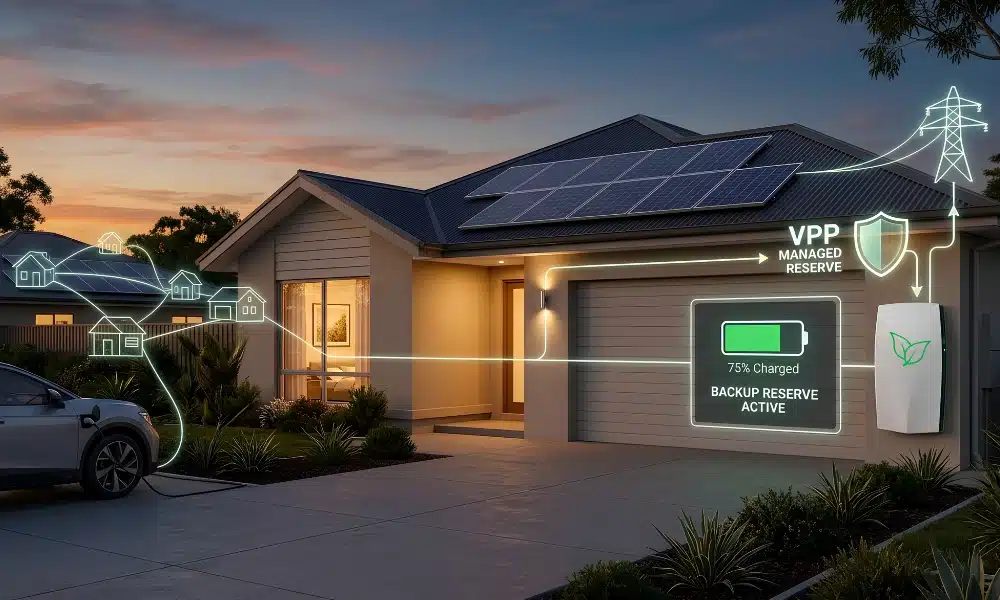




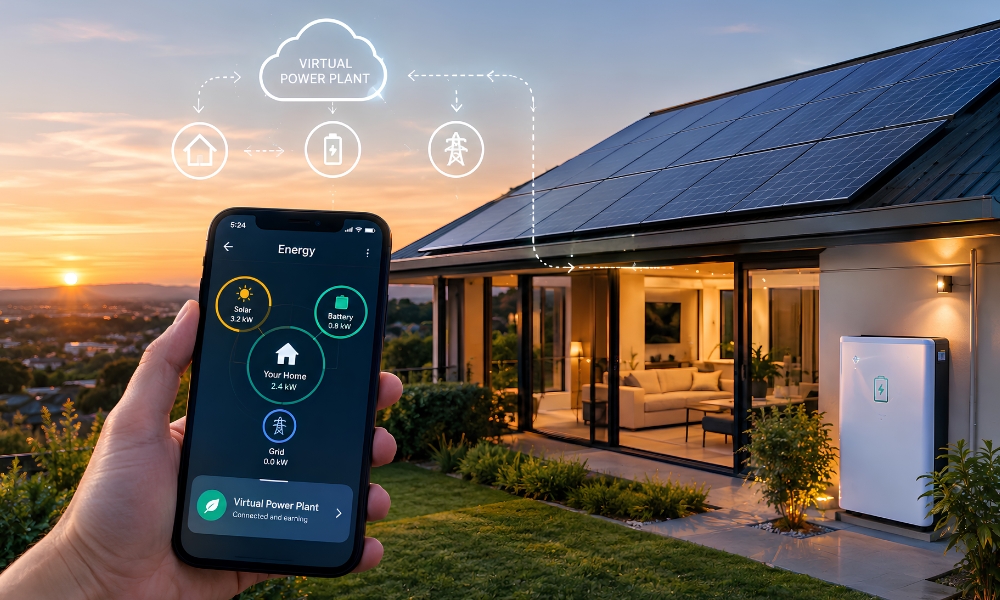
Australia’s growing fleet of rooftop solar systems and home batteries is changing how households interact with the electricity grid. As more renewable energy enters the network, virtual power plant AI Australia initiatives are helping turn individual batteries into a coordinated energy resource that can support the grid and potentially reward participating homeowners.
For households considering a battery, joining a VPP may help improve the value of their investment. The key is understanding how the technology works, what determines your earnings and whether the arrangement suits your electricity usage.
What homeowners need to know
- A VPP usually doesn’t require you to change how you use electricity every day. Once connected, the provider manages battery dispatch according to your agreement.
- AI can improve forecasting and trading decisions, but it cannot guarantee a profit or eliminate electricity bills.
- Your solar battery’s available capacity, electricity tariff, export limits and VPP contract all affect your financial returns.
Use Energy Matters’ easy-to-use solar power and solar battery storage system calculator to determine the right size for your solar system with storage. Our solar calculator will generate performance information and potential savings.
We can send this information to 3 pre-vetted, trusted local installers in your area so they can provide obligation-free solar quotes and help you take the first step toward true energy independence!

What is a virtual power plant and why should Australian homeowners care?
A virtual power plant is a network of distributed energy resources, such as household batteries, rooftop solar systems and, in some cases, electric vehicles. A VPP operator coordinates these resources through software, allowing them to respond collectively to electricity demand and market conditions.
For homeowners, joining a VPP can mean receiving payments or bill credits in exchange for allowing a provider to control some of their battery’s stored energy. Unlike a conventional power station, a VPP draws on many smaller resources spread across different locations.
Expert insight
The Australian Renewable Energy Agency (ARENA) has supported trials showing that aggregated household batteries can provide multiple services, including responding to wholesale electricity prices, delivering frequency control and supporting local networks. This shows that VPPs can create value beyond household self-consumption.
The key facts
- Virtual power plant: A digitally coordinated network of distributed batteries and other energy resources.
- AI optimisation: Software uses forecasts and market information to improve charging, discharging and energy trading decisions.
- Battery VPP earnings: Payments, credits or other financial benefits offered under a VPP agreement.
- Grid services: Support such as balancing supply and demand, managing peak loads and helping maintain grid frequency.
- Customer control: The level of control you retain depends on the provider’s contract and battery settings.
A VPP does not necessarily own your battery. In most residential arrangements, you retain ownership while agreeing to specific operating conditions and allowing the provider to dispatch some of its capacity.
Why this matters right now in Australia
The Clean Energy Council’s Rooftop Solar and Storage Report for the second half of 2025 recorded 183,245 new battery installations in just six months, a fourfold jump on the same period in 2024, taking the national household battery fleet past 454,753 systems. Rooftop solar and batteries together are increasingly described as Australia’s biggest power station, sitting on more than 4.3 million rooftops.
Yet most of those batteries are still working alone. Monash Energy Institute research found only around 24 per cent of Australian battery owners had joined a VPP, even though those who did cut their bills by as much as 63 per cent. That gap between owning a battery and actually monetising it is exactly where AI-driven VPP platforms are starting to close the loop.
How virtual power plants and AI work in Australia
A smart VPP in Australia typically combines battery hardware, an internet connection, an energy management system and a platform operated by a retailer or aggregator. AI may be used alongside conventional optimisation algorithms to analyse information and decide when the battery should charge or discharge.
The exact technology varies. Some operators use automated forecasting and rules-based optimisation, while others incorporate machine learning to improve predictions as they collect more operational data.
Expert insight
ARENA’s VPP demonstration project found that participating household batteries could respond to electricity market signals and provide frequency control services. The trials also highlighted the need to improve operational visibility and integrate VPPs into market systems.
Technical explanation
Imagine your home has rooftop solar and a 10 kWh battery. During a sunny afternoon, your panels produce more electricity than your household needs, so the battery stores some of the surplus.
An AI-supported VPP platform can then:
- Forecast solar production: Estimate how much electricity your panels will generate using weather forecasts and historical production.
- Predict household consumption: Use historical usage and other available information to estimate your evening energy needs.
- Monitor electricity prices: Identify periods when electricity prices or demand-response opportunities could make battery discharge financially valuable.
- Optimise battery operation: Decide how much energy to reserve for your home and how much may be available for VPP dispatch.
- Respond to grid requirements: Coordinate battery discharge or charging in line with the provider’s operating rules and network constraints.
For example, if your household usually consumes 4 kWh after sunset, the platform may try to preserve that amount in your battery before offering additional stored energy to the grid. The reserve may be adjustable, depending on the provider and your battery’s capabilities.
Australian examples and data
The Australian experience includes both residential VPP programs and large-scale trials. ARENA’s AEMO VPP Demonstrations have tested how aggregated batteries can participate in market services and how to make their operations more visible to the grid operator.
The ABC reported in February 2025 on Australian households participating in VPPs, including a Western Australian household using rooftop solar and a battery to supply its home and export surplus electricity. A separate ABC report in August 2026 explored VPP participation and the financial considerations facing households with batteries
These real-world experiences show that VPP participation is not a single standardised product. Providers may offer different payment structures, battery control arrangements and eligibility requirements.
What does this mean for your electricity bills?
A VPP can help reduce electricity costs, but the financial outcome depends on the value of the energy you export, the cost of electricity you avoid buying, and the agreement terms. Households should compare potential revenue with the value of keeping stored electricity for evening and overnight use.
Expert insight
The Australian Energy Regulator’s 2025 report on consumer energy resources discusses the growing role of distributed energy technologies and the challenges of integrating them into electricity networks. For households, the important consideration is not simply how much energy a battery can export, but whether the arrangement provides a measurable net benefit after costs and restrictions.
Short-term impact
VPP participation can provide several potential benefits:
- Export payments: Some providers pay customers for electricity exported during selected events.
- Bill credits: Other arrangements provide credits that reduce the household’s electricity bill.
- Upfront incentives: Eligible households may qualify for a government incentive when connecting an existing or new battery to an approved VPP.
- Automated operation: The platform can manage dispatch without requiring you to constantly monitor electricity prices.
However, a VPP may also reduce the energy available for your own household. If the provider dispatches your battery before a high-use evening, you may need to buy electricity from the grid later.
Long-term implications
The long-term value of a VPP depends on several variables, including battery degradation, changes in electricity tariffs, the number of dispatch events and the provider’s ongoing payment arrangements.
A household should also consider the opportunity cost of battery cycling. More frequent charging and discharging can contribute to battery wear, although the actual effect depends on the chemistry, operating conditions and the manufacturer’s warranty.
| Financial consideration | Potential benefit | What to check |
| VPP export payments | Additional income or credits | Payment rates, event frequency and eligibility |
| Self-consumption | Lower grid purchases | Household usage and solar production |
| Government incentives | Reduced upfront costs | Current eligibility and program conditions |
| Battery cycling | Potential revenue from additional dispatch | Warranty, throughput limits and degradation |
| Electricity tariff | Lower costs through smart scheduling | Daily supply charges, import and export rates |
| Backup reserve | Greater protection during outages | Whether VPP dispatch can access reserved energy |
A useful way to evaluate a VPP is to compare three scenarios: keeping your battery outside a VPP, joining a VPP with limited control and joining a VPP with more active dispatch. Use actual tariff figures and realistic assumptions rather than relying on promotional earnings estimates.
What Australian homeowners can do right now?
Before joining a VPP, homeowners should establish whether their battery is compatible, how much control they will retain and what the provider will pay. A well-designed arrangement should fit around household needs rather than treating the battery purely as a trading asset.
Actionable steps
- Review your electricity bills. Identify your typical daily consumption, evening demand, current feed-in tariff and peak electricity rates.
- Check your battery’s compatibility. Confirm that the manufacturer, inverter and battery capacity are accepted by the VPP provider.
- Compare payment structures. Look at upfront incentives, ongoing credits, event payments and any minimum participation period.
- Calculate your household reserve. Estimate how much electricity you need overnight and whether your provider lets you set a minimum state of charge.
- Review the warranty. Confirm the battery’s cycle and throughput limits, and whether VPP participation affects the warranty.
- Check your backup arrangements. Establish whether the system can reserve sufficient power for outages and what happens if the network connection is interrupted.
- Monitor performance. After joining, check your app or statement regularly to compare actual payments and electricity savings with your expectations.
For households still researching storage, Energy Matters provides a guide to residential solar battery systems, including what to consider when choosing a suitable system.
Questions to ask your installer or retailer
- How much control does the VPP have over my battery, and can I opt out of individual dispatch events?
- How are payments calculated, and are they guaranteed or dependent on market conditions?
- What is the minimum battery reserve, and can I change it?
- Are there any exit fees, contract lock-in periods or penalties?
- Does the VPP support backup power during a grid outage?
- Will I still receive my normal solar feed-in tariff?
- Does the provider share revenue from frequency control and other grid services?
State-by-state considerations
| State | Key considerations for homeowners |
| Victoria (VIC) | Check current state battery support and retailer VPP offers. Confirm local distributor export limits and the battery’s backup capabilities. |
| New South Wales (NSW) | The NSW Government’s VPP incentive is available for eligible households and small businesses. From 1 July 2026, batteries up to 50 kWh can qualify, subject to program requirements. NSW Climate and Energy Action. |
| Queensland (QLD) | Check current state battery programs, local network export arrangements and VPP availability. Retailer participation and tariff structures can vary across the state. |
| South Australia (SA) | Investigate available VPP offers and relevant state energy programs. Consider the impact of high solar generation, export conditions and evening electricity demand. |
| Western Australia (WA) | Check the applicable Synergy or other retailer arrangements and network rules. Confirm that the VPP supports the local electricity system and your particular battery model. |
Expert predictions for 2027 and beyond
The next stage of VPP development is likely to involve more sophisticated forecasting, improved communication between batteries and electricity markets, and increased participation from electric vehicles and other flexible household equipment. These are industry directions, not guaranteed outcomes for any particular household.
1. More advanced VPP AI optimisation
AI systems may increasingly incorporate local weather conditions, household consumption, electricity prices and network constraints into their decisions. This could allow VPPs to anticipate periods of high demand and coordinate their battery fleets more effectively.
However, better forecasting does not automatically translate into higher household earnings. Providers still need to share value fairly, and actual returns will depend on the contract and the electricity market.
2. Greater participation from electric vehicles
As vehicle-to-home and vehicle-to-grid technologies develop, compatible EVs could become another source of flexible energy. A future smart VPP Australia model may coordinate stationary batteries, EV charging and other household equipment as a single system.
Participation will depend on vehicle compatibility, charging equipment, network permissions and whether vehicle owners are comfortable allowing controlled charging or discharging.
3. Greater focus on household protection and transparency
Consumer trust will be essential as more households hand over some control of their batteries to third-party operators. Clearer reporting on dispatch events, earnings, battery cycling and customer control could become increasingly important.
The ABC’s 2025 reporting on household concerns over battery dispatch and VPP trust highlights why contract transparency and customer control deserve close attention.
4. More opportunities for local grid services
AI grid services could eventually include better management of local network congestion, coordinated charging and more responsive support during periods of high electricity demand. These services may become more valuable as distributed energy resources increase, but their availability and payment structures will vary.
For homeowners, the key question will remain whether the additional services generate enough value to justify granting the VPP operator access.
Frequently asked questions
1. How much money can a household earn from a virtual power plant in Australia?
There is no single standard VPP earnings figure. Payments depend on your provider, battery capacity, electricity tariff, dispatch frequency and contract. Some programs offer upfront incentives or bill credits, while others pay for participation in selected events. Ask for an estimate based on your actual energy usage and the provider’s current terms.
2. Does AI control my home battery all the time?
Not necessarily. Some VPPs use automated software to manage charging and discharging, while others let customers adjust their battery reserve or opt out of certain events. Your contract specifies when the provider can access your battery and what control you retain. Check these conditions before joining.
3. Can I use my battery during a power outage if it is connected to a VPP?
It depends on your battery’s backup capability, inverter configuration and VPP agreement. Some systems can reserve a portion of stored energy for emergencies, while others may prioritise grid services. Ask your installer whether your system provides backup power and whether VPP dispatch can affect your emergency reserve.
4. Are virtual power plants worth joining in 2026?
The value depends on your household’s electricity consumption, battery capacity, tariff and the terms of the VPP. Compare the expected payments and bill savings with the cost of grid electricity you might otherwise avoid purchasing. Also consider battery wear, backup requirements, contract restrictions and any available government incentives.
5. Do I need a new battery to join a VPP?
Not always. Some VPP providers accept compatible existing batteries, while others require specific models or newly installed systems. Eligibility can also depend on your location, electricity retailer and network connection. Contact several providers to confirm compatibility and ask whether your existing battery can qualify for any available incentive.
Key takeaways
- A VPP connects household batteries. It lets an operator coordinate stored energy to support electricity demand and potentially provide financial returns.
- AI can improve energy management. Forecasting and automated optimisation can help determine when batteries should charge, discharge or retain energy for household use.
- Earnings depend on the agreement. Compare actual payment rates, battery access conditions, tariff structures and potential degradation costs before joining.
- State rules and incentives matter. Check your eligibility, local export restrictions, and any current government support before deciding.
- Keep household needs in focus. Set an appropriate energy reserve, understand your backup options and regularly monitor your VPP’s financial performance.
The bottom line for Australian homeowners
Virtual power plants and AI are creating new opportunities for Australian households to participate in the electricity market while making better use of their solar batteries. Although battery VPP earnings can help offset electricity costs, the financial benefits depend on the provider, your energy needs and the conditions of your agreement.
As Australia’s renewable energy system evolves, households can prepare by comparing battery options, understanding their local incentives and carefully reviewing VPP contracts. Explore your solar and battery options with Energy Matters and request a free quote from appropriately accredited installers to find a solution that suits your home.
Get a free solar + battery quote
Find out how a suitable solar and battery system could support your household energy needs and whether VPP participation may be right for you.
Compare your options, discuss battery compatibility, and ask about available incentives before you decide.