

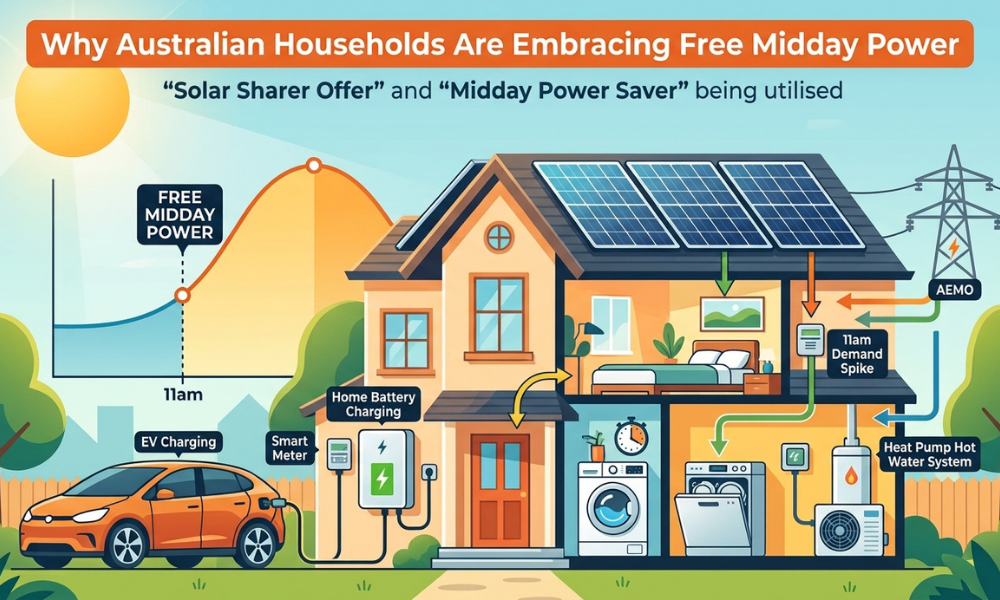
Australian households are embracing free midday power, and the grid shows it. Since the Solar Sharer Offer launched in NSW, South Australia and south-east Queensland in July, and Victoria’s Midday Power Saver followed on 1 October, homes have been switching on batteries, EVs and appliances the moment the free window opens.
Grid data shows the change clearly. Electricity demand across the National Electricity Market (NEM) now jumps by around 360 MW at exactly 11am every day, the moment free power periods begin on many plans.
It’s a clear sign that households will change when they use power if the reward is right. Three free hours a day is a strong reward, especially for homes with a battery or an electric car.
This article looks at the evidence behind the trend, what households are switching on and how you can join them. For the basics of each offer, see our guide to free electricity offers from retailers.
Quick summary
- Demand across the NEM jumps by about 360 MW at 11am every day as households use free midday power.
- Batteries, EVs, hot water systems and appliances on timers are driving the spike.
- A smart meter, the right plan and a few timers are all you need to join in.
How quickly are households embracing free midday power?
Free midday power has reached millions of homes in a matter of months. In Victoria alone, around 2.6 million households with smart meters are eligible for the Midday Power Saver, which the state government says is more than the eligible households in the three Solar Sharer states combined.
The grid shows that many are taking it up. AEMO has observed a daily demand jump at 11am that has grown steadily in recent months, in line with households signing up to free midday plans and setting their homes to use them.
Some days show far bigger jumps. Hamish McKenzie, deputy director of climate and energy at the Grattan Institute, shared data showing that on Friday 28 August, Victorian demand rose by more than 700 MW within 30 minutes of 11am. That’s almost double the NEM-wide average.
That Victorian spike came before the state’s Midday Power Saver officially launched. It suggests some retailers were already offering free midday deals, or that other timed loads were switching on. McKenzie notes the size of the spike varies by state and by day, but on most days it’s easy to see.
Expert tip
Free windows start at 11am in NSW, south-east Queensland and Victoria, and at midday in South Australia. Set your timers to the start of your state’s window, not a rough “lunchtime”.
What does free midday power look like at home?
Every household uses the free window a little differently. Here’s how it can work in practice.
The family with an EV and a battery
The car charges from 11am while it’s parked in the driveway on weekends or work-from-home days, and the battery fills up alongside it. By evening, the battery covers dinner, TV and lights, so the household barely touches peak-priced grid power.
The work-from-home couple
The dishwasher and washing machine run on timers, the hot water heats in the free window and the house is cooled in the early afternoon. Laptops, the kettle and lunchtime cooking all fall inside the free hours too.
The renters without solar
With no panels to lean on, they have the most to gain from free grid power at midday. Moving laundry, dishwashing and slow cooking into the window can cut a meaningful share of their bill, as long as their home has a smart meter.
The common thread is automation. Analysts aren’t yet sure which appliances drive most of the 11am spike, and McKenzie suggests hot water systems and EVs may matter as much as batteries. Either way, households are setting timers and apps once and letting them capture the free power every day.
Expert insight
Hamish McKenzie of the Grattan Institute describes the 11am spike as a clear example of the energy market working. His view is that when people get a clear price signal and an easy way to respond, they act on it. See his analysis on LinkedIn.
Expert tip
Start with the appliances that already have timers or apps, like dishwashers, washing machines, EV chargers and heat pump hot water systems. They take minutes to set up and run on free power every day after that.
Why home batteries are a big part of the story
Batteries are one of the easiest ways to make free midday power work harder. More than 500,000 discounted batteries have now been installed through the federal Cheaper Home Batteries Program, and AEMO estimates that 15% to 25% of home batteries may already respond to price signals like free power periods.
A battery turns free midday power into an evening saving. It can charge during the free window, from your panels, the grid or both, then power your home through the expensive evening peak. As we explained in Victoria’s Free Power: Who Actually Benefits?, a battery is what changes the offer from a modest saving that takes effort into a bigger, automatic one.
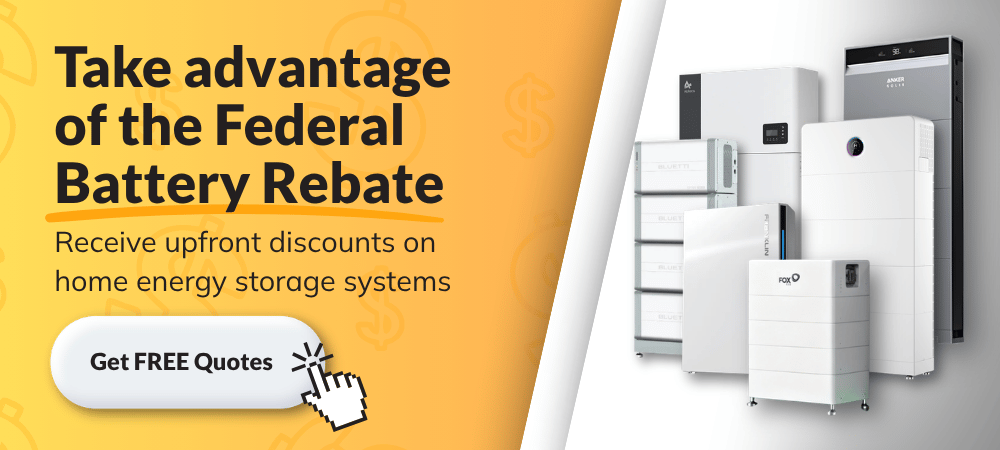
The battery rebate still takes around 30% off the cost of an eligible battery of up to 14kWh, according to the Clean Energy Regulator. The discount steps down every six months, so it will be lower from January 2027. Our battery rebates guide covers state incentives you may be able to combine.
Expert tip
If you already have a battery, check whether its app supports time-based charging. Set it to charge at the start of your free window so it’s full before the evening peak.


A quick recap of the free power offers
Free midday power is now available in four states. Here’s where and when:
| Region | Offer | Free window |
| New South Wales | Solar Sharer Offer | 11am to 2pm |
| South-east Queensland | Solar Sharer Offer | 11am to 2pm |
| South Australia | Solar Sharer Offer | 12pm to 3pm |
| Victoria | Midday Power Saver | 11am to 2pm, every day including weekends |
Both offers are opt-in and need a smart meter. Solar Sharer plans cap free use at 24kWh a day, and rates outside the free window may be higher than on a standard plan.
Expert tip
No smart meter yet? Ask your retailer about an upgrade. You can’t access free midday power without one.
How to join the households using free midday power
Follow these steps to start using free midday power at home:
- Check you have a smart meter. Your bill or retailer can confirm this.
- Look at when you use power. Your retailer’s app or recent bills show how much falls in the evening.
- Compare plans. Ask your retailer about its free midday offer and compare the total annual cost with your current plan.
- Set appliance timers. Program the dishwasher, washing machine and dryer to start when your free window opens.
- Schedule EV charging. Use your car’s app or a smart charger to charge during the free hours.
- Set your battery to charge. Time-based charging fills it with free power before the evening peak.
- Move hot water heating. Set an electric or heat pump system to heat during the free window.
Expert tip
Spread big loads across the full three hours. Running an EV, hot water system and dryer all at once can use up the 24kWh daily cap quickly on Solar Sharer plans.
Who should think twice?
Free midday power doesn’t suit every household. Retailers recover the cost of the free hours through other charges, so rates outside the window may be higher.
Solar-only homes may gain little in sunny months, because their panels already cover most daytime use. Households that use most of their power in the evening could even end up paying more. Modelling by Energy Consumers Australia found a household that shifted 30% of its use into the free period, but still used 40% in the evening peak, could be around $320 a year worse off, as summarised by Pingala.
Expert tip
Compare the total yearly cost of each plan, not just the free hours. A plan that’s free at noon but pricier at night can cost more overall.
Turn Free Midday Power into Bigger Energy Savings
Make the most of free electricity with a home battery that stores energy for when you need it most. Compare quotes from trusted local installers and find the right solar and battery system for your home.
Frequently asked questions
Why does electricity demand jump at 11am?
Demand jumps at 11am because that’s when free power periods begin on many plans in NSW, south-east Queensland and Victoria. AEMO says demand across the NEM rises by around 360 MW at that time each day, as households automatically start charging batteries and EVs and running appliances.
How many households are using free midday power?
Exact sign-up numbers haven’t been published. However, AEMO’s data shows a daily 11am demand jump of around 360 MW that has grown in recent months. In Victoria, demand rose by more than 700 MW within 30 minutes of 11am on one day in August, which points to strong uptake.
Can I charge my home battery with free midday power?
Yes. Many batteries support time-based charging through their app, so you can set them to charge from the grid during the free window as well as from your solar panels. The stored energy then powers your home through the evening peak. Check your plan’s daily cap and terms first.
Do I need solar panels to get free midday power?
No. You only need a smart meter and an eligible plan in NSW, south-east Queensland, South Australia or Victoria. Households without solar often have the most to gain, because they currently buy all their daytime power from the grid. Renters can access the offers too if their home has a smart meter.
Does free midday power apply on weekends?
Yes. Victoria’s Midday Power Saver offers free power from 11am to 2pm every day, including weekends, and Solar Sharer plans in other states also run daily. Weekends are often the easiest time to make the most of the free window, because more people are at home to use it.
Key takeaways
- AEMO says demand across the NEM jumps by around 360 MW at 11am every day as households use free midday power.
- Batteries, EVs, hot water systems and appliances on timers are behind the spike, with automation the common thread.
- More than 500,000 batteries installed through the federal program help households store free power for the evening.
- Free midday power is available in NSW, south-east Queensland, South Australia and Victoria, and needs a smart meter.
- Compare total yearly costs before switching, as rates outside the free window may be higher.
Ready to make the most of free midday power?
Sources
- Daniel Westerman, AEMO CEO, address to a Sydney energy conference, October 2026
- Hamish McKenzie, Grattan Institute, 11am demand spike analysis, LinkedIn, October 2026
- Department of Climate Change, Energy, the Environment and Water, Default Market Offer and Solar Sharer Offer
- Victorian Government, Victorian Midday Power Saver
- Clean Energy Regulator, Cheaper Home Batteries Program: solar batteries
- Pingala, Free power in the middle of the day: Is the Solar Sharer Offer right for you? (summarising Energy Consumers Australia modelling)
- Energy Matters, Free Electricity Offers From Retailers, Victoria’s Free Power: Who Actually Benefits? and Battery system rebates