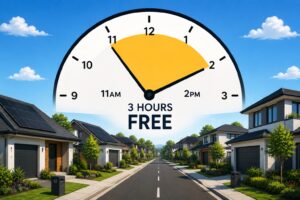





From 1 July 2026, the Australian Government’s Solar Sharer Offer (SSO) will come into effect for households across South Australia, New South Wales, and South East Queensland. Victorians will be able to benefit from a similar scheme from 1 October 2026: Victorian Midday Power Saver (VMPS). These schemes will provide a three-hour window of free electricity for all households with a smart meter.
While this sounds great (and incredibly generous) on paper, there are some important caveats that you must be aware of. Whether you have solar, a battery, or neither, we’ll explore what these schemes might mean for you.
What is the Solar Sharer Offer?
The Solar Sharer Offer is a new electricity pricing initiative designed to encourage households to use more energy during the middle of the day. This is the period when rooftop solar generation is at its highest, and wholesale electricity prices can plummet, sometimes even becoming negative.
Under the scheme, participating households will receive three hours of free electricity during a designated daytime window. While exact times may vary between retailers and regions, most are expected to fall somewhere between 11am and 3pm.
This is not simply a goodwill gesture from retailers or governments. Australia’s grid is changing rapidly. Rooftop solar generation is now so widespread that networks are regularly flooded with excess electricity during sunny periods. In some areas, the grid is effectively saying, “Please, somebody use this power before we trip over it.”
The aim of these schemes is to absorb excess daytime solar generation by encouraging households to shift their energy usage into these free windows.
What is the Victorian Midday Power Saver?
Victoria’s version of the scheme, Victorian Midday Power Saver, works in a very similar way. From 1 October 2026, participating Victorian households with a smart meter will be able to access three hours of free daytime electricity through eligible retail plans.
Unlike the federal Solar Sharer Offer, the Victorian scheme is being administered separately through the Victorian Government and the Essential Services Commission.
However, the goal remains exactly the same:
- reduce pressure from excess solar exports,
- encourage daytime consumption,
- and shift households toward smarter energy usage patterns.
For many Australians, this signals the beginning of a major shift in how electricity pricing works. Flat pricing is slowly disappearing, and dynamic pricing models are becoming the new normal.
Free electricity: What will this mean for homes with solar?
This is where things become a little less straightforward.
If your home already has rooftop solar, particularly a well-sized system, you are probably already using very little grid electricity during the middle of the day. In summer, many solar households generate more than enough electricity to cover daytime appliances entirely.
In practical terms, free daytime electricity may provide very little additional value for solar-only homes during sunny months. In fact, some households could unknowingly end up worse off if they jump onto a plan offering free electricity without examining the rates outside the free window.
Retailers still need to recover costs somehow. In many cases, this may mean:
- higher peak tariffs,
- higher shoulder rates,
- higher daily supply charges,
- or reduced feed-in tariffs.
That “free” electricity could quickly become expensive if your household mainly uses power during the evening.
Winter is a different story. Solar production drops significantly during colder months, particularly in southern states like Victoria. During these periods, free daytime electricity could help reduce heating and appliance costs for solar households.
Still, it is important to compare the entire electricity plan rather than focusing solely on the free period. A flashy offer can sometimes hide a sting in the tail.
What will this mean for homes with a battery?
Battery owners are likely to be the biggest winners under these new schemes.
Households with battery storage may be able to charge their batteries during the free electricity window and then use that stored energy during expensive evening peak periods. This could fundamentally change how batteries are operated.
Traditionally, home batteries charge primarily from rooftop solar. However, under these new tariff structures, some battery owners may strategically charge from the grid during free periods instead. This becomes even more attractive during winter or prolonged cloudy weather, when solar generation is lower.
For homes with larger battery systems, the potential savings could become substantial. A household with a 20kWh or larger battery could theoretically store most, or all, of its evening electricity needs during the free period. Electric vehicle owners may also benefit significantly by charging during the free window.
This is another sign that Australia’s energy market increasingly values flexibility. Homes that can store energy, shift loads, or intelligently manage consumption are becoming far more valuable to the grid.
What this means for homes without solar or a battery
For households without solar or batteries, these schemes could still provide genuine savings, particularly for people who are home during the day. The key will be load shifting.
Households that can run major appliances during the free window may reduce their bills considerably. This includes:
- washing machines,
- dryers,
- dishwashers,
- pool pumps,
- electric hot water systems,
- and EV charging.
However, households that primarily consume electricity at night may not benefit nearly as much. For example, a working family that leaves home at 8am and returns at 6pm may barely use the free electricity window at all. If their evening tariffs are higher, they could end up paying more overall.
This is why understanding your consumption profile matters more than ever. The cheapest plan for one household may be completely unsuitable for another.
Read the fine print of your electricity plan
This is the most important takeaway. Do not assume that “free electricity” automatically means lower electricity bills.
Before switching plans, carefully compare:
- peak rates,
- shoulder rates,
- off-peak rates,
- supply charges,
- feed-in tariffs,
- controlled load pricing,
- and any demand charges.
Retailers are becoming increasingly creative with tariff structures. Some plans may look fantastic in advertisements while quietly increasing costs elsewhere. Australians are entering an era where electricity plans will become more complex and more dynamic. The days of simple flat-rate pricing are slowly disappearing.
What happens next for Australia’s electricity market?
These schemes are likely just the beginning.
Australia’s grid is rapidly transitioning toward a system built around flexible consumption rather than constant supply. Rooftop solar has fundamentally changed the way electricity flows through the network. The challenge now is managing the enormous amount of cheap daytime energy entering the grid.
This is why we are increasingly seeing:
- lower feed-in tariffs,
- solar export limits,
- flexible export schemes,
- demand tariffs,
- time-of-use pricing,
- and now free daytime electricity.
The Australian Energy Market Operator (AEMO) has also flagged that future electricity pricing structures may evolve even further. One concept increasingly discussed across the industry is higher fixed supply charges combined with lower usage charges.
Simply put, households may eventually pay more simply to remain connected to the grid, regardless of how much electricity they consume.
For solar households, this reinforces an important reality: generating your own electricity is only part of the equation. Storing it, using it intelligently, and reducing reliance on the grid may become even more important over the next decade.
The irony is hard to ignore. Australia spent years encouraging rooftop solar exports. Now, the market is slowly pivoting toward rewarding households that keep that energy for themselves.