


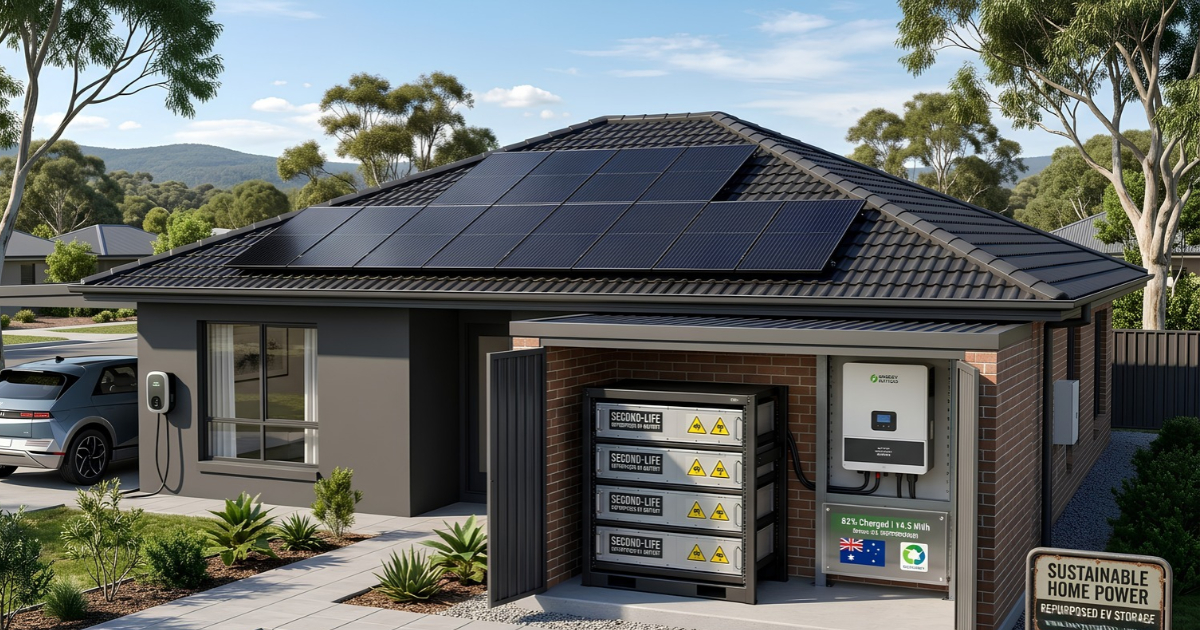
Australia’s growing fleet of electric vehicles could eventually provide more than cleaner transport. As EV batteries age, some retain enough capacity for stationary energy storage, creating an opportunity to reuse valuable materials and help households make better use of rooftop solar.
For homeowners exploring home solar systems, second-life EV battery home storage in Australia is an emerging option worth understanding. Instead of sending every retired vehicle battery directly to recycling, specialist businesses can assess, reconfigure and repurpose suitable units for storing electricity.
The idea is promising, but it is not as simple as connecting an old car battery to a house. Safety requirements, system compatibility, usable capacity and the availability of reliable installers all affect whether a second-life battery makes financial sense.
Energy Matters, Australia’s clean energy information and solutions publisher, examines the opportunities, limitations and practical considerations homeowners should know before choosing a repurposed EV battery. Compare new home battery options → Explore solar and battery quotes.
Quick answer
- Second-life EV batteries could offer a more affordable way to store solar energy by reusing vehicle batteries that no longer meet automotive performance requirements but still have useful storage capacity.
- Safety, certification, compatibility and warranty coverage are crucial. A used EV battery isn’t automatically suitable for a home installation, and a lower purchase price doesn’t guarantee lower lifetime costs.
- Australia’s second-life battery market is developing. Government-backed research and commercial trials show the potential, but homeowners should carefully compare available systems before committing to a repurposed battery.
What is second-life EV battery home storage and why should Australian homeowners care?
A second-life EV battery is a battery previously used in an electric vehicle that has been assessed for another application, usually stationary energy storage.
An EV battery may no longer deliver the range, charging performance, or reliability a driver demands. However, it could still store daytime solar electricity and supply a home after sunset.
The key facts
- Second life means reuse, not necessarily recycling. A suitable battery receives another useful application before its materials eventually enter recycling.
- Remaining capacity varies. Battery age, chemistry, temperature exposure, charging habits and previous use influence its condition.
- Professional assessment is essential. Professionals must evaluate capacity, internal resistance, cell balance, and battery management functions.
- Not every retired battery qualifies. Damaged, unsafe or severely degraded units may be unsuitable for reuse.
- The cheapest battery is not always the best investment. Installation, electronics, monitoring, maintenance and replacement costs all matter.
A repurposed EV battery may appeal to households wanting to reduce waste while increasing solar self-consumption. It could also support off-grid properties and selected commercial applications where suitable products are available.


Why this matters right now in Australia
Australia has the highest per-capita uptake of rooftop solar in the world, yet millions of households export surplus daytime power for minimal feed-in tariffs. While new stationary home batteries remain a major financial investment, second-hand EV battery storage promises to cut hardware costs significantly.
- Cost efficiency: Raw second-life EV battery cells can be up to 50% cheaper than brand-new stationary cells before final integration.
- Resource preservation: Processing retired packs onshore keeps valuable minerals like lithium, cobalt, and nickel in production cycles longer.
- Energy security: Storing cheap solar power shields households from volatile wholesale grid spikes during peak evening windows.
Expert insight: The strongest argument for second-life batteries is not simply that they are cheaper. Suitable batteries may deliver additional years of useful service before recycling, provided the economics and safety case stack up.
How second-life EV battery home storage works in Australia
Repurposing an EV battery involves considerably more than removing a battery pack from a vehicle and connecting it to a solar inverter.
A professionally engineered system must work safely with charging equipment, household electrical circuits, and control software.
The technical explanation
A typical second-life storage project follows several stages.
- Battery collection: Specialists recover a battery from a retired, damaged, or decommissioned EV.
- Health assessment: Specialists examine its condition, usable capacity, electrical characteristics and safety history.
- Reconfiguration: Specialists assemble suitable modules or packs into a stationary storage system with appropriate protection.
- Control integration: A compatible battery management system monitors voltage, temperature, current and other operating conditions.
- Installation and commissioning: Qualified professionals install the equipment, verify its operation and configure charging and discharging.
- Ongoing monitoring: The system is checked for faults, performance changes and maintenance requirements.
Once installed, the battery can store excess electricity generated by solar panels during the day. The household can then use that stored energy at night or during periods when solar generation falls.
The inverter, battery chemistry and management system must be compatible. Some EV batteries use different operating voltages and control arrangements than conventional residential storage products.

Australian examples and data
Australia already has practical experience with EV battery reuse, although residential availability remains less established than the market for purpose-built home batteries.
ARENA’s Relectrify project demonstrates the potential of repurposing Nissan Leaf batteries for stationary applications. Its reported 36 kW, 120 kWh configuration illustrates how second-life batteries can be integrated into a professionally engineered storage product. It should not be interpreted as a standard residential package or evidence that every Nissan Leaf battery can be reused economically.
The Guardian Australia also reported in September 2025 on growing interest in salvaged EV batteries for solar storage and off-grid power, highlighting activity in Australia’s vehicle salvage and reuse markets. This shows emerging interest, not proof that second-life residential systems are widely available or consistently cheaper than new products.
Expert insight: A credible second-life product should include documented testing, a clear battery management strategy, and a defined installation pathway. A loose battery pack sold online isn’t the same as a complete, professionally supported home storage system.
What Australian homeowners can do right now?
For most households, the safest starting point is to compare complete, supported battery systems before considering a repurposed EV battery.
Actionable steps
- Review your electricity usage. Review your bills and smart meter data to see when you use electricity and how much solar energy you export.
- Assess your solar system. Check inverter compatibility, available generation and whether your existing installation can support storage.
- Request complete system pricing. Ask for the battery, inverter, installation, electrical protection, commissioning and monitoring to be itemised.
- Verify safety and compliance. Ask for the applicable Australian standards, product certification and documentation for the exact configuration.
- Check warranties and service arrangements. Confirm who is responsible if the battery management system, cells or inverter fails.
- Check incentives before signing. Confirm eligibility with the relevant programme administrator or an appropriately qualified installer.
- Compare alternatives. Consider a new residential battery, improved energy efficiency or a different electricity tariff.
Households planning a wider electrification upgrade can also explore EV chargers, energy-efficiency improvements and a solar hot water system.
Questions to ask your installer or retailer
Before purchasing a second-hand EV battery storage system, ask:
- What is the battery's independently assessed usable capacity?
- Is the complete system suitable for residential installation in Australia?
- What testing and safety documentation is available?
- Is the battery management system compatible with the inverter?
- What are the round-trip efficiency and expected degradation?
- Is the system eligible for any applicable government incentives?
- Who provides the warranty, repairs and replacement parts?
- Does the installation include backup power, and which circuits will it support?
- What happens if the original battery manufacturer no longer supports the pack?
Expert insight: Do not buy a salvaged battery first and look for an installer later. Confirm the installation pathway, system compatibility and compliance requirements before paying a deposit.
Use Energy Matters’ easy-to-use solar power and solar battery storage system calculator to determine the right size for your solar system with storage. Our solar calculator will generate performance information and potential savings.
We can send this information to 3 pre-vetted, trusted local installers in your area so they can provide obligation-free solar quotes and help you take the first step toward true energy independence!

State-by-state considerations for second-life EV battery storage
The basic opportunity is similar across Australia, but local electricity networks, connection requirements, tariffs and incentive arrangements can change the financial outcome.
The Australian Government's Cheaper Home Batteries Program operates nationally, subject to its eligibility requirements. State-level offers and network rules may also apply, but homeowners should not assume a repurposed EV battery qualifies simply because a new residential battery does.
| State | What homeowners should check |
| Victoria (VIC) | Check current state energy offers, electricity tariffs, network connection requirements and the relevant distribution network's export rules. |
| New South Wales (NSW) | Review current NSW energy assistance programmes, local network requirements and whether the proposed battery meets applicable incentive conditions. |
| Queensland (QLD) | Check the relevant Energex or Ergon Energy network requirements, export limits and any current state or regional support. |
| South Australia | Review connection arrangements with SA Power Networks, export conditions and electricity tariffs that reward or penalise different usage patterns. |
| Western Australia | Check Western Power or Horizon Power requirements, depending on location, alongside Synergy or Horizon Power tariffs and current programme eligibility. |
In every state, the key question is whether the exact battery product and installation configuration are approved for the intended residential application.
A battery that works in a commercial demonstration or off-grid installation may not automatically be approved for connection to a home operating under different network and electrical requirements.
Expert insight: State incentives can change, and network rules vary by location. Confirm current conditions directly with your electricity distributor and the relevant government programme before making a financial decision.
Compare new home battery options → Get solar and battery quotes.
Expert predictions for 2027 and beyond
Second-life batteries are likely to become more relevant as Australia's EV fleet grows and more batteries reach the end of their automotive service life. The speed of adoption will depend on product availability, economics, safety and the development of reliable reuse and recycling pathways.
1. More standardised battery assessment
Consistent testing and reporting could make it easier for buyers to compare used EV battery home storage products. Clear information about remaining capacity, expected life and battery history would reduce uncertainty for households.
2. Better integration technology
Battery management systems and power electronics are central to making repurposed EV batteries practical. Improvements could reduce the complexity of integrating different battery types, although not every pack will be technically or economically suitable.
3. More competition from new batteries
The second-life market will compete with purpose-built home batteries, including products backed by established warranties and national installation networks.
Government incentives for eligible new batteries can also change the comparison. Reuse may be more attractive in particular applications, but it is not guaranteed to win on price.
4. Stronger links between reuse and recycling
Battery reuse can extend a product's useful life, while recycling can recover valuable materials when a battery is no longer suitable for further service. A mature industry will need both pathways.
ARENA's second-life battery work offers a practical foundation for learning which applications can work commercially. Meanwhile, CSIRO's research into vehicle-to-grid technology demonstrates another way EV batteries can support the electricity system while still serving their primary purpose in transport. These are related but distinct opportunities.
Expert insight: By 2027 and beyond, the most credible growth will likely come from professionally engineered products with measurable performance, clear safety documentation and dependable service support, rather than informal battery conversions.

Frequently asked questions
1. Are second-life EV batteries suitable for home storage in Australia?
Yes, some second-life EV batteries can be used for home energy storage when professionally assessed, engineered and installed in a compliant system. Suitability depends on the battery's condition, chemistry, control electronics, certification, and inverter compatibility. Homeowners should choose a supported product rather than connecting a salvaged battery pack themselves.
2. How much does a repurposed EV battery cost?
No single reliable Australian price exists for a complete second-life residential battery system. Costs depend on usable capacity, battery condition, testing, power electronics, installation and warranty coverage. Request itemised quotes and compare total installed costs against eligible new batteries, including any government incentives.
3. Can I use a Nissan Leaf battery to power my home?
Potentially. Australian second-life storage projects have used Nissan Leaf battery packs, including ARENA-supported work by Relectrify. However, converting a Nissan Leaf battery into residential storage requires appropriate engineering, battery management, electrical protection and compliant installation. Not every pack is suitable for reuse.
4. Are used EV batteries eligible for the Australian home battery rebate?
Eligibility depends on the current Cheaper Home Batteries Program requirements and the specific product and installation. A battery's ability to store solar energy does not automatically make it eligible for support.
5. Are second-life EV batteries better for the environment than new batteries?
Reuse can extend a battery's useful life and delay recycling or replacement. The overall environmental benefit depends on the battery's remaining life, refurbishment needs, efficiency, and eventual recycling. A suitable second-life battery can support a circular economy, but safe reuse and responsible end-of-life management remain essential.
Key takeaways
- Second-life EV batteries reuse suitable vehicle batteries for stationary energy storage.
- Battery condition, usable capacity, safety and compatibility determine whether reuse is practical.
- Lower battery purchase prices do not necessarily mean lower total installed costs.
- Check current government incentives and state network requirements for the exact system.
- Compare professionally supported second-life products with new residential batteries before committing.
Is second-life battery storage worth waiting for?
So, is second-life EV battery home storage Australia’s next big thing? Quite possibly, but expect commercial and community projects to lead, with household systems following once standards and warranties catch up. For now, a CEC-approved new battery remains the safer, rebate-friendly choice.
The smartest move today is to size your system correctly and compare real solar quotes.
Ready to explore your options? Energy Matters has helped Australians go solar for more than a decade, and our SAA-accredited installers can show you what suits your home. We can also help you compare solar and battery solutions for your property.
Get a free solar and battery quote and discuss suitable systems with pre-vetted installers before you decide.
Sources and References
- Australian Renewable Energy Agency: Relectrify second-life battery trial
- CSIRO: Vehicle-to-grid research, April 2025
- The Guardian Australia: Second-hand EV batteries and solar storage, September 2025
- Clean Energy Council: Battery storage safety checklist
- Australian Government: Solar PV and batteries guide