







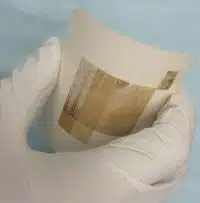
While paper silicon solar cells mightn’t be such a great thing; new technology developed by researchers at Delft University of Technology in the Netherlands that will make it possible is.
Printable electronics to date have mainly focused on the use of organic and metal-oxide ink materials given their compatibility with the application process. However, these materials don’t offer the same performance of silicon-based electronics.
There have been some inroads in the use of silicon ink, but this has been hampered somewhat by the thermal annealing process which sees temperatures of around 350C reached. This has meant some low cost substrates can’t be used due to their lack of resistance at such high temperatures.
Using excimer laser irradiation, Professor Ryoichi Ishihara and his team have formed poly-Si directly on top of paper with a single laser pulse lasting just a few tens of nanoseconds and at a maximum temperature of only 150 °C.
The method enables silicon device formation on inexpensive, temperature sensitive substrates such as polyethylene terephthalate, polyethylene naphthalate or even paper.
“We coated liquid polysilane directly on paper by doctor-blading, or skimming it by a blade directly in an oxygen-free environment,” said Professor Ryoichi Ishihara. “Then we annealed the layer with an excimer-laser [a conventional tool used for manufacturing smartphone displays]. And it worked.”
Thin-film transistors using the laser-printed layer exhibited mobilities as good as those demonstrated in conventional poly-silicon conductors.
The initial application of this development is in wearable electronics, but by further improving the production process of the thin-film transistors to incorporate additional non-silicon layers, Professor Ishihara says the process can be expanded to biomedical sensor and solar cell areas.
Professor Ishihara received his B.E., M. E., and Ph. D. degrees from Department of Physical Electronics, Tokyo Institute of Technology, Japan in 1991, 1993, and 1996. His main research activities include low-temperature chemical vapor deposition of silicon nitride film, fabrication of amorphous-Si and poly-Si thin-film transistors (TFTs) and more recently, excimer-laser crystallization of Si films.
He has been with Delft Institute of Microsystems and Nanoelectronics, Delft University of Technology, since 1996.
The Delft University team have described their work in Solution-Processed Polycrystalline Silicon On Paper