
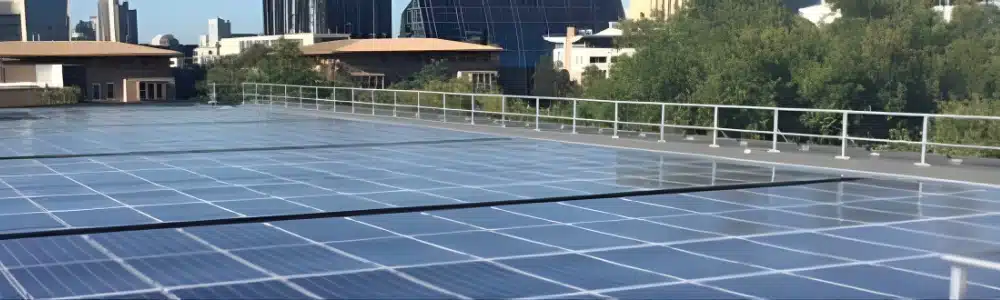
Energy Matters deployed a leading university solar PV system installation on the roof of the listed Wilson Hall at the University of Melbourne.
Did you know Energy Matters is Australia’s largest renewable news, blog and educational resource? Subscribe to Energy Matters’ weekly newsletter and keep updated even with incentives, rebates and recommended solar product offers.
Project overview
Location
Melbourne University, Victoria
System Size
100.88 kWp
Estimated Annual Production
400 MWh
Annual CO2 Savings
500 tonnes
Solar Panels
388 x Trina Solar Frameless 260W
Solar Inverter
2 x Fronius CL48.0
Mounting System
SunLock and Grace
Monitoring System
Solar-Log
Completion Date
February 2015
Energy Matters won this competitive tender because the experienced in-house design team created a solution that complied with heritage-listed building requirements and delivered an estimated 124.8 megawatt hours of power and offsetting 105 tonnes of carbon emissions annually.
To explore how solar energy can make a significant impact for your project or property, consider getting FREE solar quotes from Energy Matters. It’s a step towards sustainability that goes beyond cutting-edge technology, harmonising with the heritage and environmental considerations essential for projects like the one at Wilson Hall. Discover the potential of solar solutions that not only meet but exceed your energy needs, aligning seamlessly with your vision for a greener future.
Established in 1853, the University of Melbourne is Australia’s second-oldest university and the oldest in Victoria, which led to the impressive Wilson Hall being heritage-listed. Wilson Hall has a heritage overlay, and a permit exemption was required for the works associated with the installation.
The primary concern regarding the heritage permit exemption was that the work would not negatively affect the building’s cultural heritage significance.
An exemption was sought because no safety rails or other permanent safety features would be installed, and the solar installation would be visible from the street without detracting from the building’s appearance.
The installation, therefore, did not use tilt framing, despite a roof pitch of only 1°.
Traditional framed panels were used; the 1° roof angle would not be sufficient to allow panels to self-clean, and water would collect at the edges of the frame. Such a collection leads to panel soiling and an increased likelihood of water ingress into the panel, affecting efficiency and leading to additional maintenance costs. Instead, frameless solar panels were used for the system, which prevented water and dirt from collecting and encouraged runoff.
A total of 388 Trina Solar frameless panels were installed—the first commercial use of these modules in Australia. The 100.88 kW system showcased the expertise and innovation of Energy Matters’ in-house designed team, allowing the University of Melbourne to adopt solar energy on a difficult, heritage-listed roof.
Aside from demonstrating environmental stewardship, commercial solar can make good financial sense. Considering a commercial-scale solar project? Contact us today, and we can begin to build your Melbourne solar system together.