





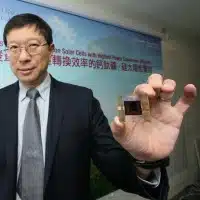
Researchers at the Hong Kong Polytechnic University (PolyU) have developed a perovskite-silicon tandem solar cell that has smashed the world record for conversion efficiency.
Scientists from PolyU’s Department of Electronic and Information Engineering used the novel solar material to create a hybrid solar cell with an efficiency of 25.5 percent – the highest level ever recorded.
The team, led by Professor Charles Chee Surya, claims the breakthrough could lower the cost of solar energy to HK$2.73/W (AUD 0.46 cents/W), compared to current market prices of HK$3.9/W (AUD 0.65 cents/W) for existing silicon solar cells.
As recently as 2009, perovskite solar cells barely delivered efficiencies above four percent. But the material’s powerful photovoltaic characteristics and the low cost of reproducing it in the lab has since led to multiple research teams around the world making major improvements to power conversion rates using perovskite.
In February last year Stanford researchers announced they had produced a tandem silicon/perovskite solar cell with an efficiency level of 17 percent. The team hoped this figure would reach upwards of 25-30 percent “within 10 years”. By the end of 2015, a Swiss team had produced a perovskite cell that converted 22.8 percent of solar energy.
The PolyU researchers used a three-tiered approach in creating their hybrid solar cell. The top layer, consisting of light-absorbing perovskite, captures short wavelength photons, while a bottom layer coated with silicon harvests longer wavelength photons.
The team then applied a sophisticated haze coating, developed by PolyU’s Institute of Textiles and Clothing, to the tandem solar cell. This mimics the surface morphology of rose petals and enables the device to trap more light.
Other innovative processes were invented to produce the new cell. Perovskite, a mineral composed calcium and titanium, is prone to defects, particularly when exposed to high levels of radiation. To counter this instability, the researchers treated it with an annealing process using dry oxygen at low temperatures.
To ensure light travels freely between the perovskite and silicon inside the cell, the team created a highly-transparent film of optimised thickness using a mix of molybdenum trioxide and gold.
PolyU said their work is ongoing. Their goal is to improve the power conversion efficiency as well as the performance of large-scale fabrication of perovskite-silicon solar cells.