




The next residential energy revolution is about to really kick into gear, with the value of the global smart home market expected to more than double over the next five years.
A smart home is one where appliances and other aspects can be automatically controlled through voice commands, biometrics or remotely via the internet using a handheld device such as a cell phone – and these appliances will increasingly be able to work in tandem with solar power systems.
Far from being a gimmick, the automation technologies involved will help people take more control over their homes and how they consume energy.
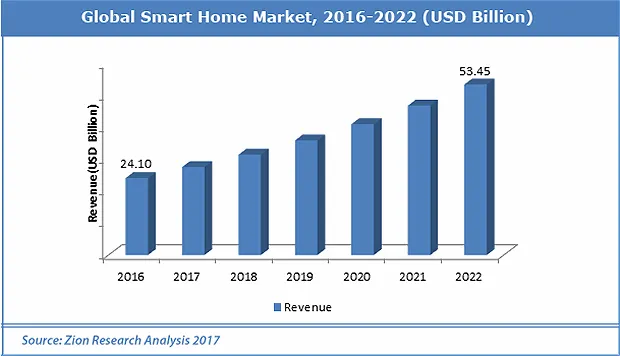
According to a report from Zion Market Research, the global smart home market was valued at around USD 24.10 billion last year and is expected to reach approximately USD 53.45 billion in 2022, achieving a compound annual growth rate of slightly above 14.5% between 2017 and 2022.
The company says a major growth driver for the smart home market is growing awareness among consumers about electricity consumption and energy efficiency.
Another recent report, from global management consulting firm A.T. Kearney, puts the current global smart home market at approximately $15 billion. However, this doesn’t include smart TVs and home solar power systems, which it says are ” inherently connected”.
A.T. Kearney estimates the total smart home market will rise to more than $50 billion in 2020 and then rapidly grow in five application categories to approximately $400 billion in 2030.
Among the categories to explode in growth will be the energy and resources management sector, which the firm forecasts will have experienced a compound annual growth rate of 30% between 2015 and 2030.
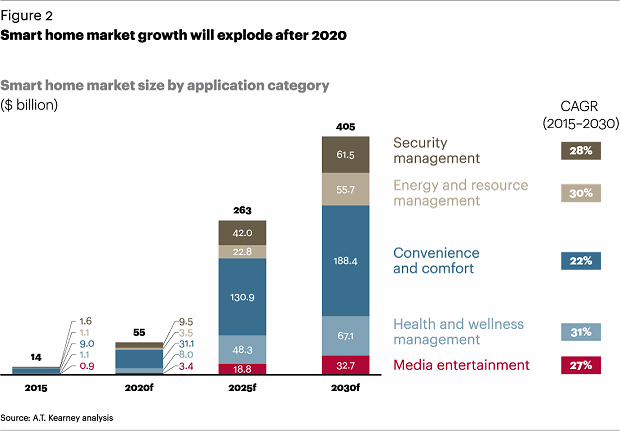
The company says the smart home industry is currently in the exploration phase; a situation that will change around the turn of the decade when it shifts into integration phase, followed by an expansion phase in 2025.
“Interoperability will no longer be an issue, and AI will be very advanced – making smart home products similar to a robot,” says the company.
Home automation will offer Australians more control, more comfort, more convenience and more options for controlling energy costs.
The day when solar + storage systems are commonly working seamlessly with home appliances in Australian homes as elements of the Internet of Things (IoT) is rapidly approaching – and as with solar and battery forecasts of the past, it may happen faster than predicted.
Related: