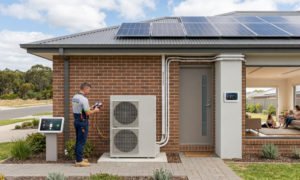







The Essential Services Commission has made a draft decision to alter the minimum Victorian feed-in tariff (FiT) rates from July 1, 2018.
Solar customers could get as much as 29 c/kWh at peak times of the week if the new rates are applied.
Two FiTs will be set: time-varying and single rates. Under the new draft rules, electricity retailers will need to offer at least one of these to their Victorian customers.
FiTs apply to customers that have installed renewable energy systems such as rooftop solar. These customers can receive a payment or reduction in their bills for any electricity they feed back into the main grid from their system. They do so by entering into a contract with a retailer.
FiTs serve several purposes. They encourage both the uptake of renewable energy systems and greater efficiency in energy use. They also promote diversification of electricity production and may assist Australia in meeting its climate goals.
Electricity consumption from the grid fluctuates during the day
Electricity consumption from the grid varies at different times of the day, as does energy production from solar. For example, a customer who has installed a solar power system is likely to be drawing more electricity from the grid after dark than at noon on a sunny day. They are therefore more likely to export or feed electricity back to the grid during the day.
However the peak hours for energy consumption are late in the afternoon / early evening as people arrive home from work and school, are cooking, using entertainment devices and climate control in their homes.

The new draft rules for Victorian feed-in tariff
The first Victorian feed-in tariff option, time-varying rates, reflects the underlying value of electricity based on the wholesale market. According to the Commission, these can vary every half-hour of the day.
The rate offered to customers in Victoria under a time-varying scheme is naturally going to be higher at peak time than at other times. The rates will be set as follows:
- Off-peak – 7.2 cents per kWh (c/kWh). Times: 10pm to 7am on weekdays and weekends.
- Shoulder – 10.3 c/kWh. Times: 7am-3pm and 9pm-10pm weekdays, and 7am-10pm weekends.
- Peak – 29 c/kWh. Times: 3pm-9pm weekdays only.
The second FiT option is a single-rate minimum of 9.9 c/kWh, which will not vary throughout the 24-hour period. This price has been weighted in line with typical export rates at various times of the day known as the solar export profile.
The choice of peak hour means that people who have Western facing roofs will find solar is now an even more attractive proposition. The peak hours for the high FiT are from 3pm to late, when the sun is in the West. Many people who already have solar now have a reason to upgrade to more efficient panels on a part of their roof they hadn’t considered before.
Reasoning behind the Victoria feed-in tariff decision
The Commission says the decision will allow customers to choose between retailers depending on the type of FiT retailers offer.
In addition, time variations are very difficult to measure without a smart metering system. Customers who have old meters may still be able to benefit from FiTs under a single-rate plan.
The Commission will be accepting submissions in response to its decision until January 29, 2018.