





Exponential growth in wind and solar places 100 per cent renewable energy within global reach by 2032, according to two Australian experts.
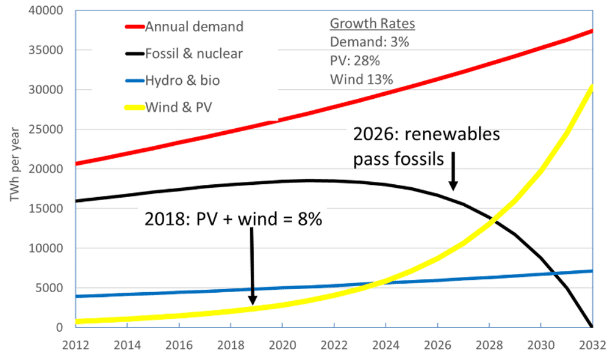
Professor of Engineering Andrew Blakers and Research Fellow Matthew Stocks, both from Australian National University (ANU), claim wind and solar panel installations are growing so fast they will overtake coal-fired power by the mid-2020s.
Battery storage and high-voltage inter-connectors can also stabilise the grid, according to the academics.
Because the cost of renewable energy is rapidly declining, it is cheaper than electricity produced by new-build coal and gas plants. It now costs between $55 and $70 per megawatt hour.
Energy storage key to future grid stability
According to ANU research, Australia’s leading energy storage technologies are pumped hydro and batteries. They have a combined market share of 97 per cent.
Storage combined with stronger interconnection between Australian regions can stabilise the grid. This balances the intermittent nature of sun and wind.
Solar storage batteries are also more viable than pumped hydro, according to the two engineering experts. Because of the limited number of rivers available for damming, hydro power is unlikely to keep pace with battery storage.
A number of large-scale battery storage projects are underway in Australia, including two in regional Victoria.
A recent report by the Australian Energy Market Commission (AEMC) also says battery storage can balance grid stability as coal-fired power stations are phased out.
100 per cent renewable energy from wind and solar
Meanwhile, a projected 100 per cent renewable scenario sees wind and solar energy making up 90 per cent. Based on figures from the Australian National Electricity Market, hydro electricity and biomass then make up the remainder.
Because ‘heroic’ growth rates in alternative clean energy sources are needed to compete with solar, they are unlikely to catch up. Wind and solar power have therefore become ‘overwhelmingly dominant’ due to:
- Rapidly falling costs.
- Free and readily available sun and wind sources.
- No requirement for a large land area.
- Modular and scalable technology.
Other competing low-emissions technologies include nuclear, carbon capture, carbon storage, concentrated solar thermal, ocean and geothermal power. None of these are likely to take off on an equivalent scale, the authors claim.