
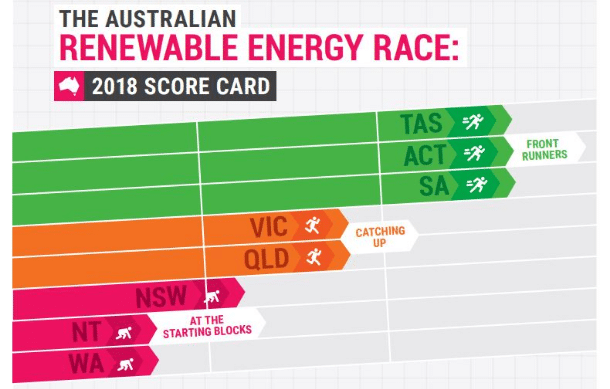
Tasmania, ACT and South Australia are the leading renewable energy states, while Western Australia, and Northern Territory trail behind.
That’s the finding of a Climate Council report, which shows more solar PV capacity was added globally in 2017 than coal, natural gas and nuclear combined.
Last year, Tasmania achieved more than 87 per cent share of renewable energy including hydroelectricity. ACT reached more than 46 per cent and SA more than 43 per cent.
Yet NT settled at 3 per cent with Queensland and WA slightly more than 7 per cent.
Renewable energy states lead as federal government falters
The report, ‘Powering Progress: States Renewable Energy Race’ shows all states and territories making progress in their transition from fossil fuels to renewable energy including solar panels and battery storage.
Yet emissions are still rising in Australia. As a result, the report says it will fail to meet its carbon reduction targets of 26-28 per cent below 2005 levels by 2030.
Subsequently, states are stepping in to tackle climate change and boost renewable investment, the report notes.
Apart from Western Australia, all states and territories have committed to renewable energy targets and/or net zero emissions goals.
How the solar stakes shape up
South Australia, the ACT and Tasmania have more wind and solar energy capacity per person than the other states and territories.
South Australia has the largest amount of installed large-scale wind and solar capacity (1,831 MW). SA is closely followed by NSW (1,759 MW) and Victoria (1,634 MW).
Queensland boasts the highest proportion of households with rooftop solar, 32.9 per cent, closely followed by South Australia (32.3%) and Western Australia (26.7%).
There are now also 26 Australian suburbs and towns where more than half of all households have rooftop solar installations. Nineteen of these are in Queensland, four in South Australia, two in NSW and one in WA.
Renewable energy goals of Australian states and territories
- Tasmania: aims to be 100 per cent renewable by 2022.
- ACT: aims for 100 per cent renewable by 2020.
- SA: no renewable energy target, but on track for 73 per cent renewable by 2020.
- Victoria: wants 25 per cent renewable by 2020 and 40 per cent by 2025.
- Queensland: aims for 50 per cent renewable by 2030; has largest number of projects under construction.
- NSW: no renewable energy target and over-reliance on coal, but has a strong renewable pipeline.
- NT: aims for 50 per cent renewable by 2030, but there is a long way to go.
- WA: only state with no renewable energy target or net zero emissions target.