




When we talk about climate change, most people think first about power stations or factories. But one of the biggest sources of Australia’s carbon emissions actually comes from how we get around. Transport makes up nearly a fifth of the nation’s emissions, and most of it comes from cars running on petrol or diesel.
Australia is one of the most car-dependent countries in the world. In many cities, driving is the default because public transport networks are limited or stretched thin. This heavy reliance on private cars doesn’t just clog roads and raise fuel bills; it also pumps millions of tonnes of carbon dioxide into the air every year.
Public transport offers a different path. Instead of each person burning fuel in their own vehicle, buses, trains, and trams move large numbers of people at once, spreading the emissions over many passengers. As these systems shift to electric power, especially from renewable energy, their carbon footprint can shrink even further.
Understanding the role of public transport in reducing emissions is vital. It’s not only about saving the environment—it’s about building cleaner, healthier, and more affordable cities for everyone.
On this page





Did you know Energy Matters is Australia’s largest renewable news, blog and educational resource? Subscribe to Energy Matters’ weekly newsletter and keep updated even with incentives, rebates and recommended solar product offers.
Cars vs public transport: The big difference
Every time you start a car, fuel burns and carbon dioxide is released into the atmosphere. The more cars on the road, the more fuel is consumed and the more emissions are produced. In Australia, where most households own at least one car, the impact adds up quickly.
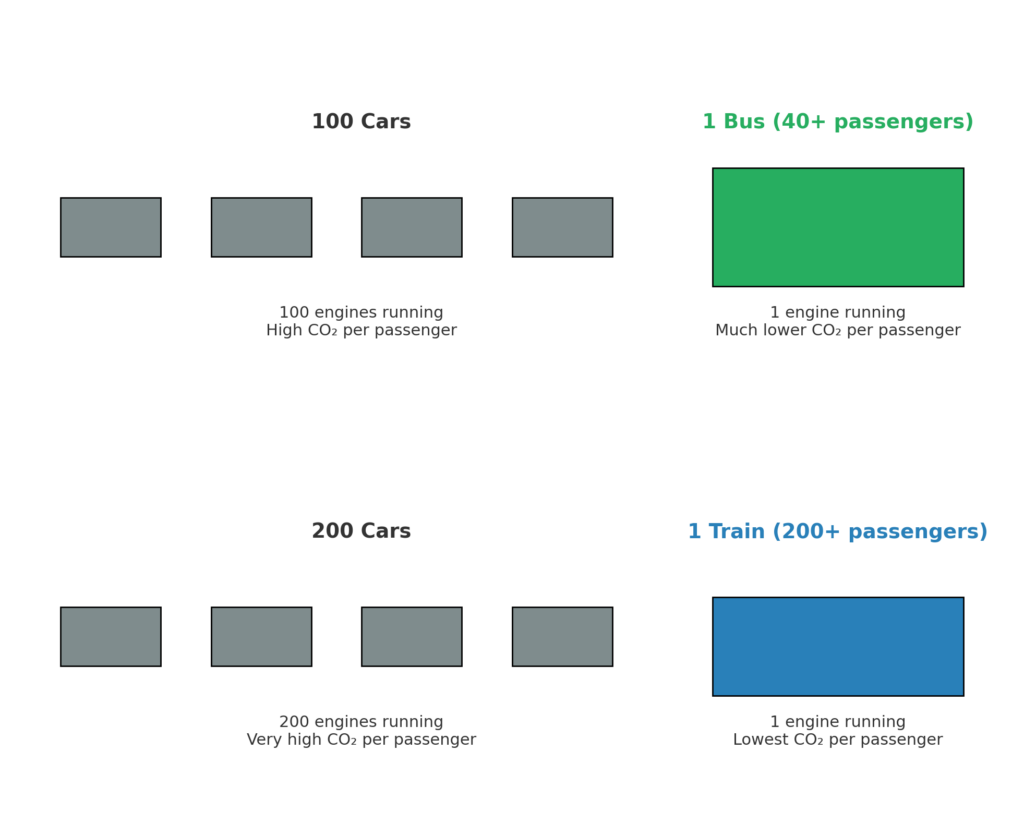
Public transport works differently. A bus, tram, or train uses energy too, but instead of carrying one or two people, it can move dozens or even hundreds at once. This means the emissions are spread across many passengers, making the carbon cost per person far lower.
To picture it, imagine 40 people driving separate cars into the city. That’s 40 engines burning fuel and releasing exhaust. Now compare it with one bus carrying the same 40 people. Only one engine is running — and in many cases, that bus is becoming cleaner as fleets switch to electric or hybrid models.
Trains take this even further. A single train carriage can carry as many people as several lines of cars, but with a fraction of the emissions per passenger, especially when powered by renewable electricity.
The difference is simple but powerful: more passengers per vehicle equals less pollution per person. This is the key reason public transport can play such a big role in cutting Australia’s transport emissions.
How public transport slashes emissions
The difference between private and public transport comes down to one simple fact: efficiency. A typical petrol car emits around 190 grams of carbon dioxide for every kilometre travelled. When that vehicle carries only one or two passengers, the carbon cost per person quickly stacks up. Multiply that by millions of daily commutes, and cars become one of the largest contributors to urban emissions in Australia.
Public transport, by contrast, spreads the emissions of a single vehicle across dozens, sometimes hundreds, of passengers. A modern bus produces roughly 8 grams of CO2 per kilometre per passenger, while an electric train can fall below 40 grams. Less efficient diesel trains still carry far more people per unit of fuel than cars ever can.
The real power lies in scale. A single busy bus route can take hundreds of cars off the road each day, cutting congestion as well as emissions. Rail networks multiply this effect even further by moving thousands of passengers in a single trip. Every additional rider choosing the bus, tram, or train strengthens the emissions-saving impact.
Health and air quality benefits
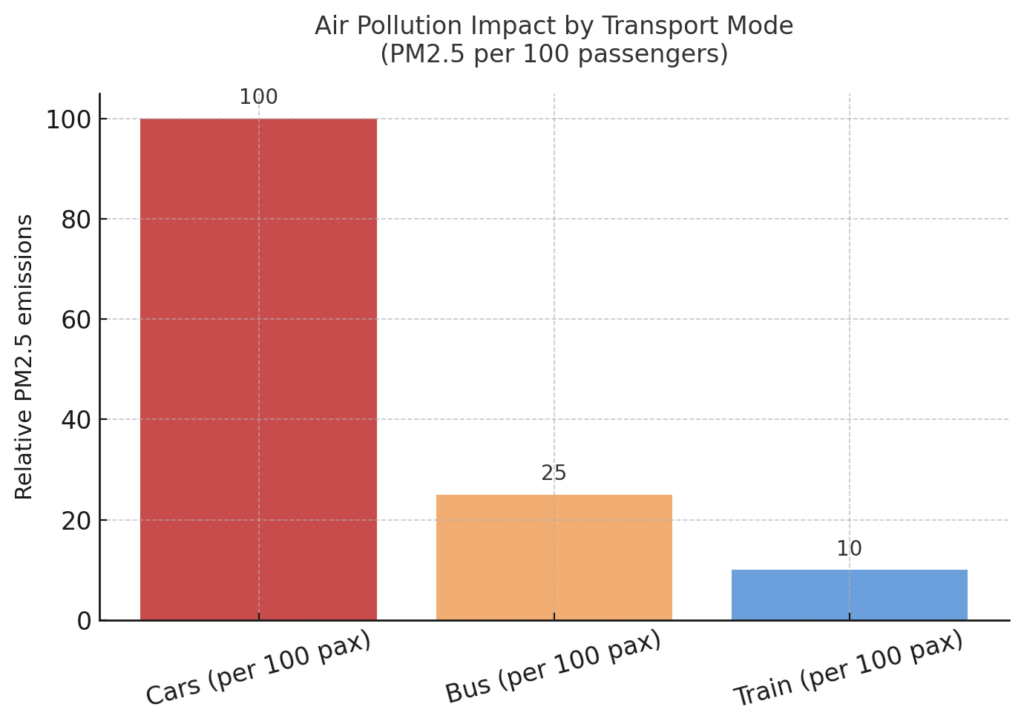
The emissions debate is often framed in terms of climate change, but the day-to-day health impacts are just as significant. Cars release carbon dioxide and nitrogen oxides, and fine particulates that linger in the air. These pollutants are linked to asthma, respiratory illness, and cardiovascular problems, especially in densely populated urban areas.
By shifting more commuters onto buses, trams, and trains, cities can reduce the concentration of harmful air pollutants. Fewer cars on the road mean cleaner air for pedestrians, cyclists, and residents living near major roads. The World Health Organisation (WHO) has consistently warned that traffic pollution is one of the leading environmental risks to public health, and studies in Australian cities show that local air quality improves when traffic volumes fall.
The benefits ripple outward. Cleaner air lowers the strain on the healthcare system, improves quality of life, and even boosts productivity by reducing sick days linked to pollution-related illnesses. Public transport also tends to encourage more walking at the start and end of trips, which contributes to better physical health and reduces the overall burden of sedentary lifestyles.
The Australian context
Australia’s transport system has long been shaped by car dependency. Wide suburban layouts and limited investment in mass transit left many cities with some of the highest per-capita car use in the world. This reliance has major consequences: in 2023, transport was the third-largest source of greenhouse gas emissions, with passenger vehicles accounting for more than half of that total.
Cities are now working to change course. Sydney and Melbourne have both invested heavily in expanding metro and light rail networks, while Brisbane is introducing “Metro” bus rapid transit system designed to cut congestion along busy corridors. Regional areas still face challenges, with limited public transport leaving many residents reliant on cars for even short trips.
Electric buses are another part of the transition. States such as New South Wales and Victoria have announced plans to phase out diesel buses, with fleets gradually shifting to electric over the coming decade. These vehicles not only cut carbon emissions but also reduce noise and local air pollution, improving the livability of urban areas.
Australia’s unique energy mix also plays a role. Public transport powered by coal-heavy electricity grids delivers fewer benefits than systems linked to renewables. This is why electrification and clean energy expansion must move together. As more solar and wind power is added to the grid, the emissions advantage of electric trains, trams, and buses will grow even further.
Economic benefits: Cost savings for households and cities
One of the strongest arguments for public transport is economic. For households, relying less on cars means avoiding the full weight of ownership costs: purchase price, fuel insurance, registration, and maintenance. The Australian Automobile Association estimates the average family in capital cities spends more than $20,000 a year running their vehicles. Even replacing some car trips with public transport can free up a significant portion of a household budget.
Fuel is a clear example. A bus or train ticket often costs less than the petrol required for the same journey by car, particularly during periods of high fuel prices. For regular commuters, savings accumulate quickly. In metropolitan areas with capped weekly fares, families can plan predictable transport expenses rather than dealing with fluctuating petrol and maintenance cots.
For cities, public transport offers efficiencies that private vehicles cannot. Building and maintaining road networks is costly, and congestion adds further economic losses through wasted time and productivity. Expanding high-capacity transport reduces pressure on road systems, lowers infrastructure costs in the long run, and avoids the environmental and health costs tied to heavy traffic.
Investment in public transport also drives broader economic benefits. New rail lines, metro systems, and electric bus networks create jobs during construction and operation, while also stimulating local economies by improving accessibility to businesses and services. These ripple effects mean that investment in sustainable transport can often deliver stronger returns than continuing to expand road infrastructure alone.
Future innovations: Smarter, cleaner systems ahead
Public transport is not standing still. Across Australia, cities and operators are testing technologies that could transform how people move while cutting emissions even further.
Artificial intelligence is already being trialled to improve scheduling and routing. By analysing traffic flows and passenger demand in real time, AI can optimise services so that buses and trains run more efficiently, avoiding wasted fuel and unnecessary trips. This also makes transport more reliable, encouraging more people to leave their cars at home.
Energy integration is another major shift. As Australia’s electricity grid becomes more renewable, public transport fleets are increasingly linked to solar and wind power. Some projects are even exploring localised microgrids—systems that generate and store power close to where it’s needed. For example, electric bus depots could be paired with rooftop solar and battery storage, ensuring vehicles are charged with clean energy rather than coal-heavy grid power.
Emerging concepts also include vehicle-to-grid (V2G) systems, where parked electric buses can feed stored energy back into the grid during peak demand. This helps stabilise supply while reducing reliance on fossil-fuel peaking plants. In the long run, transport could become not just a consumer of energy but an active part of the solution to balancing Australia’s power system.
Public transport as a pathway to cleaner futures
Public transport is more than just a way of getting from one place to another. It represents one of the most effective tools Australia has for cutting carbon emissions, improving air quality, and reducing household costs. Shifting even part of the nation’s reliance from private cars to buses, trains, and trams can deliver measurable environmental gains while also making cities healthier and more liveable.
For households, the benefits show up in smaller fuel bills, fewer maintenance costs, and more predictable transport spending. For cities, investing in efficient, renewable-powered public transport reduces the financial burden of expanding roads while delivering long-term returns through economic growth, cleaner air, and healthier populations.
Future innovations—from AI-driven scheduling to renewable-powered microgrids—mean these benefits will only grow. By connecting transport more closely with Australia’s clean energy transition, public systems can help decarbonise both mobility and the grid.
The key takeaway is simple: each bus, tram, or train that takes cars off the road multiplies into broader gains for households, communities, and the climate. Public transport is not just about moving people. It’s about moving Australia toward a sustainable and resilient future.