
Pumped hydro energy storage (PHES) is the oldest and most widely used form of large-scale energy storage in the world. At its core, it uses electricity to move water uphill when demand is low, then releases the water downhill through turbines to generate electricity when demand is high. Its ability to store energy in the form of water’s potential energy has made pumped hydro the backbone of electricity systems for more than a century.
As more countries adopt renewable power, pumped hydro has taken on a renewed importance. Unlike fossil fuel plants that can be switched on when needed, solar and wind power depend on the weather and the time of day. Pumped hydro helps bridge that gap by acting as a giant natural battery, storing surplus energy when it’s abundant and returning it to the grid when it’s needed most. With high efficiency, long lifespans, and proven reliability, it remains a cornerstone technology for building secure and sustainable energy systems.
On this page




The basic concept
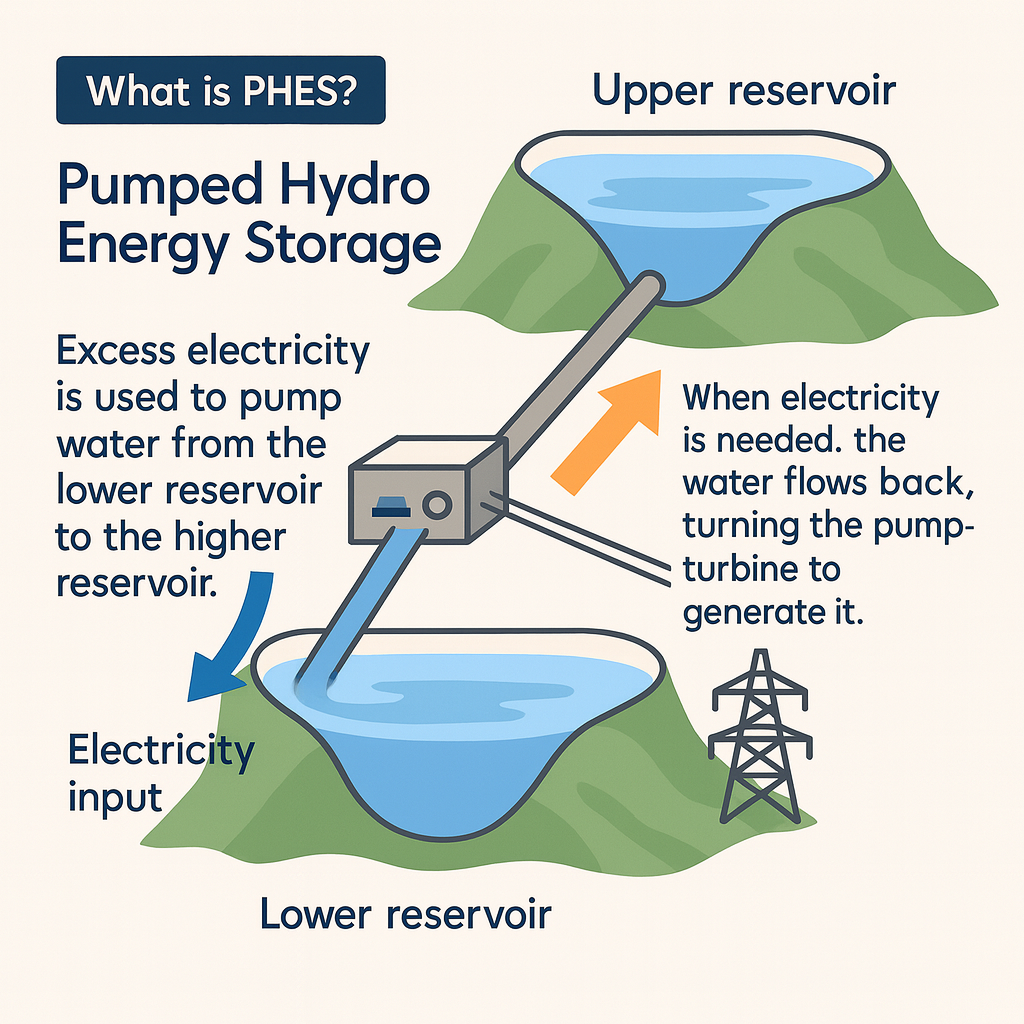
Pumped hydro works by moving water between two reservoirs located at different elevations. When there is excess electricity on the grid (often from renewable sources like wind or solar), that energy is used to pump water from the lower reservoir up to the higher one. This uphill movement effectively stores the energy in the form of gravitational potential.
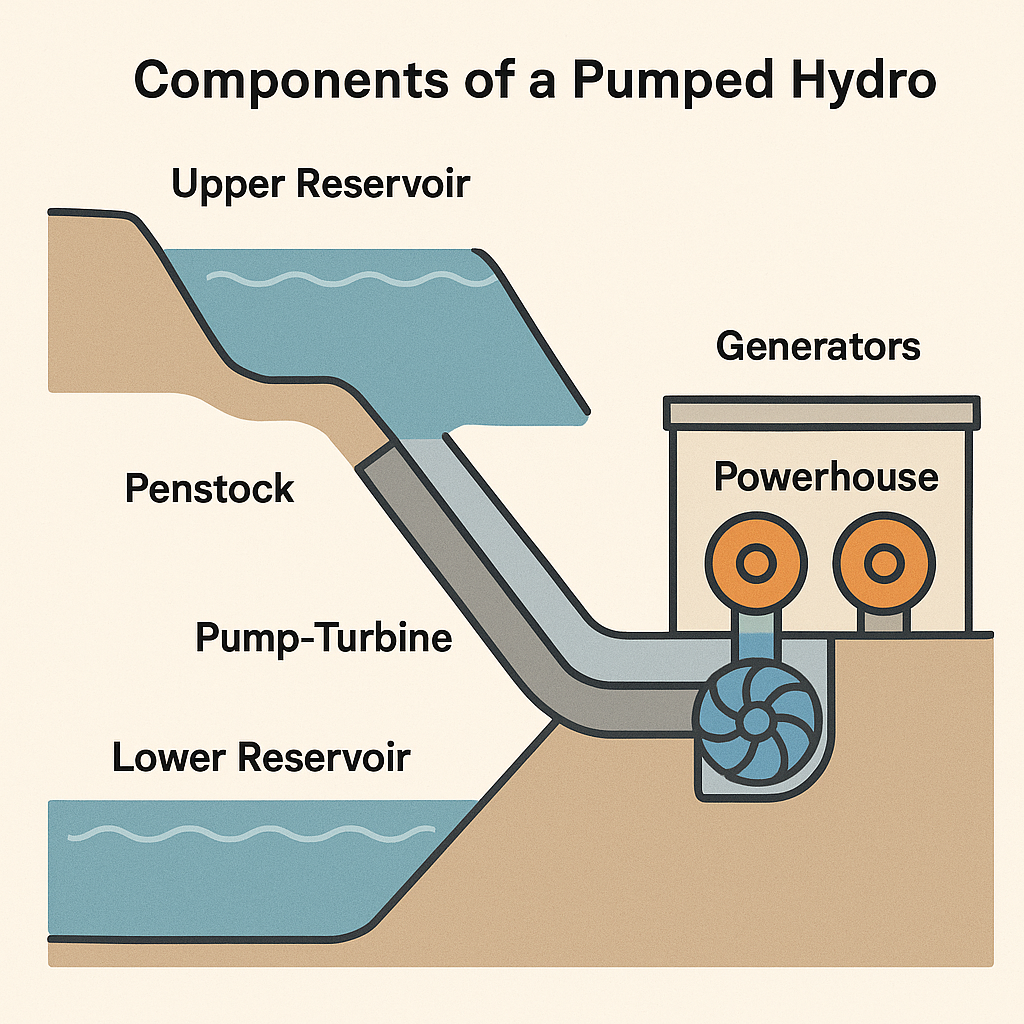
When electricity demand rises, the process is reversed. Water is released from the upper reservoir, flowing downhill through large pipes called penstocks. As the water rushes through, it spins turbines connected to generators, producing electricity that can be fed back into the grid. The same turbines are often reversible, serving both as pumps and as generators depending on which way the water is moving.
This cycle of storing and releasing energy is what makes pumped hydro so effective. It can respond quickly to changes in electricity demand, shifting from pumping to generating in a matter of minutes. By converting surplus energy into stored potential energy and back into electricity when needed, pumped hydro provides a simple yet powerful solution to balancing the modern grid.
Step-by-step process
The operation of pumped hydro can be understood as a repeating cycle of storing and releasing energy. Here’s how it works in practice:
- Storing energy (pumping mode)
When there is more electricity on the grid than people are using (often during the middle of the day when solar output is high, or overnight when demand is low) that surplus power is put to work. It drives powerful pumps that push water from the lower reservoir up to the higher one. Although this consumes electricity, it is effectively charging the system, just like charging a battery.
- Holding potential energy
Once the water is in the upper reservoir, it simply waits. The energy has been stored in the form of gravitational potential — the higher the water sits, the more energy is available for release. The size of the reservoirs and the difference in height between them (known as the “head”) determine how much electricity can later be produced.
- Generating electricity (generation mode)
When electricity demand rises, the process is reversed. Gates are opened at the upper reservoir, allowing water to surge downhill through massive pipes known as penstocks. As the water flows down, it spins turbines, which in turn drive generators to produce electricity. This power is then fed back into the grid, ready to supply homes, businesses, and industry.
- Repeating the cycle
After the water reaches the lower reservoir again, the system is ready to start over. During the next period of low demand and cheap electricity, the pumps switch on, and the cycle continues. With the ability to move from pumping to generating inputs in a few minutes, pumped hydro provides a fast and reliable way to balance electricity supply and demand.
Types of pumped hydropower storage
Not all pumped hydro systems are built the same way. Their design depends on geography, water availability, and environmental considerations. Here are the main types you’ll find in use today:
- Open-loop systems: In an open-loop setup, at least one of the reservoirs is connected to a natural water source such as a river or a lake. This means the reservoirs can be replenished naturally, but it also means the project must carefully manage its impact on surrounding ecosystems and water flows.
- Closed-loop systems: Closed-loop systems are independent of natural waterways. Both reservoirs are man-made and isolated, with water circulating only within the system. This reduces the environmental impact and makes it easier to control, though it requires a reliable initial water supply and careful maintenance.
- Conventional reservoir systems: These are the large-scale facilities most people picture when thinking of hydropower. They use purpose-built dams and reservoirs to provide significant storage capacity and can serve national grids for decades.
- Underground and innovative systems: Engineers are now exploring creative ways to expand pumped hydro. Disused mines and quarries can be repurposed as reservoirs, reducing the need for new construction. Some projects even propose using seawater, which opens up opportunities in coastal areas. These designs highlight how pumped hydro continues to evolve alongside new energy needs.
Efficiency and performance
One of the reasons pumped hydro has remained such a valuable technology is its relatively high efficiency compared with other forms of energy storage. On average, a pumped hydro system can return about 70 to 85 per cent of the electricity that was originally used to pump the water uphill. The rest is lost through friction in pipes, turbulence in the water, and the conversion processes inside pumps and turbines.
The efficiency of a plant depends largely on the head (the height difference between the upper and lower reservoirs), the design of the turbines and penstocks, and the smoothness of the system’s operation. Well-designed plants with large elevation differences tend to perform at the higher end of the efficiency range.
In practice, this means that if 100 megawatt-hours are used to pump water uphill, between 70 and 85 megawatt-hours can later be generated when the water flows back down. While no storage method is perfect, pumped hydro compares favourably with alternatives. For example, hydrogen energy storage typically achieves only 30 to 40 per cent efficiency, while grid-scale batteries vary between 85 and 95 per cent but cannot match pumped hydro’s scale or longevity.
This balance of efficiency, capacity, and durability is what makes pumped hydro uniquely suited for stabilising electricity systems and supporting renewable energy.
Environmental and geographical factors
Pumped hydro relies on the right natural conditions, which is why location is one of the most important factors in developing a project. At its core, the system needs two reservoirs at different elevations with enough distance between them to create a significant height difference, or “head.” The larger the head, the more energy can be stored. A reliable water supply is also necessary, though closed-loop systems are less dependent on natural sources.
However, building a pumped hydro facility can have environmental impacts that must be carefully managed. Open-loop systems connected to rivers or lakes can affect aquatic habitats, water quality, and natural flow patterns. Large reservoirs may also require significant land use, with consequences for local ecosystems and communities.
To reduce these challenges, developers are increasingly turning to closed-loop systems, which isolate reservoirs from natural waterways and limit environmental disruption.
There is also growing interest in repurposing existing landscapes, such as abandoned mines, quarries, or even coastal areas, for seawater pumped hydro. These approaches lower the need for new land use and can turn otherwise underutilised sites into clean energy assets.
Geography, environment, and technology must work together to make pumped hydro viable. Careful planning ensures that projects deliver reliable storage while protecting the surrounding environment.
Role in the energy systems
Pumped hydro plays a vital role in keeping modern electricity systems stable and reliable. Because it can both absorb excess electricity and release it quickly, it acts as a balancing tool that ensures supply is always matched to demand.
One of its most important functions is to support renewable energy. Solar and wind power are clean but variable—the sun doesn’t shine at night, and wind strength can change from hour to hour. Pumped hydro helps bridge these gaps by storing surplus renewable energy when it’s available and delivering it back to the grid when conditions change.
The technology also provides a range of grid services that go beyond simple storage. Pumped hydro can regulate frequency, provide backup during outages, and help restart the grid after a blackout (something known as “black-start capability”). Its ability to ramp up or down within minutes makes it ideal for responding to sudden changes in demand or generation.
Unlike batteries, which are usually sized for shorter bursts of power, pumped hydro is designed for long-duration storage. It can supply electricity for hours or even days, depending on reservoir capacity. Combined with its decades-long lifespan, this makes it one of the most trusted foundations of national and regional power networks.
Pumped Hydro in the Energy System
Role | What It Means | Why It Matters |
Balancing supply & demand | Stores surplus electricity and releases it when demand is high | Keeps the grid stable and prevents waste of renewable energy |
Supporting renewables | Smooths out variable solar and wind generation | Ensures clean energy can meet demand even when the sun isn’t shining or wind drops |
Grid services | Provides frequency regulation, voltage support, and black-start capability | Maintains reliable electricity supply, even during sudden disruptions |
Long-duration storage | Delivers electricity for hours or days, depending on reservoir capacity | Covers extended periods when renewables produce less power |
Fast response | Switches between pumping and generating within minutes | Helps operators react quickly to demand spikes or generation dips |
Longevity | Operates effectively for decades with proper maintenance | Provides a durable, cost-effective backbone for national grids |
Applications of pumped hydro
Beyond its roles in balancing the grid, pumped hydro has a wide range of practical applications that demonstrate its flexibility and value.
- National electricity grids: Large pumped hydro facilities are often integrated into national or regional electricity networks, where they help smooth out fluctuations in demand and supply. They can provide backup during peak hours, reduce reliance on fossil fuels, and allow more renewable power to be integrated into the system.
- Remote and off-grid communities: In areas far from central electricity grids, pumped hydro can work alongside solar or wind to form hybrid energy systems. By storing surplus renewable energy and releasing it when needed, these systems provide a more consistent power supply, reducing the need for costly diesel generators.
- Industrial use: Energy-intensive industries, such as mining and manufacturing, benefit from a reliable power supply. Pumped hydro can ensure that sudden fluctuations in the grid do not disrupt operations, helping protect both productivity and equipment.
- Emergency backup: Because it can switch from idle to full generation within minutes, pumped hydro is an effective emergency backup. It can help restore electricity after outages and provide critical stability during natural disasters or other grid disturbances.
- Cross-border electricity trading: In some regions, pumped hydro also supports energy trading between countries. By storing electricity when it is cheap and abundant and releasing it when prices rise, it enables more efficient and profitable cross-border power flows.
These applications show that pumped hydro is not just about storage. It is a versatile tool that supports communities, industries, and entire nations as they move toward cleaner and more resilient energy systems.


Advantages and limitations
Pumped hydro has stood the test of time because of its unique strengths, but it also comes with challenges that limit where and how it can be built.
Advantages
- Proven and mature technology: Pumped hydro has been used for more than a century, with many plants operating reliably for decades. Unlike newer technologies, it is well-understood and trusted by grid operators worldwide.
- Massive storage capacity: Unlike batteries, which are best suited to shorter bursts of energy, pumped hydro can store gigawatt-hours of electricity, enough to power entire regions for many hours or even days.
- High efficiency: With a round-trip efficiency of 70-85%, it is one of the most effective ways to store electricity at scale.
- Rapid response: Pumped hydro can shift from pumping to generating within minutes, making it ideal for balancing sudden changes in electricity supply or demand.
- Long lifespan: With proper maintenance, pumped hydro facilities can last 50-100 years, outliving most other storage technologies and spreading costs over a much longer period.
Limitations
- Geographic constraints: Suitable sites need a significant elevation difference between the two reservoirs and access to water. This restricts where projects can be developed.
- High upfront costs and long timelines: Building dams, tunnelers, and reservoirs requires billions in investment and often a decade or more of planning and construction.
- Environmental impacts: Large-scale construction can affect local ecosystems, water flows, and land use. Even with mitigation strategies, these impacts must be carefully assessed.
- Less flexibility for small-scale use: While ideal for national or regional grids, pumped hydro is not practical for smaller applications where batteries or other technologies may be better suited.
Pumped hydro is not a one-size-fits-all solution. Where geography and resources allow, it remains unmatched in scale, durability, and reliability. Where conditions are less favourable, alternative storage methods often fill the gap.
Pumped hydro vs. hydrogen storage
As the world looks for ways to store renewable energy, hydrogen is often discussed alongside pumped hydro. While both can help balance clean energy systems, they differ in how they work, how efficient they are, and where they are most useful.
How hydrogen storage works
Hydrogen storage begins with electrolysis, using electricity to split water into hydrogen and oxygen. The hydrogen can then be compressed, stored in tanks or underground caverns, and later used in fuel cells or turbines to generate electricity. Unlike pumped hydro, hydrogen can also be used directly in transport, heating, or industry.
Efficiency comparison
This is where pumped hydro has the edge. It achieves 70-85% efficiency, meaning most of the energy used to pump water uphill can be recovered. Hydrogen, by contrast, typically has only 30-40% round-trip efficiency once you account for the losses in electrolysis, storage, and conversion back to electricity.
Maturity of technology
Pumped hydro is well-established, with more than 90% of the world’s large-scale energy storage coming from this method. Hydrogen is still developing at the grid scale and requires significant investment in infrastructure before it can compete widely.
Flexibility and applications
Hydrogen’s strength lies in its versatility. It can store energy for months or seasons, making it useful for addressing longer gaps in renewable supply. It can also be used beyond electricity, in vehicles, industrial processes, and as a substitute for natural gas. Pumped hydro, by contrast, is tied directly to electricity grids and is most effective for daily or weekly balancing.
Cost and infrastructure
Both technologies require heavy investment, but in different ways. Pumped hydro needs suitable geography and large civil works, while hydrogen requires new electrolysers, pipelines, storage facilities, and conversion systems.
Complementary roles
Rather than competing, the two are likely to work side by side. Pumped hydro is best for short-to-medium-term storage and rapid grid balancing, while hydrogen offers a pathway for seasonal storage and cross-sector decarbonisation. Together, they can cover different parts of the energy storage puzzle.
Future Outlook
Pumped hydro may be a century-old technology, but its role in modern energy systems is far from outdated. In fact, as countries move toward renewable-heavy grids, its importance is only growing.
Expanding renewable integration
With solar and wind providing an increasing share of electricity, storage is no longer optional — it is essential. Pumped hydro is set to remain the backbone of large-scale storage, ensuring that renewable energy is available not just when the weather allows, but whenever society needs it.
Innovations in design
New projects are moving beyond traditional dams and valleys. Engineers are exploring underground pumped hydro in abandoned mines, closed-loop systems that are isolated from natural waterways, and even seawater-based plants in coastal areas. These innovations could open up new opportunities in regions previously thought unsuitable.
Hybrid systems
Future grids are likely to combine pumped hydro with other technologies, such as batteries and hydrogen. Batteries will handle short bursts of demand, hydrogen will cover long-term and cross-sector needs, and pumped hydro will continue to provide medium-to-long duration storage with unmatched scale and reliability.
Policy and investment trends
Governments are increasingly recognising the strategic value of pumped hydro. Long project timelines mean early investment is critical, and many countries are now supporting feasibility studies, streamlined approvals, and financing mechanisms to accelerate development.
Global outlook
From Australia’s Snowy 2.0 to Europe’s underground concepts, pumped hydro projects are advancing across the world. The challenge will be balancing cost, environmental impact, and construction timeframes with the urgent need for storage. If addressed, pumped hydro will remain a cornerstone of net-zero energy strategies well into the future.
Pumped hydro remains the world’s most trusted large-scale energy storage solution. With its ability to store vast amounts of electricity, respond quickly to demand, and operate for decades, it continues to anchor renewable energy systems. While new technologies like hydrogen and batteries will complement it, pumped hydro’s proven reliability ensures it will stay central to the clean energy transition.
Energy Matters has been in the solar industry since 2005 and has helped over 40,000 Australian households in their journey to energy independence.
Complete our quick Solar Quote Quiz to receive up to 3 FREE solar quotes from trusted local installers – it’ll only take you a few minutes and is completely obligation-free.