



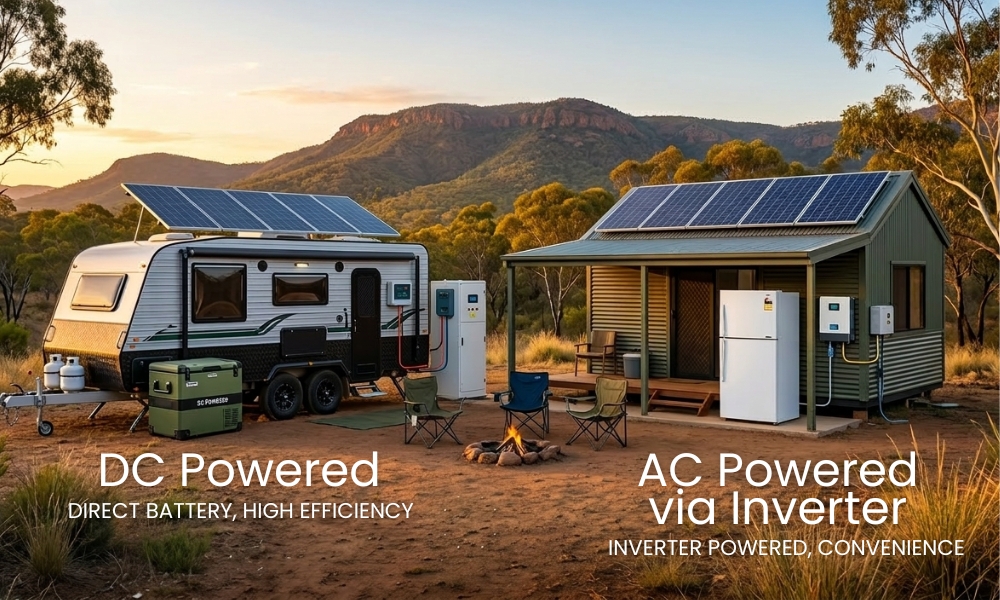
Choosing between a DC refrigerator and an AC refrigerator is a critical decision for anyone living off-grid in Australia. This choice impacts your solar array size, battery capacity, and overall daily comfort. Whether you are outfitting a remote homestead or a caravan, understanding how these cooling technologies perform in the harsh Australian climate is essential for long-term energy independence.
On this page



Did you know Energy Matters is Australia’s largest renewable news, blog and educational resource? Subscribe to Energy Matters’ weekly newsletter and keep updated even with incentives, rebates and recommended solar product offers.
Understanding the core technology
A DC (Direct Current) refrigerator is designed to run directly off battery power, typically at 12V or 24V. These units use highly efficient compressors specifically engineered for variable power inputs. Because they don’t require an inverter, they eliminate the energy loss associated with converting power from DC to AC.
Key features of DC refrigerators
DC refrigerators are designed for energy efficiency. Their compressors and electronics are optimised for solar power systems. Many off-grid homes use DC refrigerators because they save valuable solar energy.
Ready to harness the power of the sun and secure your solar energy future?
Energy Matters is here to guide you every step of the way. Energy Matters is one of Australia’s most trusted solar quote providers, thanks to our high customer satisfaction and industry recommendations. Our team of solar experts can help you get up to 3 FREE solar quotes from pre-qualified and vetted solar firms in your area.
Typical features include:
- Extremely low energy consumption
- Variable-speed compressors
- Direct battery connection
- Minimal power losses
An AC (Alternating Current) refrigerator is a standard household appliance designed for 230V wall sockets. To run this off-grid, you must use an inverter to change your battery’s DC power into AC power. While standard fridges are cheaper to buy, the “inverter tax” on energy can be significant over time.
Key features of AC refrigerators
Modern AC refrigerators are widely accessible and affordable. However, the inverter conversion process increases energy use in off-grid systems. Common advantages include:
- Large variety of sizes and brands
- Lower upfront cost
- Easy availability in stores
- Familiar household appliance
Energy efficiency in the Australian heat
Modern AC refrigerators are widely accessible and affordable. However, the inverter conversion process increases energy use in off-grid systems. Common advantages include:
- Large variety of sizes and brands
- Lower upfront cost
- Easy availability in stores
- Familiar household appliance
The cost equation: Upfront vs. Long-term
When you compare the price tags of a DC refrigerator and an AC refrigerator, the AC unit usually comes out cheaper. You can buy a high-quality AC fridge for $800, whereas a similar-sized DC unit might cost $1,800 or more.
However, the “hidden” costs of the AC unit include the need for a larger solar panel array. You may also need additional lithium battery capacity to account for the 10-15% energy loss during power inversion. Over five years, the DC fridge often becomes the cheaper option due to reduced system hardware requirements.
Why DC refrigerators excel off-grid
In a remote Australian setting, reliability is everything. A DC refrigerator vs AC refrigerator comparison usually highlights that DC units are built for rugged environments.
- Lower low-voltage cutout: DC fridges can often run even when the battery voltage is slightly low.
- No single point of failure: If your inverter breaks, an AC fridge stops working. A DC fridge keeps running as long as the batteries are charged.
- Better performance in motion: If your off-grid setup is a mobile van, DC fridges handle tilts and bumps much better than domestic AC units.
The case for AC refrigerators
If you have a massive solar setup with an “always-on” inverter for your whole house, the DC refrigerator vs AC refrigerator debate shifts.
Large-scale off-grid homes often use high-quality AC fridges because they offer more features. You get better shelving, larger freezer compartments, and built-in ice makers. If your solar system is oversized, the 10% energy loss becomes a negligible factor compared to the convenience of a standard kitchen appliance.
Solar system impact
Your choice of a DC refrigerator vs. an AC refrigerator dictates your solar budget. A 12V DC fridge might only require 200W of solar panels to stay levelled.
An AC fridge requires the inverter to stay on all night. This constant draw means you need a larger battery bank to ensure you don’t hit the “low battery” shutoff before sunrise. In the cloudy winter months in Victoria or Tasmania, this extra demand can be a major headache.
Installation and maintenance
Installing a DC fridge requires heavy-gauge wiring to prevent voltage drop. If the wires are too thin, the fridge won’t get enough “juice” to start the compressor.
AC fridges are “plug and play” into any standard outlet. However, you must ensure your inverter is a Pure Sine Wave model. Cheap Modified Sine Wave inverters can damage the sensitive electronics in modern AC refrigerators.

Environmental impact and sustainability
Reducing your carbon footprint is often a goal for off-grid Aussies. When comparing a DC refrigerator vs. an AC refrigerator, the DC option is technically more sustainable. It uses less raw energy to achieve the same cooling result. By minimising energy waste, you extend the lifespan of your expensive battery bank.
Practical performance tips
To get the most out of your DC refrigerator, ensure proper ventilation. Heat is the enemy of efficiency. Leaving a 5cm gap around the sides and top can reduce energy consumption by up to 20%. In Australia, we also recommend keeping the fridge out of direct sunlight and away from external walls that heat up in the afternoon.

Get expert advice for off-grid solar systems
Designing an off-grid solar system requires careful planning. Every appliance affects the overall energy demand and system cost. If you are planning an off-grid solar home, expert advice can make a huge difference.
At Energy Matters, our solar experts help Australians design efficient off-grid systems tailored to their needs. Start your off-grid journey today.
- Speak with the Energy Matters team to design a reliable solar power system for your home.
- Explore our solar solutions and discover how renewable energy can power your off-grid lifestyle.
Energy Matters has been Australia’s trusted source of renewable energy news and education since 2005. We offer free services: providing free solar quotes, free battery quotes, and connecting home and business owners with local and pre-vetted installers.
“Energy Matters believes in a clean energy future. Australia’s road to electrification will be paved with solar, battery, and other renewable energy tech adoption – from households to industry. Our goal is to see Australia move towards net-zero” – Roshan Ramnarain, CEO of Energy Matters
Find out more information about solar across Australia:
Solar Panels Brisbane, Solar Panels Melbourne, Solar Panels Sydney, Best Solar Panels Canberra, Reputable Solar Companies Perth, Solar Panels Darwin, Solar Panels Hobart, and Solar Panels Adelaide.