
Australia stands at the forefront of a global energy revolution, driven by the rapid expansion of renewable resources. Green hydrogen in Australia represents the pinnacle of this shift, offering a carbon-free alternative to traditional fossil fuels. This comprehensive guide explores how the nation leverages its vast solar power and wind wealth to lead the world in sustainable fuel production.
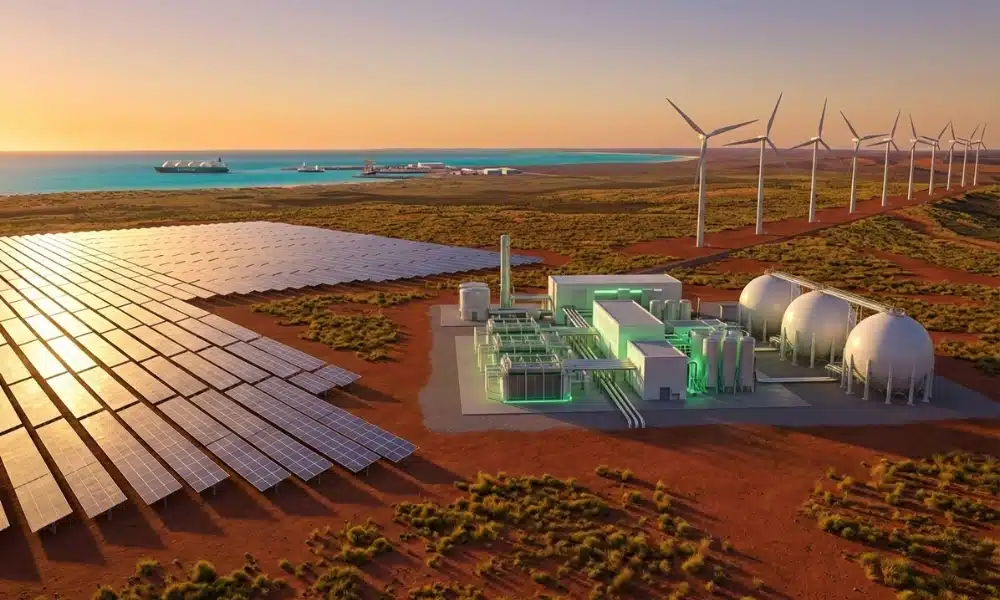
By understanding the mechanics, benefits, and future of green hydrogen in Australia, you can better appreciate the roadmap toward a net-zero future. Energy Matters is here to help you navigate this transition with solar expert insights and renewable solutions.
On this page




Did you know Energy Matters is Australia’s largest renewable news, blog and educational resource? Subscribe to Energy Matters’ weekly newsletter and keep updated even with incentives, rebates and recommended solar product offers.
What exactly is green hydrogen?
At its core, green hydrogen is hydrogen gas produced by electrolysis, powered entirely by renewable energy. Unlike “grey” or “blue” hydrogen, which rely on natural gas and coal, green hydrogen emits only oxygen as a byproduct during production.
This clean energy carrier is vital for decarbonising industries that are traditionally difficult to electrify, such as heavy manufacturing and long-haul shipping. In the context of green hydrogen in Australia, the process typically utilises the nation’s abundant solar and wind power to split water molecules into hydrogen and oxygen.
The chemical reaction for electrolysis is represented as follows:
2H₂O + Electricity ⟶ 2H₂ + O₂
This simple formula is the foundation of a multi-billion-dollar industry aimed at replacing carbon-intensive fuels globally.
The different "colours" of hydrogen
To understand the value of green hydrogen in Australia, it is important to distinguish it from other production methods. The industry uses a “colour” spectrum to categorise hydrogen based on its environmental impact.
Hydrogen Type | Production Method | Source | Environmental Impact |
Green | Electrolysis | Renewable energy (Solar/Wind) | Zero emissions |
Blue | Steam methane reforming | Natural gas + Carbon capture | Low emissions |
Grey | Steam methane reforming | Natural gas | High emissions |
Brown/Black | Coal gasification | Coal | Highest emissions |
Why green hydrogen in Australia is a global game-changer
The unique geography and climate of the continent make green hydrogen in Australia a highly competitive prospect on the international stage. With more solar radiation per square metre than almost any other nation, the cost of the renewable electricity needed for production is significantly lower.
Furthermore, Australia has vast tracts of land suitable for hosting large wind farms and solar arrays. These resources enable “off-grid” production hubs where hydrogen can be generated at the power source.
Proximity to Asian markets like Japan and South Korea also enhances the viability of green hydrogen in Australia. These nations have high energy demands but limited land for renewable generation, making them eager importers of Australian-made green fuel.
How green hydrogen in Australia is produced
The journey of green hydrogen in Australia begins with the installation of large-scale renewable energy infrastructure. Solar panels and wind turbines capture energy, which is then fed into an industrial unit known as an electrolyser.
Inside the electrolyser, an electric current passes through water, breaking the chemical bonds between the hydrogen and oxygen atoms. The resulting hydrogen gas is captured, compressed, and stored for use or export as a liquid or ammonia.
For green hydrogen in Australia to reach its full potential, the efficiency of these electrolysers must continue to improve. Current technologies like Proton Exchange Membrane (PEM) and Alkaline electrolysis are being scaled up across various domestic hubs.
Major green hydrogen projects in Australia
The pipeline for green hydrogen in Australia is currently the largest in the world, with over 100 projects in various stages of development. These projects are strategically located in “hydrogen hubs” where infrastructure and industry overlap.
The Western Green Energy Hub (WGEH)
Located in Western Australia, the WGEH is one of the most ambitious energy projects ever conceived. It aims to use 70 GW of solar and wind power to produce millions of tonnes of green hydrogen in Australia annually.
The Australian Renewable Energy Hub (AREH)
Another massive venture in the Pilbara region, the AREH focuses on exporting hydrogen derivatives, such as green ammonia. This project highlights how green hydrogen in Australia can transform existing mining regions into clean energy powerhouses.
South Australia’s Whyalla Hydrogen Hub
South Australia is leading the charge with its government-backed Whyalla project, featuring a 250 MW electrolyser. This facility is a primary example of how green hydrogen in Australia can provide grid stability and support local green steel manufacturing.

The role of government policy and incentives
Success in the green hydrogen sectorin Australia is heavily supported by federal and state government initiatives. The National Hydrogen Strategy 2024 provides a clear roadmap for becoming a global leader by 2030.
Key to this strategy is the Hydrogen Production Tax Incentive, which provides a $ 2-per-kilogram refundable tax offset. This incentive is designed to bridge the “green premium” and make green hydrogen in Australia price-competitive with fossil fuels.
Additionally, the $4 billion Hydrogen Headstart Program provides revenue support for large-scale projects to reach final investment decisions. These financial mechanisms ensure that green hydrogen in Australia remains an attractive prospect for private investors.
Environmental and economic benefits
The transition to green hydrogen in Australia offers a dual benefit for the environment and the national economy. By replacing coal and gas in industrial processes, the nation can significantly reduce its total carbon footprint. Use Energy Matters’ carbon footprint calculator to calculate your household and business’s direct emissions.
Economically, the industry is expected to create tens of thousands of high-skilled jobs in regional areas. These “regional powerhouses” will become the backbone of a new export industry, potentially rivalling the current LNG market.
Furthermore, green hydrogen in Australia enhances national energy security by reducing dependence on imported liquid fuels. It allows the nation to store renewable energy for long periods, providing a reliable backup for the electricity grid.
Green hydrogen in Australia overview
Category | Details |
Production Method | Renewable-powered electrolysis |
Emissions | Zero |
Key Energy Sources | Solar, wind |
Main Uses | Industry, transport, storage |
Export Potential | High |
Government Support | Strong |
Cost Trend | Declining |
Challenges for green hydrogen in Australia
While the outlook is positive, green hydrogen in Australia faces several hurdles that must be overcome in the coming years. The primary challenge is the high capital cost of electrolysers and the associated infrastructure, like pipelines and ports.
Water scarcity is another concern, as electrolysis requires significant amounts of purified water. Many Australian green hydrogen projects are now investigating desalination as a sustainable way to meet this demand.
Finally, the global competition is heating up, with the United States and Europe offering substantial subsidies for clean energy. To maintain its edge, green hydrogen in Australia must continue to innovate and lower production costs through massive scale.
The future outlook: 2030 and beyond
By 2030, Australia’s goal for green hydrogen is to produce over 1 million tonnes of clean fuel annually. This target is a stepping stone toward the 2050 vision of being a global energy superpower with 15 million tonnes of production.
We expect the first major export shipments to leave Australian shores by the late 2020s. This will mark the beginning of a new era in which green hydrogen from Australia fuels international shipping and heavy industry worldwide.
Technological breakthroughs in hydrogen storage and transport will be crucial during this period. Whether stored as liquid hydrogen or converted into green ammonia, the flexibility of green hydrogen in Australia makes it a versatile tool for global decarbonisation.
Decarbonising hard-to-abate sectors
One of the most exciting applications of green hydrogen in Australia is in the production of “green metals”. Traditional steelmaking relies on coking coal, but hydrogen can be used as a reducing agent to produce iron with zero CO2 emissions.
Similarly, the production of green ammonia for fertilisers is a major opportunity for green hydrogen in Australia. This transition ensures that the agricultural sector can reduce its environmental impact while maintaining productivity.
Heavy road freight is another sector where green hydrogen in Australia will play a vital role. Fuel cell electric vehicles (FCEVs) offer longer ranges and faster refuelling times than battery-electric trucks, making them ideal for the vast Australian landscape.
Frequently asked questions
Is green hydrogen in Australia safe?
Yes, hydrogen has been used safely in industrial applications for decades. The industry follows strict safety protocols for the storage and transport of green hydrogen in Australia, ensuring minimal risk to the public and workers.
How does it compare to batteries?
While batteries are excellent for short-term electricity storage, green hydrogen in Australia is better for long-term storage and high-energy applications. Hydrogen can store energy for months and is easier to transport over long distances.
Will green hydrogen in Australia lower my electricity bills?
Indirectly, yes. By providing flexible load and grid firming services, green hydrogen in Australia helps stabilise the energy market and supports the integration of more low-cost renewable energy.
Sources: ARENA – Hydrogen energy | CSIRO – Hydrogen, Hydrogen Energy Systems | Department of Climate, Energy, the Environment and Water (DCEEW) – National Hydrogen Strategy 2024 | Geoscience Australia – Hydrogen


The role of solar power and Energy Matters
The growth of green hydrogen in Australia is inextricably linked to the continued success of the solar industry. As more households and businesses adopt solar power, the overall cost of renewable energy continues to fall, benefiting the hydrogen sector.
Energy Matters has been a pioneer in the Australian renewable space, helping thousands transition to clean energy. By supporting solar and battery adoption, we help build the renewable capacity that ultimately fuels green hydrogen in Australia.
If you are looking to be part of this green revolution, Energy Matters offers the latest in solar technology and battery energy storage solutions. Our solar expertise ensures you get the most efficient systems to power your home or business while helping to clean up Australia. Check our page for our recommended solar products.
Use Energy Matters’ easy-to-use solar power and battery energy storage calculator to determine the size of your solar system with storage! Our solar calculator will generate performance information and potential savings.
We can send this information to 3 of our pre-vetted and trusted local installers in your area to receive obligation-free solar quotes and take the first step towards true energy independence!

Are you ready to join the energy transition? Take action today!
Energy Matters provides free solar quotes to help you find the best renewable energy solutions for your needs. Switch to solar now and help pave the way for a future powered by green hydrogen in Australia.