

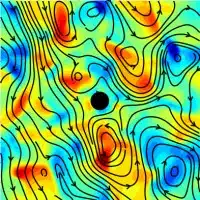
A team of Oxford University scientists have demonstrated how the natural movements of bacteria can drive what they describe as microscopic “wind farms” (sans the wind though).
The discovery has the potential to open up a new field of study into biology-based engines for powering micromachines that are self-assembling and self-powered, such as optical switches and smartphone microphones, the scientists say.
The team used computer simulations to show how dense chaotic swarms of bacteria are able to organise into a group to turn cylindrical rotors and provide a steady stream of power.
Dr Tyler Shendruk, from Oxford University’s Department of Physics, explains:
“Many of society’s energy challenges are on the gigawatt scale, but some are downright microscopic,” he said. “One potential way to generate tiny amounts of power for micromachines might be to harvest it directly from biological systems such as bacteria suspensions.”
These dense bacterial suspensions contain microorganisms swimming in an active yet disorganised flow. The flow of bacteria is so disordered has been considered too chaotic to extract any useful amount of power.
Until now.
When the Oxford researchers sank a microscopic lattice of 64 symmetric rotors into the bacterial fluid, they found the bacteria spontaneously organised itself so that each rotor began to spin in the opposite direction of its neighbour.
“The amazing thing is that we didn’t have to pre-design microscopic gear-shaped turbines. The rotors just self-assembled into a sort of bacterial windfarm,” Dr Shendruk says.
“When we did the simulation with a single rotor in the bacterial turbulence, it just got kicked around randomly. But when we put an array of rotors in the living fluid, they suddenly formed a regular pattern, with neighbouring rotors spinning in opposite directions.”
OK, so there’s no wind as such driving these turbines, not even bacterial flatulence it would seem, but let’s not let that get in the way of good headline.
The beauty of the system according to the Oxford team comes from the ability of bacteria to self-organise and drive a mechanical system using biological processes alone, without any need for input power.
“Nature is brilliant at creating tiny engines, and there is enormous potential if we can understand how to exploit similar designs,” says Professor Julia Yeomans, from Oxford University’s Department of Physics
The group’s study, “Active micromachines: Microfluidics powered by mesoscale turbulence”, was published in the journal Scientific Advances and can also be viewed via the Cornell University Library (PDF).