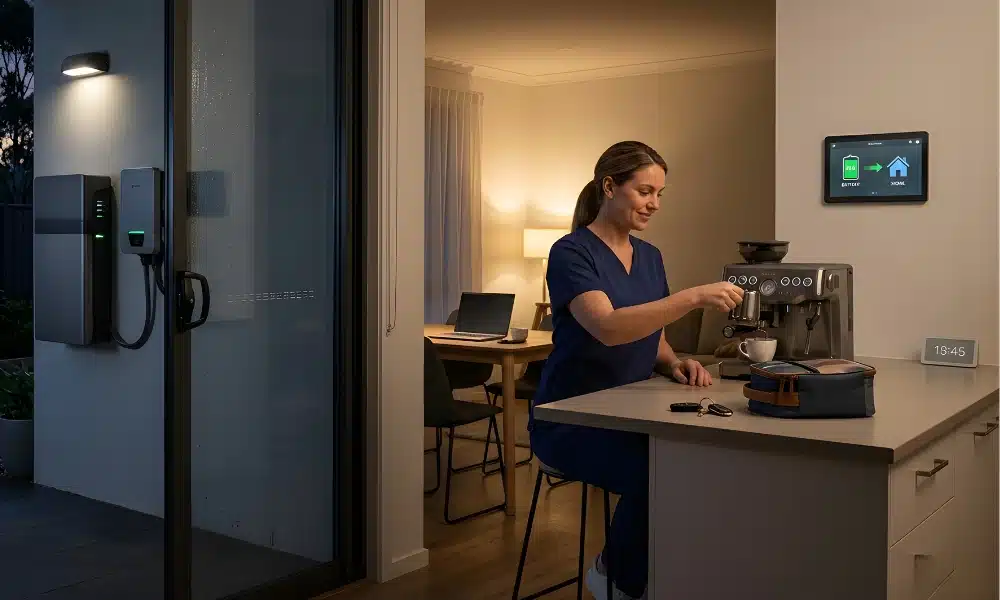




The debate around bidirectional charging vs home battery Australia is growing fast. With electric vehicles and solar energy on the rise, homeowners want smarter energy solutions.
Should you invest in a home battery or use a bidirectional EV charger in Australia? This guide explains both options clearly so you can decide what works best.
What is bidirectional charging?
Standard electric vehicle (EV) chargers are “unidirectional,” meaning power only flows from the grid into your car. A bidirectional EV charger changes this by allowing electricity to flow in two directions. This technology effectively turns your electric car into a high-capacity “battery on wheels.”
There are several ways this technology works in the Australian market today:
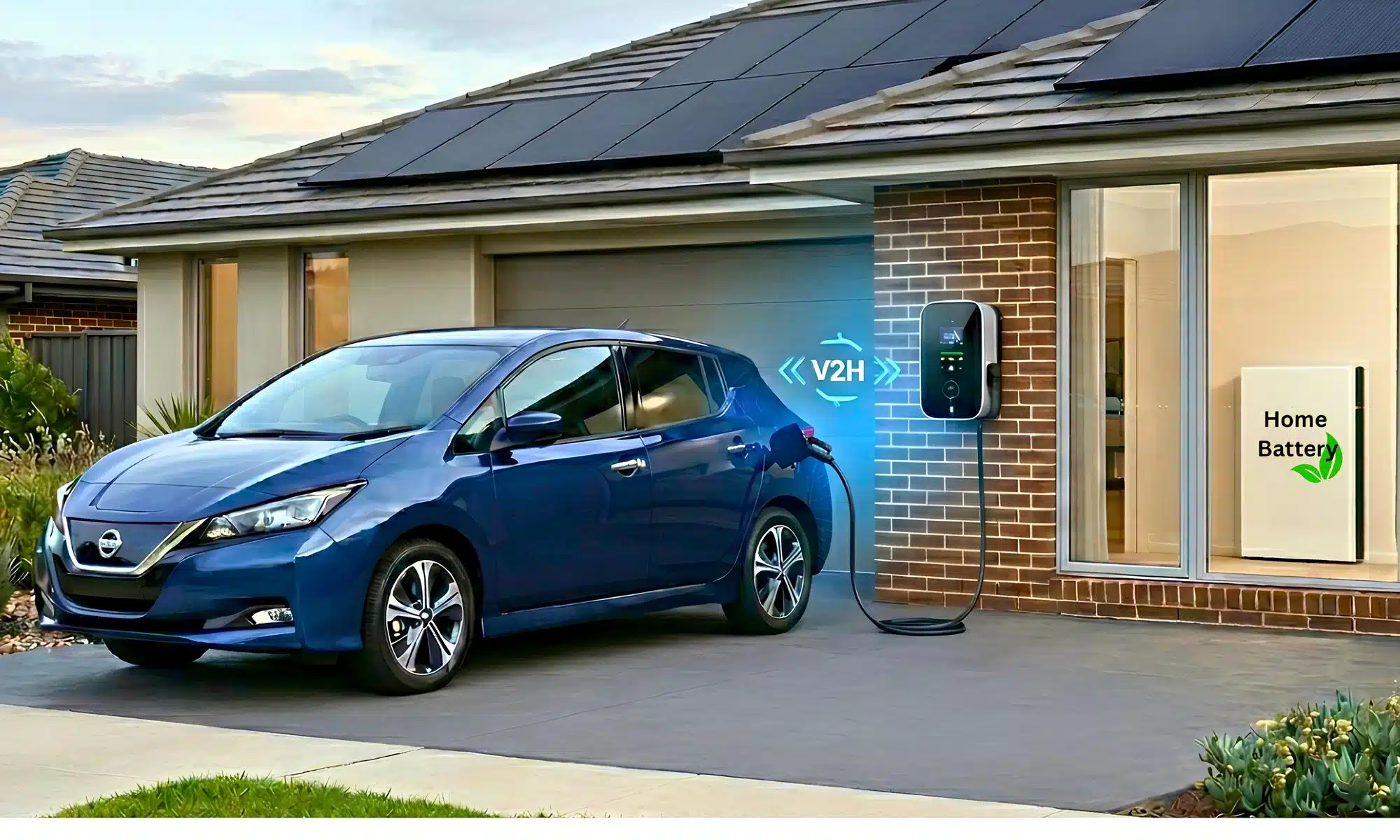
- V2H (Vehicle-to-Home): Your car powers your home directly during peak times or outages.
- V2G Australia (Vehicle-to-Grid): Your car exports power back to the electricity network for credits.
- V2L (Vehicle-to-Load): Your car powers individual devices via a simple plug.
The rise of V2G Australia and V2H
In 2026, V2G Australia has moved beyond trial phases and into real-world applications. By using a bidirectional charger, homeowners can participate in Virtual Power Plants (VPPs). This allows you to sell energy back to the grid when demand is high and prices are at their peak.
Vehicle-to-home (V2H) is often the most practical choice for many families. It allows you to use your EV’s massive storage capacity to power your lights, fridge, and air conditioning. Because the average EV battery is five to ten times larger than a standard home battery, the potential is enormous.
Understanding V2G cars
Not every electric vehicle is ready for two-way power flow. Currently, V2G cars in Australia often include models like the Nissan LEAF and the Mitsubishi Outlander PHEV, which use the CHAdeMO plug. However, newer CCS2-compatible bidirectional systems are rapidly entering the Australian market in 2026.
Before buying, you must ensure your vehicle manufacturer supports bidirectional use under their warranty. Some brands are more advanced in this area than others. Using vehicle-to-home technology is a great way to gain independence from the big energy retailers.
Powering up your EV with solar
If you’re thinking of buying an EV, adding an EV charger to your solar system is a smart way to “fuel” your car with clean, renewable energy.
What is a home battery?
A home battery stores excess solar energy for later use. It is fixed in your home and works automatically. Popular systems in Australia include lithium-ion batteries paired with solar panels. Unlike a bidirectional charger, a home battery is always available.
Key features of home batteries
- Stores solar energy for night use
- Provides backup during blackouts
- Reduces grid reliance
- Works seamlessly with solar
How home batteries work
Home batteries are simpler in comparison. They are already widely used across Australia. This makes home batteries a proven solution in the bidirectional charging vs. home battery debate in Australia. Check our page for our recommended home battery products.
Basic process
- Solar panels generate electricity
- Excess energy charges the battery
- The battery powers your home at night
- Grid power is used only when needed
Use Energy Matters’ easy-to-use solar power and battery storage calculator to determine the size of your solar system with storage! Our solar calculator will generate performance information and potential savings.
We can send this information to 3 of our pre-vetted, trusted local installers in your area to receive obligation-free solar quotes and take the first step toward true energy independence!

Comparing storage capacity: EV vs. Home Battery
When looking at a bidirectional EV charger in Australia, the most striking difference is its storage capacity. A typical home battery usually offers around 13.5 kWh of storage. In contrast, many V2G cars in Australia come with batteries ranging from 60 kWh to 100 kWh.
| Feature | Home battery (e.g., 13.5 kWh) | EV battery (e.g., 75 kWh) |
| Storage capacity | Moderate (Powers home for ~1 day) | Massive (Powers home for 3-5 days) |
| Portability | Fixed to your wall | Moves with your vehicle |
| Primary use | Energy storage only | Transport + Energy storage |
| Availability | Always connected to the home | Only available when parked at home |
| Cost comparison | Dedicated investment | Included in the price of the car |
| Benefits | ● Stable and consistent energy storage ● Works without an EV ● Easy integration with solar | ● Dual-purpose investment (car + battery) ● Supports vehicle-to-home energy use ● Can earn money via V2G Australia programs ● Reduces the need for a separate battery |
| Best for | ● Families with solar panels ● Homes without EVs ● Users wanting simplicity | ● EV owners ● Tech-savvy households ● Early adopters of V2G cars in Australia |
| Drawbacks | ● High upfront cost ● Limited storage capacity ● Fixed location ● Payback period can be long | ● Limited availability of bidirectional EV chargers in Australia ● Not all EVs support V2H or V2G ● Battery wear may increase ● Regulatory approvals required |
Which option saves more money?
Savings depend on your setup.
Bidirectional charging savings
- Uses an EV battery instead of buying a separate battery
- Potential income from V2G
- Lower upfront cost (if EV already owned)
Home battery savings
- Reduces electricity bills
- Stores solar efficiently
- More predictable ROI
Verdict
- EV owners: Bidirectional charging may offer better value
- Non-EV owners: Home battery is the better choice
Final verdict: Bidirectional charging vs Home battery Australia
The answer depends on your situation. For most households today, batteries still win. But the gap is closing fast.
- Bidirectional charging is innovative and cost-effective for EV owners
- Home batteries are reliable and widely available
When to choose bidirectional charging
Choose a bidirectional charger if:
- You already own a compatible EV
- You want flexible energy storage
- You are interested in V2G Australia programs
- You are comfortable with new technology
When to choose a home battery
Choose a home battery if:
- You want a proven solution
- You don’t own an EV
- You prefer low complexity
- You want reliable backup power
Future-proofing your home
The future looks strong for bidirectional charging vs home battery in Australia. As technology improves, vehicle-to-home systems could become mainstream.
What to expect
- More V2G cars are entering the market in Australia
- Government support for V2G Australia
- Improved grid integration
- Lower costs for chargers
The choice between bidirectional charging and a home battery in Australia comes down to lifestyle and budget. Both options can reduce energy bills and boost solar use.
Ready to take control of your energy future? Contact Energy Matters today for expert solar advice and tailored solutions for solar, battery, and bidirectional charging.