



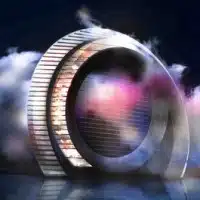
The Dutch WindWheel, touted as a “sustainable icon”, is as controversial as it is stunning.
The Dutch Windwheel Corporation has set its sights on building the unique facility in Rotterdam, The Netherlands, to “be a showcase and accelerator for innovation, renewable energy and the circular and inclusive economy.”
Standing 174 metres high, the outer ring will host 40 carriages that run on rails, enabling passengers an unprecedented view of Rotterdam and the surrounding area. Relevant information will be displayed on “smart glass” walls in the carriages.
The inner ring will have a restaurant and sky lobby, 72 apartments, plus a hotel with 160 rooms on 7 floors.
In relation to sustainability, the site mentions a “climatic facade” and organic waste will be used to create biogas. Rainwater will be harvested for use in the facility and in a wetlands to be created outside the building.
Water will also play another important role – it along with wind will create electricity.
Helping to power the facility will be an EWICON (Electrostatic WInd Energy CONvertor). The technology, developed at Delft University of Technology (TU Delft) a few years ago, involves a series of tubes, electrodes and nozzles that release positively-charged water droplets. The method is based on transporting electrically charged droplets against the direction of an electric field by the wind, building their potential electrical energy, and accumulating them at a collector.
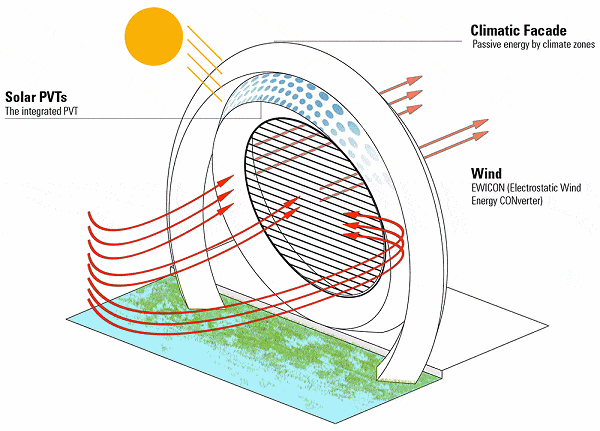
As interesting as the WindWheel concept may be, engineer Tom Lombardo questions the viability of the wind power system.
Based on what he says is an efficiency of 1.7% at best*; an inner diameter of around 87 metres and Rotterdam’s average wind speedof 6m/s, the EWICON would generate roughly 13.5 kW, or about 324 kWh/day. That’s not much power considering the space the generator occupies – and how much electricity the generator and building will consume.
However, using solar panels in the same area angled at 45 degrees and spaced so they don’t impact too much on the view through the center of the building; Mr. Lombardo estimates the system would produce about 1100 kWh/day – more than triple the EWICON’s production.
Mr. Lombardo notes that Delft University, where the EWICON was developed, states while the wind power system has been proven to work on a small scale, there is no evidence to support use on a commercial scale.
Even with the current Windwheel design, solar PV does get a look in elsewhere on the structure, with Building-integrated PV (BiPV) along the top of the inner ring. The capacity of this array isn’t provided.
While costs of building the entire structure aren’t mentioned either, its backers estimate around 1.5 million people will visit the Dutch Windwheel per year if it is built; allowing for the entire development to be profitable within 10 years after construction.
The Dutch Windwheel Corporation is a consortium of Rotterdam based companies BLOC , DoepelStrijkers and Meysters.
* A paper by the inventors of the EWICON technology states 7% efficiency.