



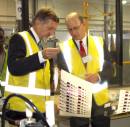
Victorian Minister for Energy and Resources, Peter Batchelor, announced yesterday the beginning of trials to print solar cells using technology developed by the CSIRO, a partner in the Victorian Organic Solar Cell Consortium project.
Mr. Batchelor stated the production of the polymer solar cells will be literally as easy as printing money. The process uses elements of the technology employed in the production of Australia’s polymer banknotes.
According to the CSIRO’s Gerry Wilson, print trials conducted yesterday ran at 200 metres a minute, which would work out to 100 kilometres per day under normal manufacturing conditions. Based on the cells attaining 10% efficiency, over 5 months enough plastic solar cells could be printed to generate a gigawatt of power.
The printable solar cells offer several advantages over traditional solar panel technology including of the potential to mass produce the cells cheaply and install them over large areas with uneven surfaces.
The flexible and lightweight nature of the cells make them ideal for a myriad of uses and the cells can also be made thin enough to become semi-transparent, allowing for applications such as windows. Given their ability to float, more novel uses could include blankets for dams and pools to reduce evaporation while generating power.
However, even if the 10% conversion efficiency rate is achieved within 5 years, that’s still far behind solid polycrystalline and monocrystalline solar panels currently available that achieve up to 19% efficiency; that is, the ability to convert 19% of the sunlight the panel is exposed to into electricity. For smaller applications, such as home solar power, solid panels will likely be the preferred choice for many years to come.
The printing trials are occurring six months ahead of schedule and it’s estimated the printable solar cells will hit the general market the market in about five years.
The three year $12 million Victorian Organic Solar Cell Consortium (VICOSC) solar cell project is 50% funded by the Victorian Government through an Energy Technology Innovation Strategy Sustainable Energy Research and Development grant. The VICOSC is a collaboration between academia and industry with other partners including University of Melbourne, Monash University, Securency, BP Solar, Bluescope Steel, Merck and Nanovic.