






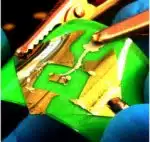
Latest research into the photovoltaic qualities of graphene by scientists from the University of Manchester could lead to a wildly different solar powered future, where rooftop solar panels are augmented or replaced by energy-generating ultra thin coatings.
Working in conjunction with the National University of Singapore, Manchester scientists found that by adding layers to the two-dimensional heterostructure of graphene they vastly improved its photonic potential, opening up exciting new possibilities for next-generation electronic devices.
Capable of being produced in layers just one atom thick, graphene is the thinnest material ever produced. It is also one of the strongest, densest and most conductive of electricity.
Graphene is composed of pure carbon and was first isolated in 2004 at University of Manchester by Andre Geim and Kostya Novoselov, who were awarded the Nobel Prize for Physics in 2010 for their work. Their efforts led to a new field of research into atom-thick materials.
In this latest development, researchers found that sandwiching monolayers of light- absorbing transition metal dichalcogenides (TMDC) between two layers of super-conductive transparent graphene created a highly efficient photovoltaic device.
“Such photoactive heterostructures add yet new possibilities, and pave the road for new types of experiments. As we create more and more complex heterostructures, so the functionalities of the devices will become richer, entering the realm of multifunctional devices,” said Professor Novoselov.
In findings published in Science magazine, the scientists say entire buildings could run on the electric energy generated from walls coated with photovoltaic graphene solar cells. The applications for the breakthrough are potentially endless, with every TMDC stack adding new possibilities for technological improvement to devices like smartphones and computer chips.
University of Manchester researcher and lead author Dr Liam Britnell said, “It was impressive how quickly we passed from the idea of such photosensitive heterostructures to the working device. It worked practically from the very beginning and even the most unoptimised structures showed very respectable characteristics.”
Source/image source