




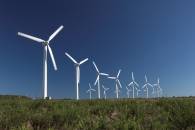
One of the major challenges of wind power is the sometimes fickle nature of the resource. When the wind isn’t blowing, no power is produced. While the location of wind farms is usually carefully chosen, even these installations can be becalmed at times, leaving millions of dollars worth of wind turbines standing idle and requiring increased production of electricity from more environmentally damaging sources, such as coal or natural gas, to make up the shortfall.
Several companies are investigating air compression technology that could overcome this challenge. While the wind is blowing, some of the electricity generated by a wind farm will be used to compress air that will be stored in chambers below ground. In a situation where conditions are calm and power needs to be generated, the compressed air will be released, allowing the wind turbines to continue providing electricity. In effect, the cave becomes a battery of sorts.
While the idea of using compressed air in such a way may sound like pie-in-the-sky dreaming, it’s already in use. At Huntdorf in Germany, a 290MW plant, powerful enough to run 290,000 homes, has been running in such a way for a quarter of a century. However in that case, the compressed air is generated by conventional power stations during off-peak.
One of the companies involved in compressed air wind power projects is Sirius Exploration, which has a 51% shareholding in Dakota Salts. Dakota has around 5,000 acres of exploration leases in the Williston Basin in North Dakota, the USA’s windiest state. Sirius is working closely with Dakota to examine the prospects for using salt caverns for "electricity storage".
The caverns will be about 16m in diameter and 160m tall; capable of storing around 100MW of electricity potential. Sirius and Dakota plan up to eight caverns during the first phase of the project and is expected to be on line in about five years. The company is also looking at establishing similar projects in China and Australia.
According to a Times Online article about wind farms and air compression, a compression plant should achieve an overall efficiency of about 75%, which requires capturing the heat generated when air is compressed. Without the harnessing of this waste heat, the efficiency can fall to 65% or less.
Given the efficiency, even at the high end, utilising conventional power generation based on fossil fuels for air compression is still a rather wasteful affair; however for wind power it may be a perfect solution to ensuring that wind farm turbines achieve their full potential.