




Are you tired of paying massive electricity bills every single quarter? Heating your water accounts for roughly 25% of your average household energy usage. Choosing the right system can instantly slash those costs in half. In this article, we compare Heat pump vs. Electric hot water setups to find the true winner for your wallet. Both systems run on electricity, but they handle power in completely different ways. Let us find out which one will help you save the most money.
How does each system work?
Standard electric hot water systems
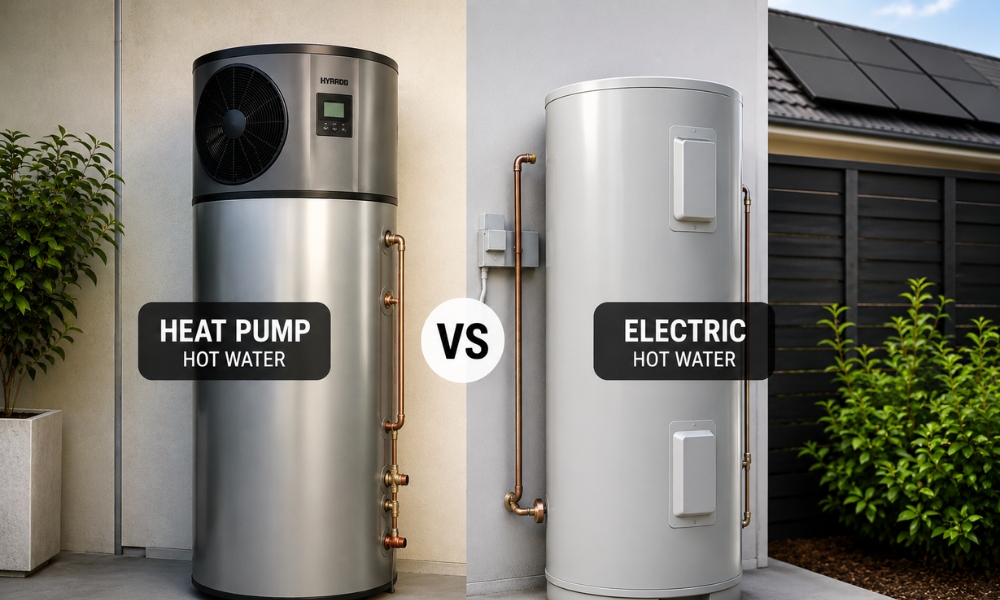
A standard electric hot water system works like a giant electric kettle. A heating element inside a storage tank uses electricity to heat water directly. It is cheap to buy and easy to install, but it is also the most expensive type to run. Every unit of electricity it uses produces just one unit of heat — a 100% conversion rate that sounds good, but is actually very inefficient by modern standards.
These systems are still common in Australian homes because of their low upfront cost. However, rising electricity prices mean their long-term running costs are becoming harder to justify.



Heat pump hot water systems
A heat pump hot water system works more like a reverse-cycle air conditioner. Instead of generating heat from electricity, it draws heat from the surrounding air and transfers it to a water storage tank. The electricity only powers the compressor and fan — not the heating itself.
This clever process means a heat pump uses just one unit of electricity to produce three or four units of heat. That is 300–400% efficiency, compared to 100% for a standard electric system.
Running costs: Where the real difference shows
This is where the numbers really start to matter. A standard electric storage system for a family of four can cost between $780 and $1,015 per year to run at peak electricity tariffs. A heat pump doing the same job typically costs just $150 to $300 per year.
That is a saving of up to $700 or more every year. Over a 10–15-year system lifespan, that adds up to $7,000 to $10,000 in your pocket — money that would otherwise go straight to your energy retailer.
The gap grows even wider if you have rooftop solar panels. Pairing a heat pump with a solar system — and setting it to run during peak sunlight hours — can slash hot water costs by up to 90% compared to a standard electric system powered by grid electricity.
Ready to take control of your energy bills and switch to solar? Contact Energy Matters today, and we’ll connect you with up to 3 FREE solar quotes from trusted local solar installers!
Upfront costs and government rebates
Yes, a heat pump costs more to buy and install than a standard electric system. But government rebates across Australia significantly close that gap.
Federal rebates: Small-Scale Technology Certificates (STCs)
Every heat pump hot water system installed in Australia is eligible for STCs under the federal government’s Small-scale Renewable Energy Scheme. Your installer deducts the STC value directly from your quote — you never have to chase a refund. In 2025–2026, the typical STC discount is around $700 to $1,200, depending on your location and system size.
State rebates
On top of federal STCs, many states offer additional incentives:
- Victoria: Victorian Energy Upgrades (VEU) — up to $1,000 off, which can stack with additional Solar Victoria rebates.
- New South Wales: Energy Savings Scheme (ESS) rebates of $350 to $1,200, depending on whether you are switching from electric or gas.
- South Australia: Retailer Energy Productivity Scheme (REPS) offers further discounts through accredited installers.
- Queensland: The QBEST scheme offers up to $12,500 for eligible small businesses upgrading to energy-efficient equipment.
Heat pump vs. electric hot water: Side-by-side comparison
| Feature | Heat pump | Standard electric | Winner |
| Efficiency | 300–400% | ~100% | Heat Pump |
| Annual running cost* | $150–$300 | $500–$1,000+ | Heat Pump |
| Upfront cost (installed) | $3,000–$6,500 | $1,200–$3,000 | Electric |
| Payback period | 2–5 years | N/A | Heat Pump |
| 10-year savings potential | $4,000–$8,000+ | – | Heat Pump |
| Government rebates | Yes (federal + state) | No | Heat Pump |
| Works with rooftop solar | Excellent pairing | Possible | Heat Pump |
| Carbon emissions | Very low | High | Heat Pump |
| Noise | ~45–55 dB | Silent | Electric |
| Lifespan | 10–15 years | 8–12 years | Heat Pump |
*Annual running costs are estimates based on a 2–4-person household at current 2025–2026 Australian electricity rates. Source: Sustainability Victoria, Solar Choice.
What is the payback period?
The payback period is the time it takes for energy savings to cover your additional upfront investment. For most Australian homes upgrading from a standard electric system, the payback sits at just 3 to 5 years. Some households in high-electricity-cost states like South Australia recover their investment in as little as 2 years.
After that break-even point, every dollar you save on hot water is pure profit. With a system lifespan of 10 to 15 years, you can expect 5 to 12 years of penalty-free savings once the upfront cost is covered.
Does the Australian climate affect heat pump performance?
This is a common concern — and a fair one. Heat pumps extract warmth from the surrounding air, so colder temperatures mean they have to work a bit harder. However, modern heat pumps sold in Australia are designed to operate efficiently in virtually all Australian climate zones, including cooler southern cities like Hobart and Melbourne.
Most units include an electric boost element that kicks in on very cold days (typically below 5°C), ensuring you never run out of hot water. In practice, this booster rarely operates in most Australian locations, so your efficiency gains stay intact throughout winter.
In hotter, sunnier climates — Queensland, Northern Territory, Western Australia — heat pumps perform even better and often achieve the higher end of their efficiency range year-round.
Is a heat pump right for your home?
A heat pump is almost always the better long-term choice if you plan to stay in your home for more than 3–5 years. Here are the key factors to consider:
- Your household size: Larger households use more hot water, so savings are greater and payback is faster.
- Your current system: Switching from a standard electric storage system delivers the highest savings.
- Solar panels: If you already have rooftop solar or plan to add it, a heat pump is a natural partner.
- Your location: All states qualify for federal STCs. Check what state rebates are available to you.
- Installation space: Heat pumps need to be installed outdoors in a well-ventilated area. A split system gives more flexibility.
A standard electric system may still suit very small households, renters who cannot make permanent changes, or properties with very limited outdoor space. But for the majority of Australian homeowners, the heat pump wins on lifetime cost — and by a significant margin.

Tips to maximise your hot water savings
- Set your heat pump to run during off-peak electricity tariff hours, or during the day if you have solar panels.
- Choose the right tank size — around 50 litres per person per day as a rule of thumb.
- Service your system every 3–5 years to keep it running at peak efficiency.
- Check for manufacturer warranties of at least 5 years on the heat pump unit and 10 years on the tank.
- Look for a system rated 7 stars or higher under the Australian energy rating scheme.
Explore more energy-saving solutions
Hot water heating is just one piece of the puzzle. Find out how combining a heat pump with solar battery storage or getting free solar quotes can transform your entire energy bill. Use our solar savings calculator to see what you could save, or explore EV charger options for a fully electrified home.
Use Energy Matters’ easy-to-use solar power and battery storage calculator to determine the size of your solar system with storage! Our solar calculator will generate performance information and potential savings.
We can send this information to 3 of our pre-vetted, trusted local installers in your area so they can provide obligation-free solar quotes and take the first step toward true energy independence!

Powering up your EV with solar
If you’re thinking of buying an electric vehicle (EV), adding an EV charger to your solar system is a smart way to “fuel” your car with clean, renewable energy.
The verdict
When you compare a heat pump vs. electric hot water in terms of lifetime cost, the heat pump wins — clearly and consistently. You pay more upfront, but you earn it back in 2 to 5 years and keep saving for a decade beyond that. Add in government rebates, solar compatibility, and lower carbon emissions, and the choice becomes even clearer.
Ready to make the switch? Our team of Australian renewable energy experts is ready to help you choose the right heat pump system and start saving from day one.
Sources and References:
- Hogan Hot Water – Heat Pump System Costs Australia (2026)
- NSW Government – Hot Water Upgrade Incentive (ESS)
- Sustainability Victoria – Water Heating Running Costs
- Solar Answered – Heat Pump Buyer’s Guide 2026
- Clean Energy Council – Small-scale Technology Certificates