





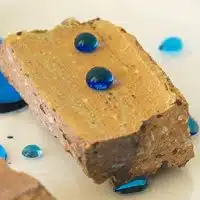
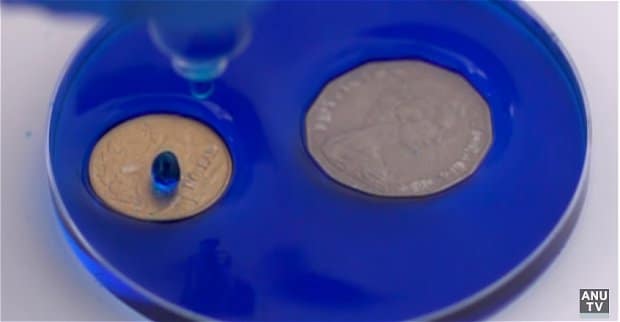
Scientists at the Australian National University have developed a super-hydrophobic coating that has the potential to enhance the self-cleaning attributes of solar panels.
The waterproofing coating is made up of nanoparticle structures likened to two interwoven fishing nets and consists of two types of plastics – one quite rigid and another very flexible. The technology is based on interpenetrated polymer networks (IPNs); where two materials are tangled up together.
The spray-on material is not solar-specific and could be used for a wide range of applications; including waterproofing cell phones and protecting the hulls of ships. It can be applied to any just about any surface – porous and non-porous. The materials and process used to produce it is lower in cost than current manufacturing processes for other water repellent materials.
“The key innovation is that this transparent coating is able to stabilise very fragile nanomaterials resulting in ultra-durable nanotextures with numerous real-world applications,” said lead researcher and head of the ANU’s Nanotechnology Research Laboratory, Associate Professor Antonio Tricoli.
It’s certainly an interesting development – but there is a catch in relation to its use with solar panels. According to a Brisbane Times article on the invention, the coating is 85 per cent transparent; which could mean a drop in solar panel output of 15% – quite a significant level. Perhaps with further development that can be improved; but it doesn’t appear testing has been carried out as yet to determine just how much efficiency would be lost.
There are quite a few super-hydrophobic coatings already around says Ph.D. student William Wong, but most are susceptible to wear damage. The coating he helped develop is much more robust he says, retaining its nanostructure under various stresses.
The team’s work has been published in the journal Applied Materials & Interfaces
Other super-hydrophobic solutions specifically for solar panels have been developed previously; but these combine specially designed glass and a coating. One such system was created at Brigham Young University a couple of years ago, combining surfaces with a microscopic pattern of ridges and a water repellent coating. A more recent development at the USA’s Oak Ridge National Laboratory (ORNL) mimics the atomic structure of a moth’s eye and lotus leaves.
Related: