




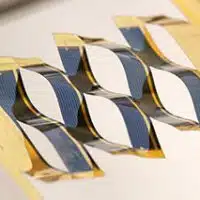
University of Michigan researchers have successfully combined thin-film solar technology with the Japanese paper-cutting art form Kirigami to produce a flat solar cell capable of splitting into segments and tracking the sun throughout the day.
Solar tracking systems are usually reserved for large-scale, grid-connected solar PV farms covering acres of land. Although solar cells capture up to 40 per cent more energy when they can track the sun, installing the same bulky and expensive technology for rooftop solar power just isn’t feasible, so the U-M team had to build the sun-tracking into the panel.
“The beauty of our design is, from the standpoint of the person who’s putting this panel up, nothing would really change,” said Max Shtein, an associate professor of materials science and engineering at U-M. “But inside, it would be doing something remarkable on a tiny scale: the solar cell would split into tiny segments that would follow the position of the sun in unison.”
The work, “Dynamic Kirigami structures for integrated solar tracking”, is published in the journal Nature Coummunications.
To fabricate the cells, researchers used flexible thin-film gallium arsenide strips stuck onto a highly malleable space-grade plastic called Kapton. Shtein then brought in fellow U-M lecturer and Kirigami expert, Matthew Shlian to design and cut patterns into the material with a carbon dioxide laser.
They found a simple pattern of lattice cuts produced the best results. When the solar cell was stretched, the rows first spread, then revolved in a perfectly measurable proportion. The design also provided the most tilt/sun-tracking without losing width as the pattern was stretched.
While the U-M lab does not have the capacity to manufacture a realistic prototype of the Kirigami cell, simulations carried out using data from the Arizona summer solstice showed the optimised design achieved a 36 per cent improvement over a standard flat solar panel.
“We think it has significant potential, and we’re actively pursuing realistic applications,” said Shtein. “It could ultimately reduce the cost of solar electricity.” The University has now applied for a patent and is seeking private investment to bring the technology to market.