



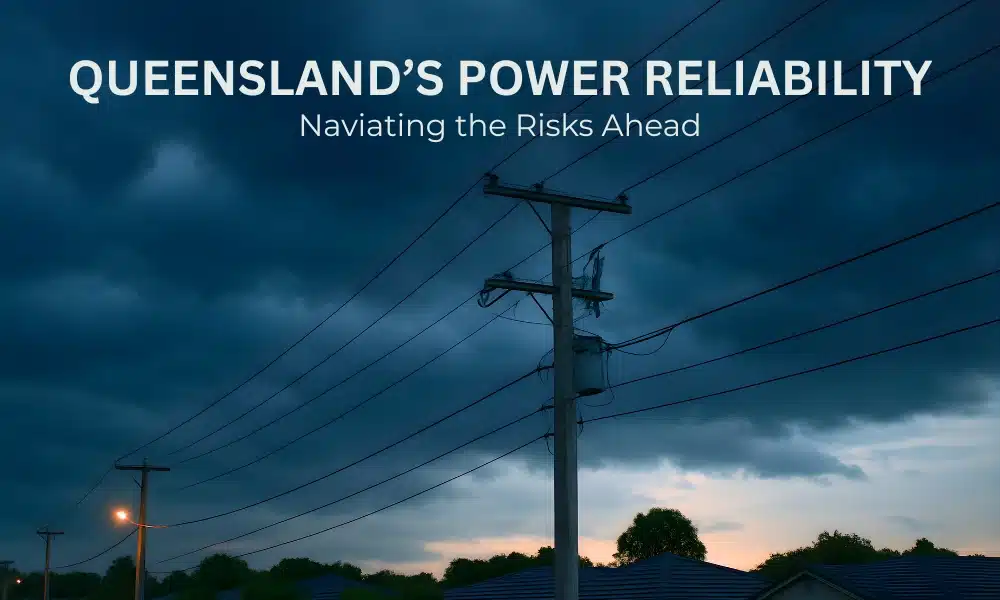
Queensland is at the forefront of Australia’s energy transition, rapidly shifting towards renewable sources to meet ambitious clean energy targets. This transformation, while vital for a sustainable future, introduces unprecedented challenges to power reliability in the state. The complex interplay of retiring coal infrastructure, the intermittent nature of wind and solar power, and the need for a massive grid upgrade creates significant risks that must be proactively managed.

The big-picture risks
Queensland’s electricity system is moving through a major transition. Key risks include:
- Ageing thermal fleet & plant retirements: Ageing coal-fired power stations are facing increasing technical and commercial pressures. As a result, around half of Queensland’s coal capacity is expected to be decommissioned over the next decade, based on historical Australian coal plant closure ages.
- Capacity gap: The phased closure of these plants will create a substantial capacity gap that new wind power and solar projects must fill. If the replacement infrastructure is delayed, the system’s ability to meet peak demand is compromised.
- Asset deterioration: Even before retirement, the remaining coal fleet is becoming less reliable, experiencing more frequent and longer unplanned outages. These unexpected breakdowns, especially during periods of high demand, have been a primary driver of power outage risk in the National Electricity Market (NEM).
- Supply–demand tightness: AEMO has identified a small reliability gap in 2025–26 driven by higher peak demand and delayed commissioning of some projects.
- Extreme weather & natural hazards: Queensland’s geographical location exposes its energy infrastructure to extreme weather events, a risk intensified by climate change. Cyclones, severe storms, and flooding pose a direct threat to transmission and distribution (T&D) networks.
- Infrastructure damage: Events like Cyclone Debbie have previously left hundreds of thousands of customers without power. As climate risks rise, the resilience and adaptation of T&D assets become increasingly critical.
- Peak demand surge: Heatwaves drive up cooling demand, often coinciding with potential generator deratings or outages, placing maximum stress on the system when it is most vulnerable.
- Transmission and project delays: The transition requires a complete overhaul of the transmission network to create a “SuperGrid” connecting remote Renewable Energy Zones (REZs) to load centres. Delays in this crucial infrastructure present a major reliability risk.
- Infrastructure bottlenecks: New transmission lines, such as those planned under the Queensland Energy and Jobs Plan (QEJP), are necessary to transport vast amounts of renewable power. Any permitting or construction delays for these projects, or for major storage projects like pumped hydro (PHES), directly threaten the system’s ability to integrate new renewables and store surplus energy.
- Need for firming capacity: To back up intermittent renewables, the system requires significant dispatchable capacity, including large-scale batteries and PHES. AEMO modelling is based on the timely delivery of these projects; a failure to deliver them creates forecast reliability gaps.
- System security with more renewables: Rapid renewables growth needs fast-response services (inertia, frequency control), otherwise stability risks rise.
Why these risks matter to you
- Households might experience brief outages or increased bills during shortages or when emergency procurement is needed.
- Businesses — especially manufacturing and large industrial sites — face costly interruptions and supply chain disruptions if major plants shut down early.
- Regional communities reliant on a single asset (e.g., Gladstone) are particularly vulnerable if local generation or network links break down.
Quick facts table
| Risk | Likely impact | Timeframe | How it’s being managed |
| Ageing coal units | Unplanned outages; reduced capacity | Now — 2029+ | AEMO monitoring; reliability reserves (RERT). |
| Small reliability gap (80 MW) | Potential shortfall during peak summer | Summer 2025–26 | Short-notice reserves; urgent project delivery. |
| Severe weather (cyclones, floods) | Widespread outages, infrastructure damage | Seasonal (now increasing) | Network resilience upgrades, emergency plans. |
| Transmission/project delays | Slower integration of renewables/storage | 2025–2030 | Policy roadmaps & investment (state & federal). |


Practical steps for Queensland households & businesses
Short-term actions
- Fit surge protectors and keep a basic power-outage kit (lights, chargers, food).
- Register for local outage alerts and check Energex/Ergon status pages.
- Consider a home battery storage system + solar to ride through short outages and reduce peak grid demand.
Use Energy Matters’ easy-to-use solar power and battery storage calculator to determine the size of your solar system with storage! Our solar calculator will generate performance information and potential savings.
We can send this information to 3 of our pre-vetted and trusted local installers in your area to receive obligation-free solar quotes and take the first step towards true energy independence!

Medium-term actions
- Businesses: invest in backup generators or onsite solar+storage for critical loads.
- Join community energy programs or virtual power plants (VPPs) where available.
- Upgrade to energy-efficient appliances and smart thermostats to lower peak load.
Long-term resilience
- Support and monitor regional transmission upgrades and new dispatchable generation (gas peakers, pumped hydro).
- Advocate for clear transition plans when large plants (like Gladstone) consider early closure — this helps protect local jobs & supply.
Sources: AEMO – 2025 Electricity Statement of Opportunities | Queensland Treasury – Queensland Government Energy Roadmap 2025 | Office of the Inspector-General Emergency Management (IGEM) – 2023-2024 Severe Weather Season Review (Report 1: 2024–25)

Securing Queensland’s energy future
Queensland’s power grid faces a critical decade defined by the rapid shift away from thermal generation toward a renewable future. The reliability of the state’s electricity supply hinges on the timely and coordinated delivery of new generation, massive storage, and a modern, resilient transmission network. These are complex engineering and logistical tasks that require decisive government policy and sustained private investment.
Don’t wait for a blackout to act—invest in your energy future today! Protect your home and business from Queensland’s power reliability risks — get free solar + battery quotes from Energy Matters today and discover cost-effective ways to stay powered through outages and save on bills. Act now with Energy Matters.